


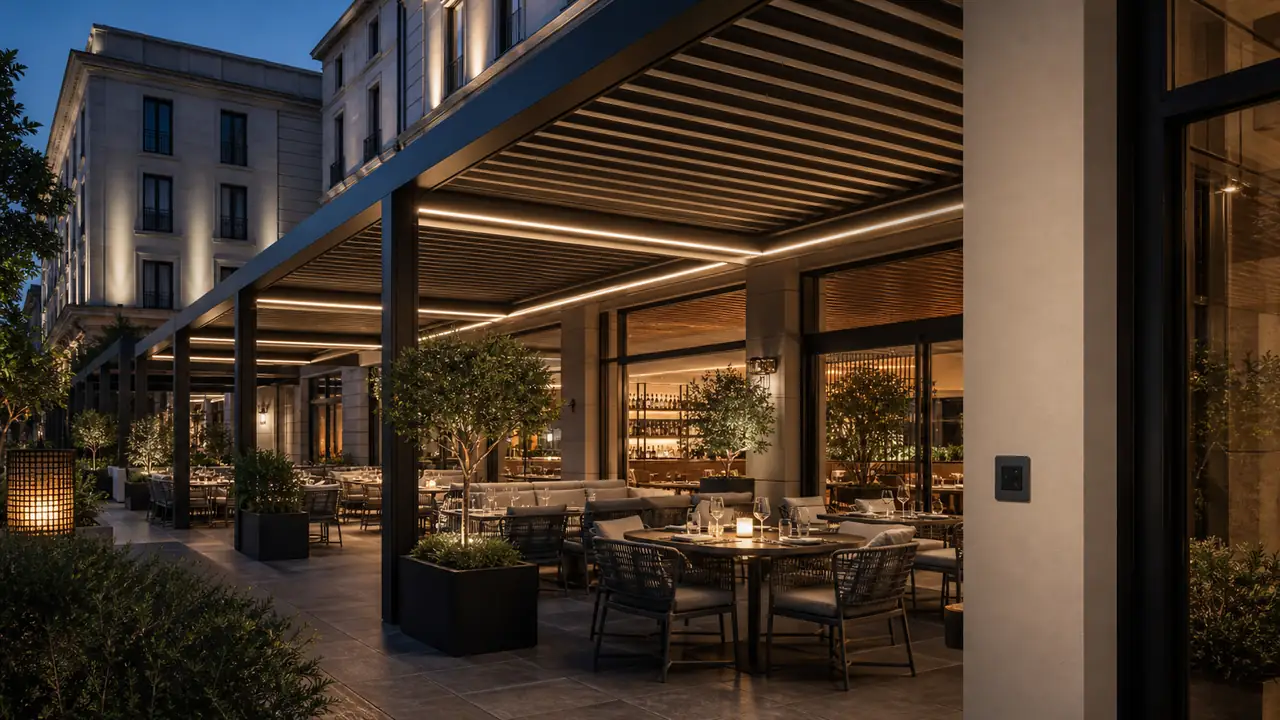
A commercial pergola does not fail only when a motor stops. It fails when a waiter cannot close one dining zone during sudden rain, when guests under one bay are too bright while the next table is too dark, when a hotel operator needs three remotes to manage one terrace, or when an installer has to explain a confusing control layout to a busy restaurant manager on opening day.
For restaurants, hotels, rooftop bars, resorts, and outdoor venues, the pergola is not just an architectural product. It is part of the operating environment. It affects table turnover, guest comfort, event readiness, service flow, and the reputation of the property. That is why commercial pergola control systems should no longer be treated as accessories added after the frame, louvers, and lighting have already been specified.
Our view is direct: for pergola manufacturers selling into hospitality and commercial outdoor projects, control architecture is becoming one of the clearest ways to separate a professional system from a decorative structure.
Commercial Pergola Content Talks About Space, Not Control Architecture
A review of current search results shows a clear pattern. Commercial pergola pages tend to focus on outdoor seating, weather protection, aesthetics, and business value. For example, Azenco Outdoor’s commercial pergola page presents pergolas as a way for restaurants, hotels, and bars to create outdoor seating and improve atmosphere. StruXure’s commercial page emphasizes food and beverage, hospitality, resorts, stadiums, and event spaces, with a strong focus on year-round comfort and revenue-generating outdoor areas.
Other results take a practical buyer-guide approach. Mirador’s article on commercial pergola systems discusses modular aluminum structures, drainage, accessories, and planning considerations for restaurants and hospitality patios. Azenco’s restaurant and hospitality pergola checklist looks at roof strategy, comfort features, and operational planning. Renson’s restaurant case study shows how a premium pergola can elevate outdoor dining through lighting, sun protection, and all-weather usability.
These pages answer a real market need, but they leave space for a manufacturer-side argument. The next level of commercial pergola content should not only ask, “Which pergola is best for a restaurant?” It should ask, “Which control system makes that pergola reliable, staff-friendly, expandable, and serviceable after installation?”
The Commercial Buyer Is Purchasing Uptime
Residential pergola buyers often think in terms of lifestyle: shade for family meals, a comfortable patio, a better garden experience. Commercial buyers think differently. A restaurant terrace is a revenue area. A hotel poolside cabana is part of the guest experience. A rooftop bar needs lighting scenes, wind awareness, and fast staff control. An event venue needs repeatable settings that work before guests arrive, not troubleshooting during service.
For manufacturers, this changes the product definition. A commercial pergola system must be designed around uptime, predictable operation, and clear responsibility. The frame may be strong, the louvers may be well engineered, and the LED channels may look premium, but the project can still feel weak if the control system is fragmented.
Fragmentation usually appears in small ways first. One supplier provides motor control. Another provides lighting drivers. A third adds heaters. A dealer chooses a wind sensor at the jobsite. The app works for one zone but not another. The remote labels are unclear. The control box has limited space for future accessories. None of these issues may look severe on a drawing, yet together they create a poor commercial experience.
In hospitality, small control problems become visible quickly because staff repeat the same actions every day. Open before lunch. Adjust shade during afternoon sun. Dim lights for dinner. Close louvers before a storm. Isolate one bay for maintenance. Reset after power interruption. The system either supports that rhythm or it becomes a source of friction.
Controls Should Be Specified Before the Pergola Leaves Engineering
The best time to design a commercial pergola control system is not after installation. It is during product engineering and project specification. Manufacturers should decide early how motors, LED lighting, sensors, remotes, wall controls, app modules, power supplies, and optional accessories will work together.
This early decision affects more than electronics. It affects extrusion planning, cable channels, service access, junction box placement, drainage separation, assembly instructions, spare parts strategy, and dealer training. A control system is physical infrastructure as much as it is software or radio communication.
When control is specified late, installers often have to solve problems on site. That can lead to visible wiring, oversized boxes, unclear labeling, inconsistent zone grouping, and longer commissioning. When control is specified early, the pergola manufacturer can ship a cleaner system with repeatable logic, documented terminals, matched drivers, and a clear setup process.
For commercial projects, repeatability is not a small advantage. A hotel may order multiple pergolas across pool, lounge, dining, and event areas. A restaurant group may want similar behavior across different locations. A dealer network needs a control package that can be explained and installed without improvisation. Early specification makes the product scalable.
Zoning Is the Heart of Commercial Pergola Control
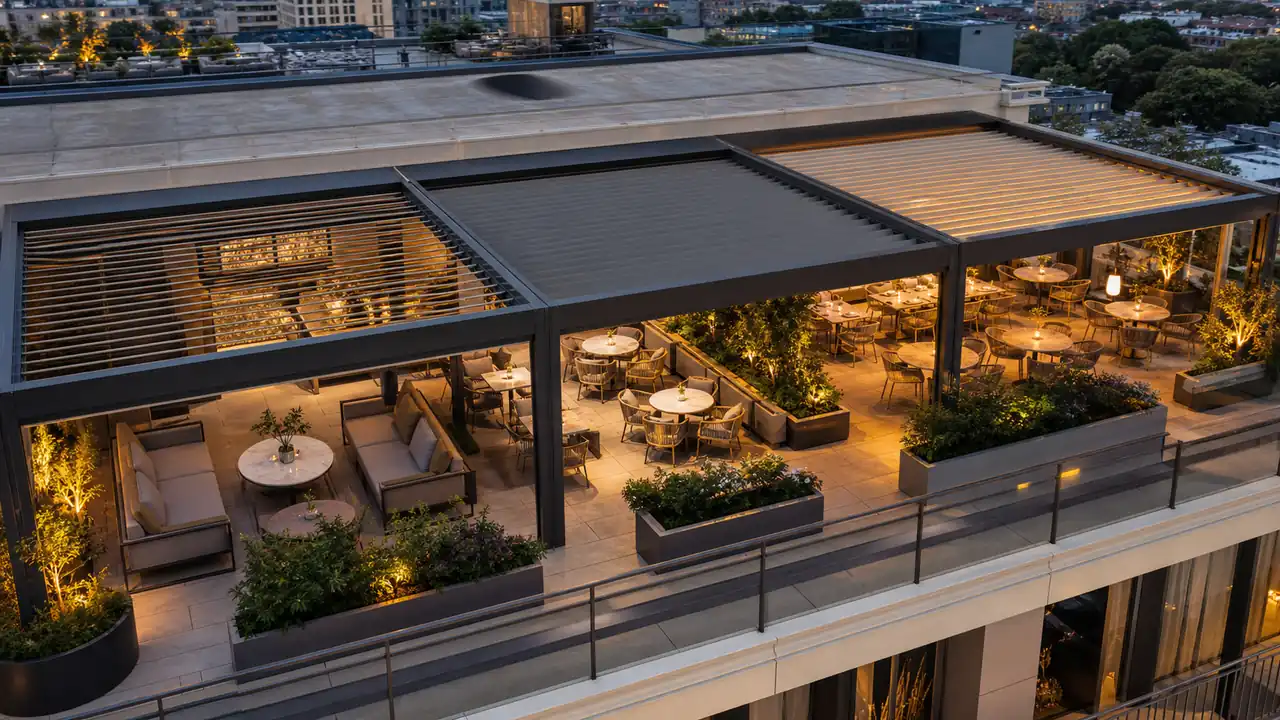
A single-zone pergola may be acceptable for a small residential patio. Commercial spaces need more precise control. Restaurants may separate smoking and non-smoking areas, private dining zones, bar seating, and main dining terraces. Hotels may need different behavior for cabanas, walkways, poolside seating, and event spaces. Outdoor venues may need fast changes between daytime shade and evening presentation.
Good zoning gives staff control without making the system complicated. A practical commercial control system should allow louvers, lights, fans, and other accessories to be grouped by real operating areas, not only by electrical convenience. If one dining bay is exposed to wind and another is sheltered, they may need different behavior. If a VIP area requires warmer lighting, it should not force the entire terrace into the same scene.
Manufacturers should think about zoning at three levels:
- Structural zones, such as individual pergola bays or connected modules.
- Functional zones, such as dining, lounge, service path, bar, or event area.
- Control zones, such as remote groups, wall switch groups, app rooms, and sensor response groups.
The commercial control system should map these levels cleanly. If a dealer has to explain the logic with a long verbal workaround, the design is not ready for hospitality use.
Staff-Friendly Control Matters More Than Feature Count
Commercial buyers may like the idea of app control, voice integration, and automation. Staff members need something simpler: reliable control under time pressure. During dinner service, a restaurant manager should not have to search through several menus to close the louvers above four tables. A hotel attendant should not need administrative access to adjust a cabana zone. A venue operator should be able to recall event lighting scenes quickly.
This is where pergola manufacturers should separate consumer convenience from commercial usability. A strong commercial control system can include app control, but it should not depend only on an app. RF remotes, wall keypads, dry-contact inputs, central control modules, and clearly labeled zones still matter because they support fast action and reduce training time.
Control hierarchy is also important. A guest-facing app may be appropriate for private cabanas. A staff wall control may be better for restaurant zones. A maintenance override may be necessary for service teams. A weather sensor should have priority over normal comfort commands when the structure needs protection. These roles should be designed intentionally, not discovered after complaints.
The most professional commercial systems feel simple on the surface because the complexity has already been solved inside the control architecture.
Weather Response Must Protect the Project, Not Surprise the Operator
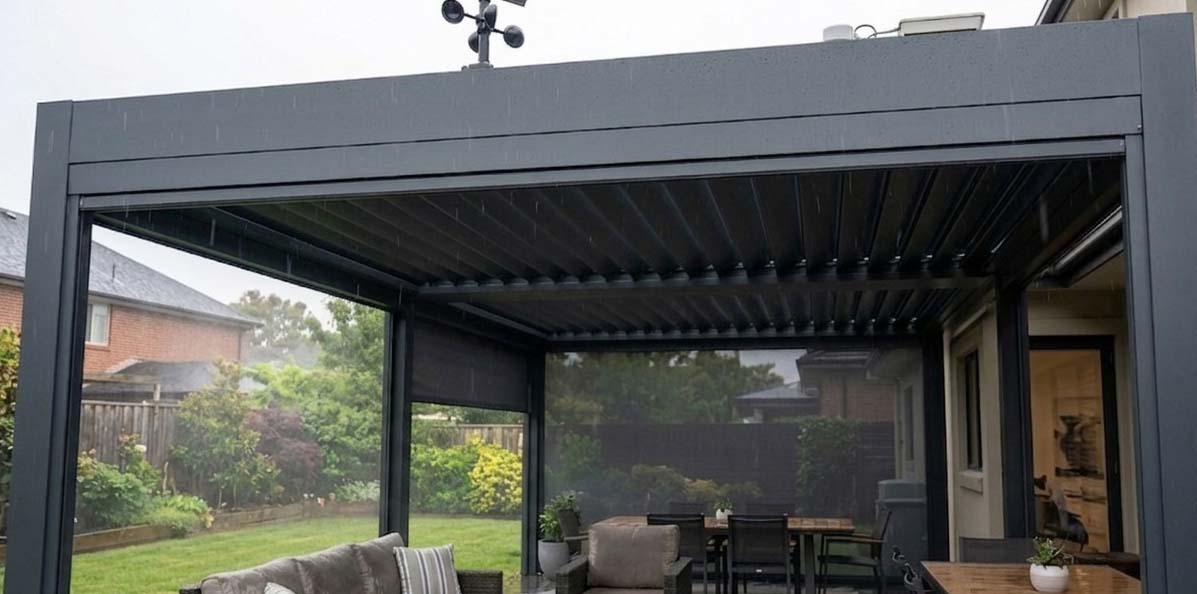
Weather automation is often marketed as a premium feature, but in commercial projects it is closer to risk management. Rain, wind, strong sun, and temperature changes affect guests, furniture, equipment, and the pergola itself. A well-designed control system can respond automatically, but the response must be predictable and properly documented.
Rain sensors should not only trigger movement. They should fit the use case. A restaurant may want louvers to close when rain begins, but the system must also consider drainage direction, lighting safety, and staff override rules. Wind sensors may require different thresholds depending on structure, location, and engineering requirements. Sun response may be useful for comfort, but it should not fight with manual staff decisions every few minutes.
Manufacturers should avoid treating sensors as simple add-ons. Sensor behavior should be part of the product specification: priority level, trigger delay, reset logic, manual override, fault indication, and service guidance. If the system closes because of weather, staff should understand why. If a sensor fails or disconnects, the system should fail in a way that can be diagnosed.
Commercial projects also require local code and professional review. The International Code Council is a useful starting point for understanding building code frameworks in the United States, while project-specific requirements must be confirmed by qualified local professionals. Control suppliers and pergola manufacturers should make documentation easy for architects, contractors, and inspectors to review.
Lighting Control Is Part of the Hospitality Product
For restaurants and hotels, lighting is not a secondary accessory. It shapes the guest experience. A terrace that looks bright and practical at lunch may need warm, low-glare lighting at dinner. A hotel lounge may need quiet ambient light most nights and stronger scene lighting for private events. A venue may need separate control for task areas, perimeter lighting, decorative LED lines, and pathway safety.
This is why commercial pergola lighting control should be designed with scenes, dimming quality, driver capacity, and channel separation in mind. A simple on-off LED output may work for a basic patio. It is rarely enough for a premium hospitality project.
Manufacturers should specify whether the control system supports single-color dimming, tunable white, RGB or RGBW channels, multiple circuits, and scene recall. They should also confirm driver placement, service access, voltage drop considerations, cable routing, and compatibility with the lighting products they intend to ship. The goal is not to add complexity. The goal is to make premium lighting repeatable from one project to the next.
Commercial lighting control also affects after-sales support. If LED strips, drivers, and control channels are documented clearly, a service team can replace parts faster. If every project uses a different driver and wiring method, the manufacturer inherits avoidable support burden.
Electrical Planning Should Look Commercial From the Start
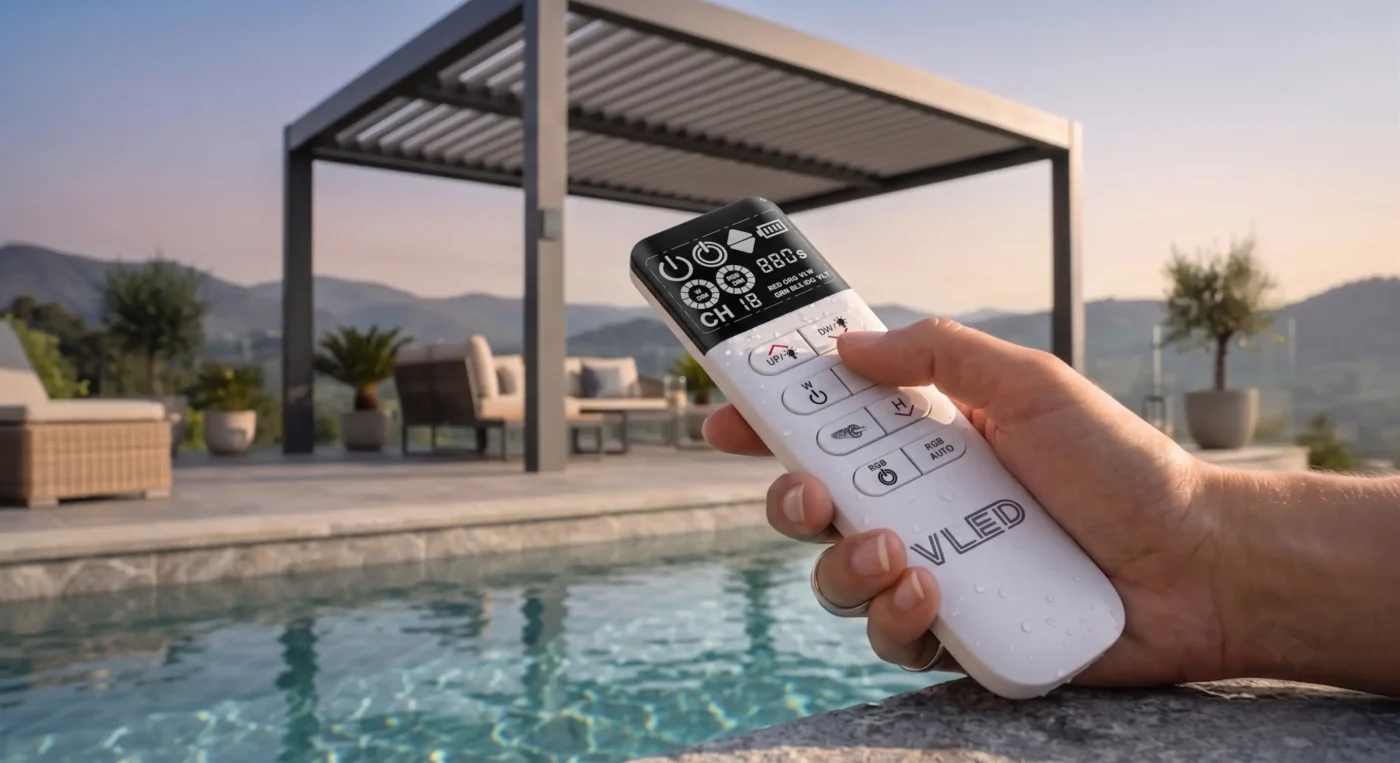
Outdoor commercial control systems live in demanding conditions. They may face moisture, heat, dust, cleaning activity, long cable runs, and frequent operation. Electrical planning should therefore be treated as a product-quality issue, not only an installation detail.
Enclosure selection is one example. Outdoor electrical enclosures should be chosen according to the environment and relevant requirements. The NEMA enclosure type guide is a useful reference for understanding how enclosure categories relate to environmental protection. For control panels and related assemblies, manufacturers can also review UL Solutions’ industrial control panel resources as part of a broader compliance discussion with qualified electrical professionals.
For pergola manufacturers, the practical point is simple: the control box should not feel improvised. Terminals should be labeled. Motor outputs should match the actuator or tubular motor requirements. Lighting outputs should match driver loads. Sensor inputs should be protected and documented. Cable entry should be clean. Service teams should be able to open the enclosure and understand what they are seeing.
This level of planning is especially valuable for OEM and ODM production. When the control system is engineered as a repeatable module, manufacturers can reduce site variation, simplify purchasing, and make dealer training more consistent.
App, RF, WiFi, and Smart Integration Need a Clear Role
Smart control is useful, but commercial pergola manufacturers should be careful with the word “smart.” A system is not smart because it has an app. It is smart when the right person can trigger the right function at the right time with minimal risk.
RF remote control remains valuable because it is fast, familiar, and independent of some network issues. Wall controls are useful because they stay in a predictable location. App control is helpful for configuration, multi-zone operation, scheduling, and property management. WiFi or gateway-based control can support integration into broader building or hospitality systems. Each method has a role.
Manufacturers should decide which control method is primary for daily operation and which is secondary for setup, service, or premium features. They should also think about permissions. A hotel may not want every staff member changing every zone. A restaurant may need manager-level control for weather override or closing routines. A venue may need temporary access for event teams.
For future-facing projects, interoperability is worth watching. The Connectivity Standards Alliance’s Matter standard reflects a broader market push toward more interoperable connected devices. Not every commercial pergola system needs Matter today, but manufacturers should avoid control architectures that make future integration unnecessarily difficult.
Serviceability Is a Sales Feature, Even If Buyers Do Not Ask for It First
Commercial pergola buyers often ask about design, lead time, weather protection, and price before they ask about serviceability. Manufacturers should still make serviceability part of the value proposition. A restaurant or hotel does not want a terrace closed for a minor control issue. Dealers do not want to diagnose unlabeled wiring. Installers do not want to call engineering for every project variation.
A serviceable commercial control system should include clear labels, accessible control boxes, replaceable modules, documented pairing procedures, spare remote options, sensor diagnostics, and a wiring diagram that matches the delivered product. It should also define what happens after power loss, communication interruption, sensor failure, or motor overload.
This is where an integrated control supplier can help manufacturers reduce hidden costs. Warranty cost is not only the price of parts. It includes calls, truck rolls, dealer frustration, project delays, and brand damage. A cleaner control architecture reduces those costs before they appear.
What Pergola Manufacturers Should Specify Before Choosing a Commercial Control Platform
Before selecting or developing a commercial pergola control system, manufacturers should define the project requirements in plain operational language. The following checklist is a practical starting point:
- How many pergola zones must be controlled independently?
- Which functions belong in each zone: louvers, lights, fans, heaters, screens, or other accessories?
- Which control method is primary for daily use: remote, wall keypad, app, central controller, or external system input?
- What should happen automatically during rain, high wind, strong sun, or sensor failure?
- Which commands should staff be able to override, and which safety responses should remain protected?
- What lighting scenes are required for lunch, dinner, cleaning, events, and closing routines?
- Where will control boxes, drivers, gateways, and power supplies be installed and serviced?
- What documentation will dealers, electricians, architects, and property managers receive?
- Which components should be standardized across projects to reduce training and spare-part complexity?
- How will the system support future accessories or smart integration without a full redesign?
This checklist helps move the conversation away from isolated components and toward a complete commercial system. It also helps manufacturers compare suppliers more accurately. The lowest-cost control box may become expensive if it creates installation delays, limited zoning, poor lighting behavior, or unclear support responsibility.
Our Position: The Control System Is Now Part of the Pergola Brand
Commercial pergola manufacturers compete through structure, engineering, finish quality, lead time, and dealer support. Control systems now belong on that list. A well-integrated control platform makes the pergola feel more professional to the end user and easier to sell for the dealer.
The strongest manufacturers will not present controls as a bag of accessories. They will present a commercial operating system for outdoor comfort: structured zoning, reliable weather logic, refined lighting scenes, simple staff control, clean electrical planning, and serviceable documentation.
This approach does not require every project to become complicated. In fact, the best control architecture often makes projects feel simpler. Standardized modules, clear interfaces, and repeatable commissioning reduce uncertainty. Manufacturers can still offer project flexibility, but they do it from a stable control foundation.
For restaurants, hotels, and outdoor venues, the pergola is expected to perform during real service hours. For manufacturers, that means the control system must be engineered with the same seriousness as the frame and roof system.
Conclusion: Build Commercial Pergolas That Operators Can Trust
Commercial outdoor spaces are judged by how they perform when guests are present. Shade, lighting, ventilation, and weather response must work together without creating extra work for staff. That result depends on control architecture.
As a professional pergola lighting and control system manufacturer, we believe OEM and ODM pergola brands should specify controls earlier, integrate lighting and sensor logic more carefully, and treat serviceability as part of product quality. The manufacturers that do this will be better prepared for restaurants, hotels, rooftop bars, resorts, and outdoor venues that expect dependable comfort, not just attractive shade.
If your pergola product line needs integrated louver control, LED lighting control, rain and wind sensor logic, RF remote control, app control, or project-ready OEM/ODM control modules, now is the right time to design the system around commercial use. A stronger control platform can help your dealers install faster, help operators work with confidence, and help your pergola brand stand out in hospitality projects.

Pingback: Rain Sensor Placement for Motorized Louvered Roofs
Pingback: How to Differentiate a Pergola Product Line with Custom Control Features