


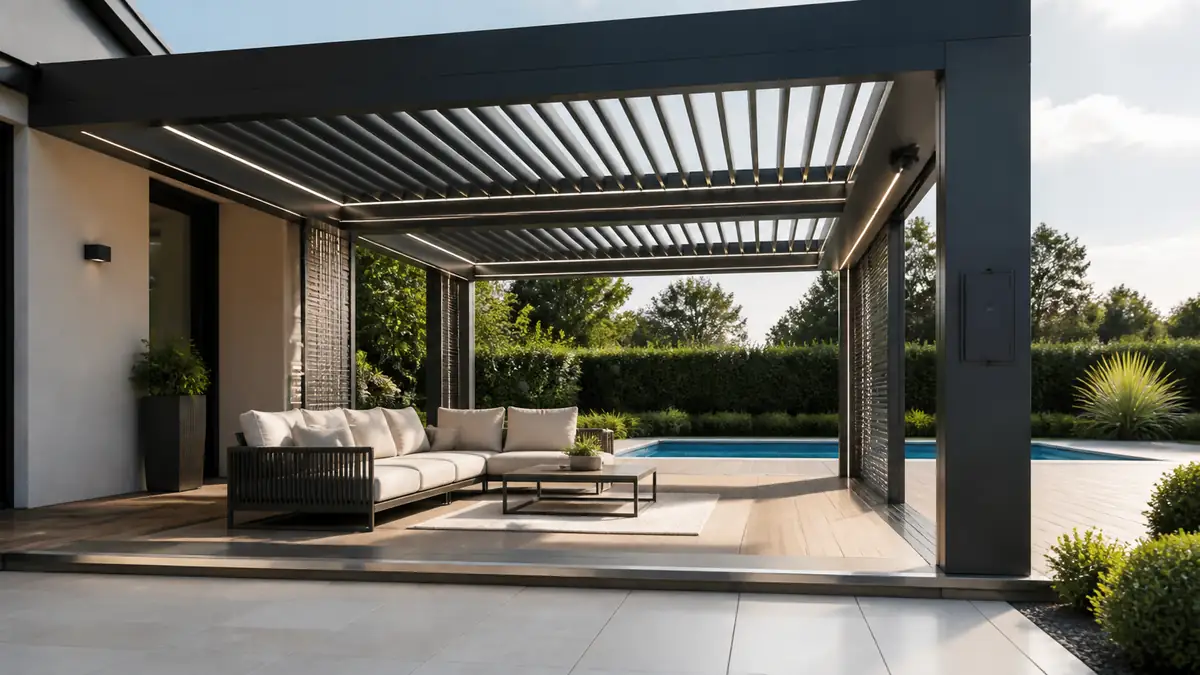
A retractable louvered pergola fails in small ways before it fails in public. A remote loses pairing. A rain sensor closes too late. A motor stops with no useful diagnostic. A homeowner presses an app command and cannot tell whether the roof is moving, blocked, offline, or waiting for a weather override.
These problems are often blamed on the installer, the Wi-Fi network, or the end user. In our view, they usually begin earlier: at the specification stage. Many pergola brands still buy motors, remotes, lighting drivers, receivers, sensors, and app modules as separate parts. The structure looks integrated, but the electrical architecture behaves like a collection of unrelated devices.
That approach is becoming risky. Buyers in the United States, Canada, the United Kingdom, and the European Union now compare outdoor living systems with smart gates, EV chargers, automated shading, and high-end lighting. They expect quiet motion, repeatable positioning, weather protection, app control, remote control, and serviceable diagnostics. Dealers expect fewer call-backs. Manufacturers need a control platform that can scale across residential, hospitality, and commercial models.
Nuestra postura: a modern retractable louvered pergola should be specified as one motor-control-sensor ecosystem. The remote is the user interface, the sensor is the safety input, the controller is the decision layer, and the motor is the mechanical execution point. If any one part is selected in isolation, the whole pergola becomes harder to sell, install, and support.
What are the current market results overlooking?
The leading search results around motorized pergolas, smart pergola technology, rain sensors, and louvered roof controls mainly answer homeowner questions. Pages from brands and dealers such as Renson, StruXure, Azenco, and Somfy explain convenience, weather automation, app control, rain closure, wind response, and lighting options. This makes sense for retail demand, but it leaves a gap for pergola manufacturers.
The common content structure is predictable: first, describe remote or app operation; next, mention rain, wind, or sun sensors; then show lifestyle benefits such as shade, ventilation, and furniture protection. Some pages list wind ratings, drainage, or snow load. A few explain smart-home integrations. Very few explain how an OEM should specify motor voltage, receiver channels, RF behavior inside aluminum structures, sensor priority logic, overload protection, manual override, compliance documentation, and field replacement rules.
That is the opening for a stronger article. The decision-maker at a pergola factory does not need another explanation of what a rain sensor does. They need a practical opinion on what the control system must include before it is shipped under their brand.
The Control System Starts With the Motor
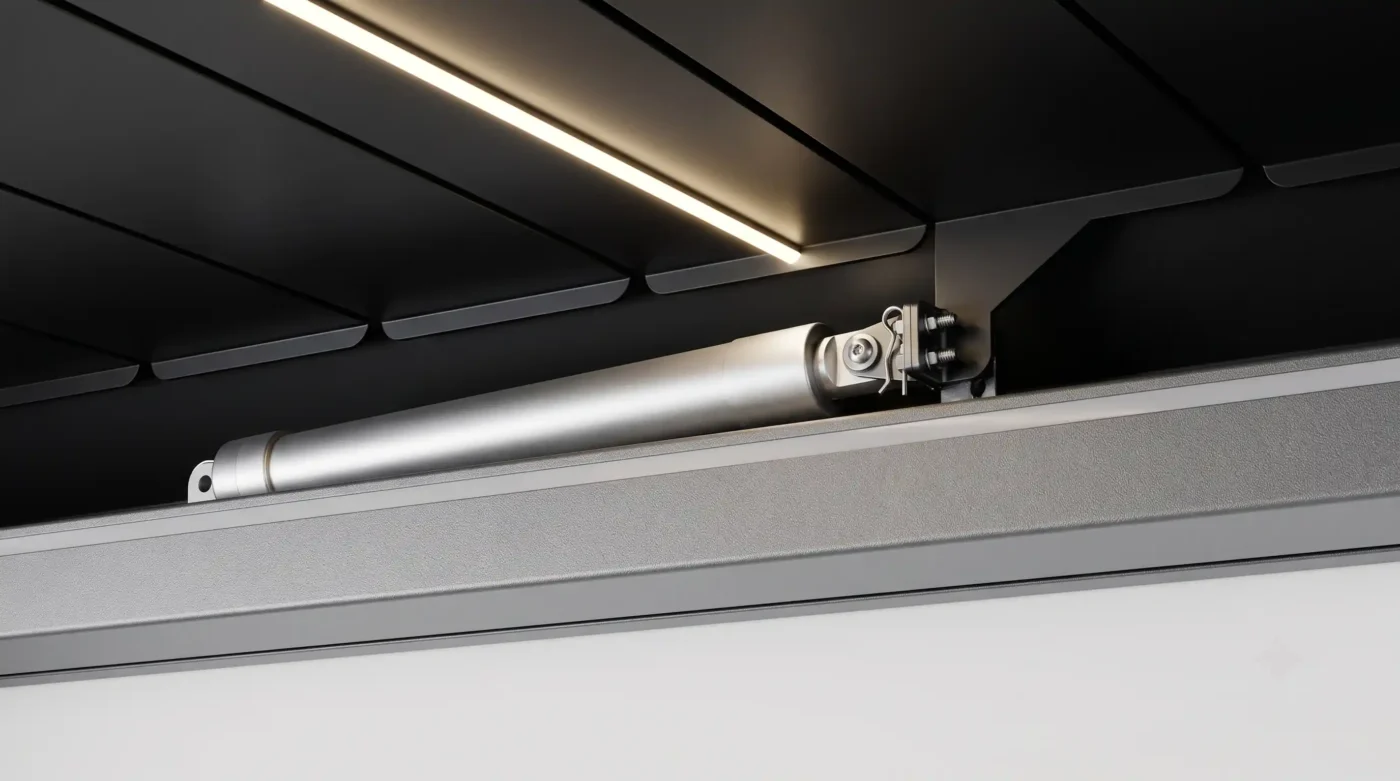
The motor is not just a power component. It defines torque margin, movement speed, noise, limit accuracy, current feedback, thermal protection, manual rescue strategy, and the type of controller the system can support. A premium remote or app cannot compensate for an underspecified actuator.
For retractable louvered roofs, the most common motor options are 24 V DC linear actuators, 24 V DC tubular motors, and AC tubular motors. Each has a place, but for new OEM development we usually recommend a low-voltage architecture where the motor, controller, sensors, and lighting can be coordinated from one outdoor-rated control cabinet. This is especially useful when the brand wants one platform for louvers, LED strips, spotlights, screens, fans, and heaters.
Manufacturers building a wider product family can start with our guide to a complete pergola control system and then adapt the motor interface around the pergola structure, roof size, and accessory strategy.
Motor requirements manufacturers should specify
| Requirement | Recommended OEM direction | Why it matters |
|---|---|---|
| Voltage architecture | Prefer 24 V DC for integrated control platforms; use AC only where the regional installation model clearly supports it. | Low-voltage systems simplify accessory integration and reduce risk around wet outdoor wiring. |
| Torque or thrust margin | Specify based on roof size, louver count, linkage friction, gasket compression, ice risk, and aging tolerance. | A motor that works in a showroom may fail after powder-coated parts, seals, and linkages age outdoors. |
| Limit setting | Use repeatable electronic or mechanical limit methods that installers can verify without opening sealed electronics. | Incorrect end positions cause water leakage, noisy stops, and premature linkage wear. |
| Obstacle and overload response | Require current sensing, stall protection, thermal protection, and predictable retry behavior. | Blocked louvers, debris, frozen joints, and installation errors should not burn the motor or bend linkages. |
| Ingress protection | Match the motor, cable entry, connector, and controller enclosure to the same outdoor exposure philosophy. | An IP-rated motor does not protect the system if the connector, receiver, or cable gland is weak. |
| Manual override | Define a real service procedure for power failure, controller failure, and motor replacement. | Dealers need a recovery path before they climb onto the structure with a frustrated homeowner below. |
The international IP rating framework, commonly tested against IEC 60529 methods such as those described by Intertek’s ingress protection testing overview, is a useful reference for enclosure protection. But it should not be reduced to a marketing number. A controller cabinet marked IP65 beside an unsealed antenna lead or poorly positioned cable entry still creates failure risk. The system has to be weather-resistant as installed, not only as tested on a bench.
Remote Control Is a System Design Decision
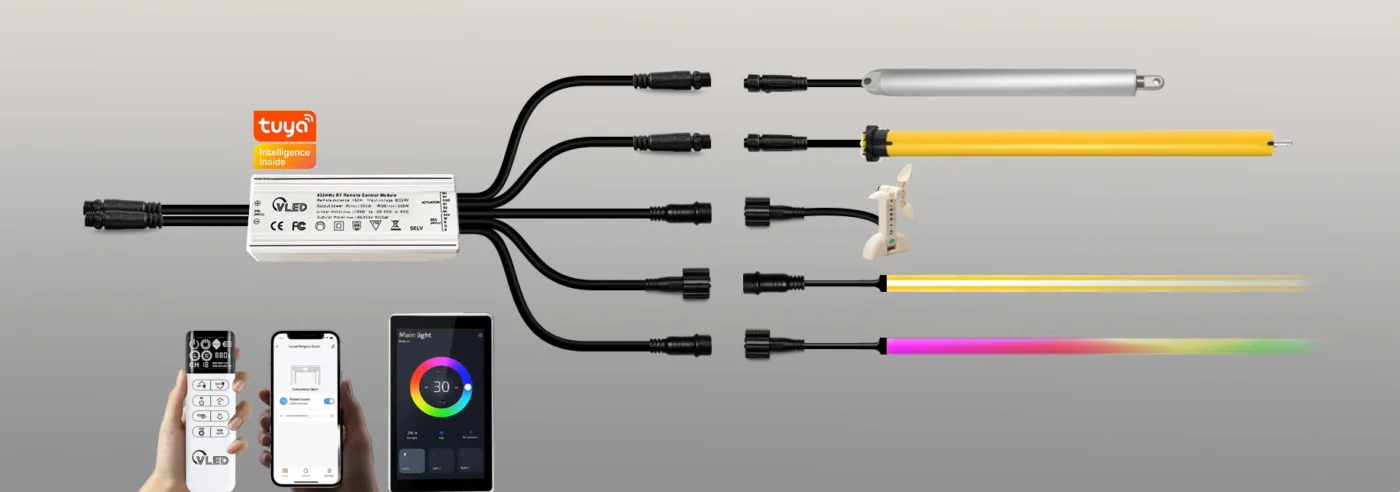
Remote control looks simple from the outside: open, close, stop, maybe lighting, maybe scenes. For a manufacturer, it is more strategic. The remote defines how many channels the installer must pair, how the end user understands zones, how support teams diagnose complaints, and how easily the brand can add lighting and screens later.
A one-channel remote is acceptable for a single small pergola. It becomes weak when the same brand sells dual-bay roofs, side screens, dimmable LED strips, RGBW lighting, heaters, and fans. The remote should not force the manufacturer to redesign its product line every time a new accessory is added.
A better OEM remote architecture should support separated motor channels, grouped commands, lighting dimming, scene recall, and lockout states. It should also allow installers to pair, unpair, replace, and label channels in a repeatable way. If your current support team receives frequent calls about “the remote works for the light but not the roof,” the issue is rarely the button itself. It is usually the channel model.
We have a separate guide on remote-controlled pergola louver channel layout and pairing because this detail often decides whether dealers perceive a control kit as professional or troublesome.
RF, wall switch, app, and voice should not compete
Manufacturers sometimes ask whether they should choose RF remote, wall switch, Wi-Fi app, voice assistant, RS485, dry contact, or Matter. The stronger answer is to define priority and coexistence. A pergola installed at a restaurant may need wall switches for staff, RF remotes for managers, dry contacts for the building system, and sensor override for weather safety. A residential pergola may need RF control for daily use, app control for scenes, and voice control for convenience.
For OEMs, the remote should remain the dependable local control method. Apps and cloud integrations are valuable, but they should not be the only path to operate the roof. This is especially important outdoors, where Wi-Fi coverage is often weaker at the patio edge than inside the house.
Smart-home compatibility is still worth planning. The Connectivity Standards Alliance describes Matter as an IP-based standard aimed at reliable, secure, interoperable smart-home connectivity. For pergola manufacturers, Matter is not only a badge. It is a signal that future product lines should be less dependent on proprietary apps and isolated clouds. That said, the control system still needs robust local inputs when the phone, router, or cloud service is unavailable.
Sensor Logic Must Protect the Structure, Not Just React to Weather
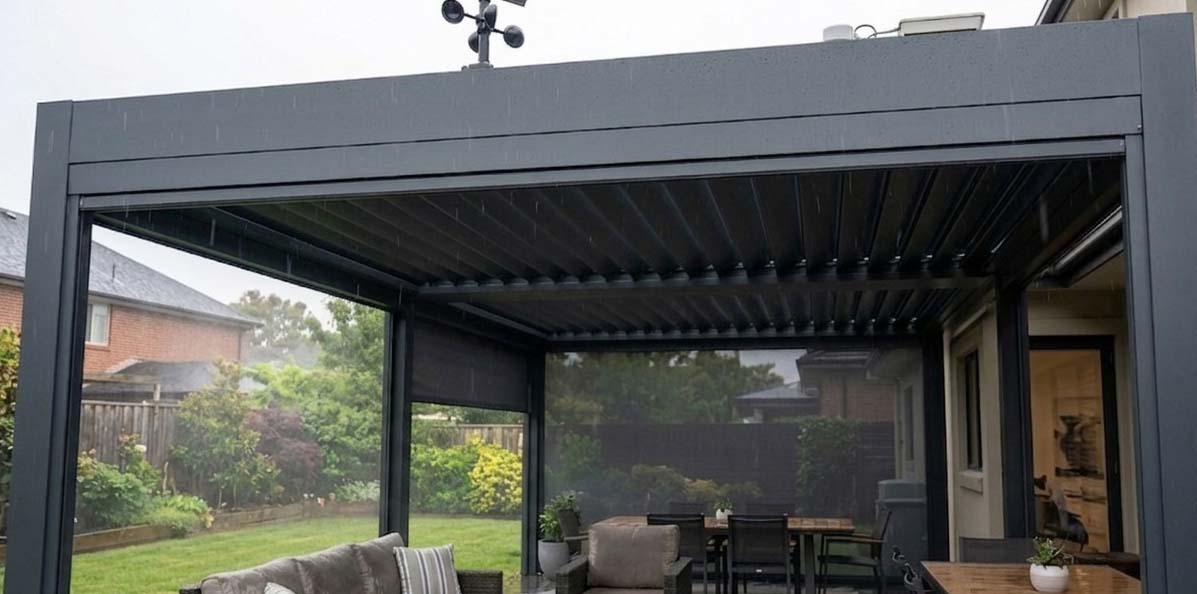
Rain, wind, sun, temperature, and optional snow logic are often listed as features. They should be specified as control priorities. A sensor is not valuable because it detects something. It is valuable because the controller knows what to do, what to ignore, what to delay, and which command has authority.
The most important rule is simple: weather protection must outrank user convenience. If wind, rain, or freeze logic requires a safety movement, the remote and app should not casually override it. The user interface can report the override, but it should not encourage the user to fight the protection sequence.
For a deeper technical view, see our guide to integrating rain, wind, and sun sensors with pergola louvers and lighting. In this article, the key point is the manufacturing requirement: define the sensor hierarchy before choosing the sensor hardware.
Rain sensor requirements
A rain sensor should close the louvers early enough to protect furniture, lighting, and hospitality seating. But speed alone is not the full requirement. The sensor also needs false-trigger resistance, recovery behavior after rain, and a clear relationship with wind and temperature logic.
For premium pergolas, manufacturers should define whether the rain sensor is wired or wireless, whether it has a heated surface, how quickly it resets after precipitation stops, how it handles condensation, and whether the close angle is fully closed or a brand-specific water-management position. The louver profile and gutter design decide that final position. A copied rain-close angle from another roof system may create leakage.
Wind sensor requirements
Wind logic is more complex because different pergola designs require different survival positions. Some systems close the roof during storm conditions. Others open the louvers to reduce uplift. Side screens may need to retract before the roof moves. In a multi-bay pergola, one wind sensor may trigger several controllers, but the system must avoid conflicting movements.
Renson and StruXure both emphasize automatic wind response in their public control pages, which confirms that the market already understands weather automation as a premium expectation. The missing OEM question is how that response is validated for a specific structure. The threshold should be connected to engineering data, not selected only because a sensor default looked reasonable.
Sun and temperature sensor requirements
Sun sensors are usually treated as comfort features, but for manufacturers they also affect lighting logic and indoor-outdoor temperature management. A sun-triggered louver angle can reduce glare at midday, improve airflow, or preserve shade near glazing. If the pergola also includes LED strips or downlights, the controller should prevent awkward scenes where lights remain on in strong daylight unless the user has intentionally selected them.
Temperature inputs are useful for freeze strategy. If moisture is present near freezing conditions, the controller may need a snow-shedding or anti-freeze position. This decision should be tested against the roof mechanics. A large louver roof with tight seals and heavy linkage friction may need different behavior from a light residential system.
Controller Requirements: The Decision Layer
The controller is where a pergola becomes either a coordinated product or a collection of parts. It receives commands from remotes, wall switches, sensors, dry contacts, app modules, voice bridges, and sometimes building management systems. It then decides what the motor, lights, and accessories should do.
For manufacturers, the most important question is not “Can the controller move the louvers?” It is “Can this controller protect the brand when the installation becomes complex?” A commercial terrace may include five roof zones, eight lighting zones, multiple screens, a shared wind sensor, staff wall switches, and an emergency weather behavior. A weak controller can move one motor. A professional control unit can manage the system.
Our unidad de control de la pérgola page shows how the control cabinet becomes the practical integration point for manufacturers who need motor, lighting, and sensor wiring to be repeatable across projects.
Controller features that deserve specification sheet space
- Independent outputs: separate motor, lighting, and accessory outputs reduce wiring confusion and make troubleshooting faster.
- Sensor priority table: rain, wind, temperature, sun, manual command, app scene, and building automation inputs should have documented priority.
- Dry-contact inputs: installers need a universal method to connect wall switches, third-party systems, and safety triggers.
- RS485 or other wired bus option: commercial projects often prefer addressable wired control for long cable runs and multi-zone systems.
- Diagnostics: LED status, fault codes, pairing state, overload history, and sensor state reduce dealer support time.
- Replaceable modules: a failed receiver or power supply should not require replacing the entire pergola control package.
- Surge and reverse-polarity protection: outdoor wiring mistakes and storm events are too common to ignore.
Wireless devices sold into the United States also need appropriate RF planning and authorization. The eCFR text for 47 CFR Part 15 covers radio frequency devices, including intentional and unintentional radiators. For European distribution, manufacturers should also understand CE responsibilities. The European Commission guidance on CE marking explains that CE marking indicates the manufacturer has assessed the product against applicable EU safety, health, and environmental protection requirements for the EEA market.
Compliance should not be treated as a document collected after production. Antenna design, enclosure material, cable routing, power supply selection, labeling space, manuals, and firmware behavior can all affect the final approval path.
Aluminum Pergolas Create RF Problems That Spec Sheets Often Hide
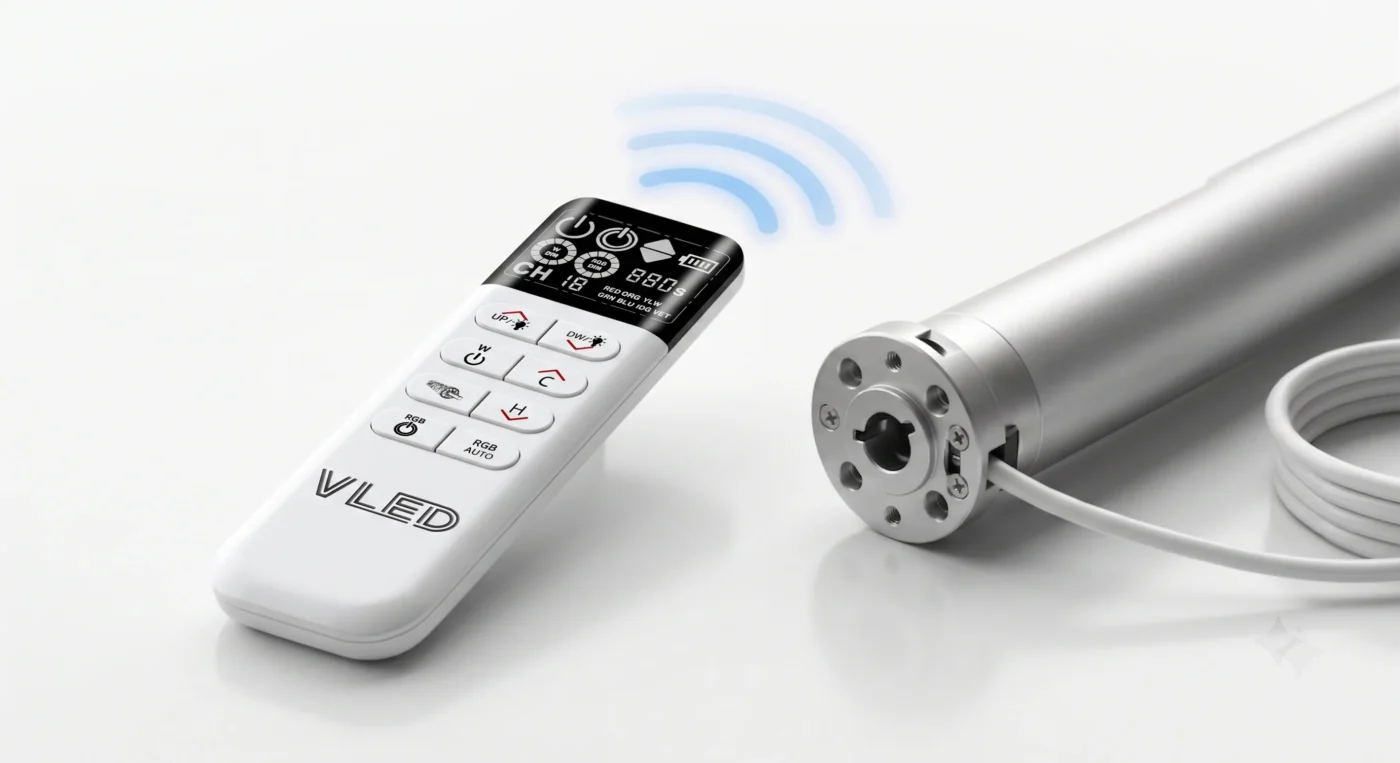
A pergola is not a plastic smart-home gadget sitting on a shelf. It is a large aluminum structure with metal posts, beams, louvers, brackets, motor housings, and often integrated LED profiles. That structure can weaken or reflect RF signals, especially when the receiver is buried in a beam or cabinet with poor antenna placement.
This is why some remotes work during factory testing and become unreliable after installation. The motor housing changes orientation. The controller is moved behind metal. The homeowner operates the remote through glass doors. The Wi-Fi bridge sits at the far side of the house. The installer adds LED drivers and power cables near the receiver. None of these are unusual. They are normal outdoor installation conditions.
Manufacturers should test RF performance in a pergola-like metal environment, not only in open air. Antenna position, cable length, grounding strategy, controller placement, and receiver sensitivity all deserve early validation. We cover this problem in more detail in our article on metal interference and reliable pergola lighting control.
Lighting Integration Changes the Control Requirement
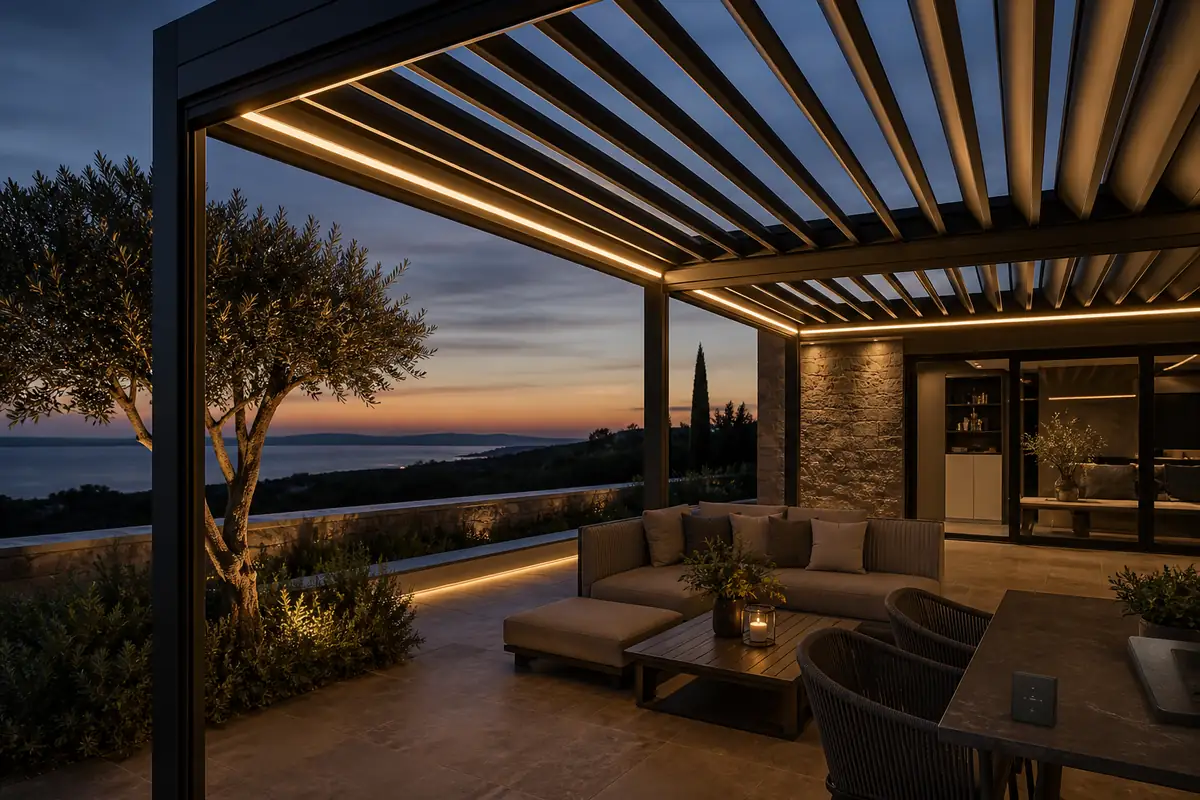
Many louvered pergola brands still discuss the roof motor separately from lighting. End users do not experience it that way. They press one remote, open one app, or create one scene. They expect the louvers, LED strips, spotlights, fan, and screens to behave as one outdoor room.
For manufacturers, lighting integration affects controller sizing, power supply layout, dimming protocol, heat management, cable routing, waterproof connectors, and channel naming. A motor-only control box may look cheaper at first, but the brand will often spend more later on custom dealer work, extra receiver modules, pairing confusion, and inconsistent user experience.
If your pergola line includes integrated strips, spotlights, RGBW accent lighting, or fan control, review our motor and lighting integration solutions for outdoor pergolas. The stronger architecture is usually a unified system with separated outputs and shared command logic, not a pile of accessory receivers added after the roof design is finished.
Compatibility With Somfy, Nice, Teleco, and Other Ecosystems
European and North American pergola manufacturers rarely operate in a clean single-brand world. Dealers may already sell Somfy, Nice, Teleco, Bond, Lutron, Control4, or local smart-home systems. A control platform that ignores this reality creates friction in the sales channel.
Compatibility does not mean copying another brand’s protocol without permission. It means offering practical integration paths: dry contacts, relay outputs, wired bus options, matched voltage logic, clean channel mapping, and accessory modules that dealers can understand. It also means being honest about limits. For example, a bridge that controls a motor may not automatically support every weather sensor from the same ecosystem.
We recommend documenting compatibility in layers:
| Layer | OEM question | Practical requirement |
|---|---|---|
| Electrical | Can the controller accept the same voltage, relay, or dry-contact behavior? | Provide isolated inputs and clear wiring diagrams. |
| Command | Can third-party systems send open, close, stop, lighting, and scene commands? | Define command mapping and default states. |
| Status | Can the user or building system know the current state? | Offer feedback where possible, or clearly label one-way control limits. |
| Weather | What happens when third-party commands conflict with rain or wind protection? | Weather override should remain authoritative. |
| Service | Can a dealer replace a remote, receiver, or sensor without rebuilding the system? | Use documented pairing, reset, and replacement procedures. |
Our compatibility article on making lighting kits work with Somfy, Nice, and Teleco motors is a useful starting point for brands that sell into dealer networks with mixed control ecosystems.
The Specification Should Include Failure Modes
A premium pergola specification should not only describe normal operation. It should describe failure behavior. This is where many low-cost systems reveal their weakness.
What happens if the rain sensor battery dies? What happens if the wind sensor loses communication? Does the controller fail open, fail closed, or hold last state? What happens if the motor reaches the current limit before the expected travel position? Can the dealer see a fault code? Can the homeowner still use a local switch? Can the system recover after a power outage without losing pairing?
These are not edge cases. Outdoor products face storms, condensation, insects, dust, UV exposure, pressure washing, voltage drop, weak Wi-Fi, user error, and installers working under time pressure. Failure logic is part of product design.
A practical fault-response matrix
| Fault condition | Recommended response | Dealer benefit |
|---|---|---|
| Motor overload | Stop, report fault, prevent repeated forced movement, allow controlled retry after inspection. | Reduces broken linkages and motor burnout. |
| Rain sensor active | Move to defined rain position and show weather override state. | Prevents support calls where users think the remote is broken. |
| Wind sensor active | Move to engineered wind-safe position, including screen retraction if applicable. | Protects the structure and accessories together. |
| Sensor lost | Report communication loss and use a conservative default behavior defined by the OEM. | Allows preventive maintenance before damage occurs. |
| Power interruption | Restore previous safe state, retain pairing, and avoid unexpected automatic movement unless weather logic requires it. | Improves user trust after outages. |
| RF pairing lost | Keep local wired control available and provide simple re-pairing steps. | Shortens service calls. |
Our compatibility article on making lighting kits work with Somfy, Nice, and Teleco motors is a useful starting point for brands that sell into dealer networks with mixed control ecosystems.
Cost Is Not Only Component Price
Manufacturers often compare control systems by motor price, receiver price, remote price, and sensor price. That misses the bigger cost structure. The real cost includes dealer training, installation time, replacement parts, warranty claims, product returns, remote pairing confusion, failed smart-home promises, and reputational damage when a roof does not close during rain.
A cheaper motor may require more support. A cheaper RF receiver may lose signal inside aluminum beams. A cheaper rain sensor may trigger during condensation or reset slowly after a storm. A cheaper controller may require extra modules for lighting, creating a wiring cabinet that only the original installer understands.
We discuss the commercial side in our article on how motors, controls, lighting, and sensors affect louvered pergola cost. For OEMs, the key lesson is this: the control system is part of margin protection. A stable system gives dealers confidence to upsell. A confusing system turns every accessory into a support risk.
Recommended OEM Control System Architecture
If we were advising a pergola manufacturer preparing a new retractable louvered roof line for Europe and North America, we would define the control architecture before finalizing the aluminum profile. The wiring channels, service access, antenna placement, motor bracket, drainage path, and lighting grooves should all support the electrical strategy.
A strong baseline architecture would include:
- 24 V DC motor platform with overload protection, repeatable limit setting, and documented manual service procedure.
- Outdoor-rated control unit with separated outputs for louvers, lights, and optional accessories.
- Multi-channel RF remote with clear channel grouping, lockout feedback, and replacement pairing procedure.
- Rain, wind, sun, and temperature inputs with a written priority table.
- Dry-contact inputs for wall switches, third-party systems, and commercial integration.
- Optional RS485 or addressable wired bus for multi-zone commercial projects.
- App and smart-home bridge as an added interface, not the only control path.
- Weather override behavior that cannot be casually defeated by a remote or app scene.
- Lighting control designed into the system from the beginning, including dimming, color options, and power supply capacity.
- Service diagnostics that show pairing state, motor fault, sensor state, and power condition.
For brands that need a broader specification framework, our OEM specification guide for motorized louvered pergola control systems can help align control hardware with the complete product strategy.
Our Opinion: The Remote Is No Longer the Product
For many years, pergola control was sold as a remote-control upgrade. That language now feels too small. The real product is confidence: confidence that the louvers move quietly, the rain sensor closes the roof, the wind logic protects the structure, the lighting scene works, the dealer can replace parts, and the brand can pass compliance review in its target market.
This is why manufacturers should stop asking only which motor or remote is cheapest. The better question is: can this control system become our standard platform for the next five years of pergola models?
If the answer is no, the system will probably create hidden cost. If the answer is yes, the control architecture becomes a brand asset. It improves the end-user experience, supports dealer training, enables accessory bundles, and makes the pergola easier to specify for homes, hotels, restaurants, and outdoor living projects.
PREGUNTAS FRECUENTES
What voltage is best for retractable louvered pergola motors?
For new OEM systems, 24 V DC is often the most practical direction because it supports safer outdoor low-voltage wiring, integrated control cabinets, battery backup options, and coordinated accessories. AC motors may still be used in some regional installation models, but they should be specified with clear compliance and service requirements.
Should a pergola manufacturer choose RF remote, app, or Matter?
The best architecture usually includes more than one interface. RF remote remains the dependable local control method. App and smart-home control improve convenience and premium positioning. Matter can reduce ecosystem friction, but manufacturers should still keep local control and weather override available when the network is unavailable.
Which sensors should a louvered pergola control system include?
A professional system should at least support rain and wind sensors. Sun and temperature inputs add comfort and freeze-protection logic. The important part is not only the sensor list, but the written priority logic that decides what happens when weather input conflicts with user commands.
How should manufacturers handle Somfy, Nice, Teleco, or third-party compatibility?
They should document compatibility by electrical interface, command mapping, status feedback, weather override behavior, and service procedure. Dry contacts, isolated inputs, relay outputs, and optional wired bus control often matter more than broad marketing claims about smart-home compatibility.
What is the biggest control-system mistake in retractable louvered pergola design?
The biggest mistake is treating the motor, remote, lighting, sensors, and app as separate purchasing decisions. That creates pairing problems, unclear fault behavior, weak RF performance, difficult support, and inconsistent user experience. A unified control architecture is more reliable and easier to scale.
Build the Control System Before the Warranty Problem
If you manufacture retractable louvered pergolas for European or North American markets, the control system should be specified as early as the extrusion, drainage, and motor bracket design. PergolaLights can help you design OEM-ready control units, remote layouts, lighting channels, sensor logic, and compatibility paths for your pergola product line.
Explore our smart pergola controller solutions o contact PergolaLights to discuss a control platform for your next pergola model.

Pingback: Actuator and Tubular Motor Control for Pergola Louvers: OEM Integration Guide
Pingback: Pergola Motor Control: Actuator vs Tubular Motor OEM Guide