


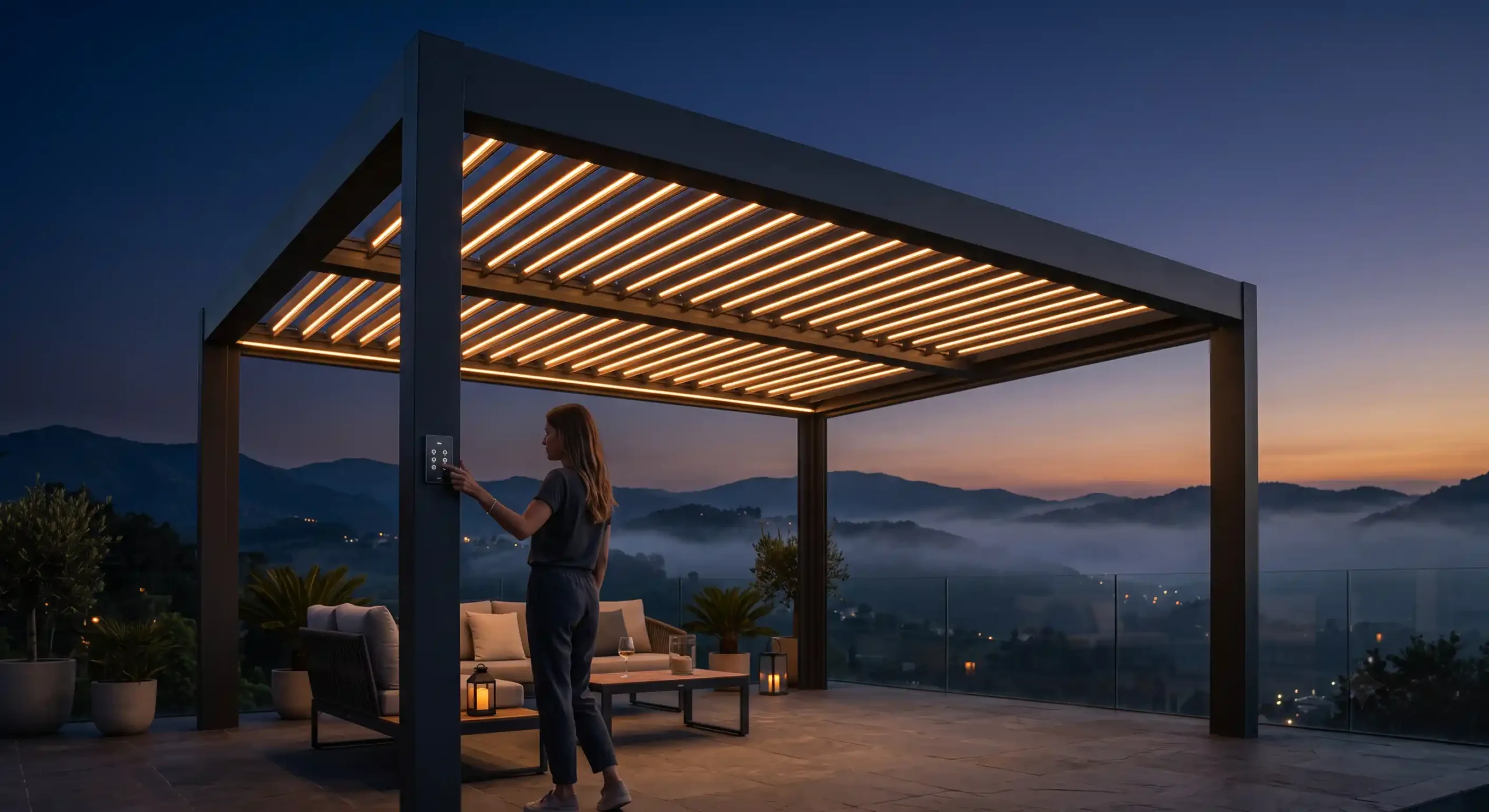
The modern bioclimatic pergola has long surpassed its role as a simple backyard shade structure. It has evolved into a highly engineered extension of the smart home ecosystem. In this evolution, the control interface is no longer merely a switch that starts a motor — it is the core touchpoint that defines the “luxury experience” for the end user. The tactile feedback of physical buttons, the response latency of a mobile app, the accuracy of a voice command: these factors directly determine how a consumer perceives the premium value of a pergola kit worth tens of thousands of dollars.
Market research targeting European and North American pergola OEMs and kit suppliers shows that most SERP discussions around pergola control remain at the consumer-facing feature-listing level — simple smartphone remotes or weather sensor introductions. From a B2B manufacturing and system integration perspective, however, the real question is not how to blindly stack up every available control feature. It is how to build a systematic control matrix with high compatibility, low complaint rates, and compliance with local stringent electrical codes such as the U.S. NEC standard. As a professional pergola lighting and control system manufacturer, this article offers a deep technical analysis of RF Remotes, App control, Voice control, and Wall Switches — providing a strategically valuable innovation blueprint for the electrical architecture of pergola kits.
Competitive Landscape and Innovation Space: The Paradigm Shift from Single-Interface to Systematic Matrix
Before diving into communication protocols and control terminals, it is necessary to deconstruct the current market landscape. Existing solutions from industry leaders such as Somfy Systems, Renson, and Teleco indicate that the market has moved past the “should I motorize my pergola?” stage of enlightenment and has fully entered the era of full-scenario automation. Analysis of top-ranking Google search content reveals that consumer search intent is shifting from “how do I motorize my pergola” toward “how do I integrate my pergola into an existing smart home ecosystem such as Apple HomeKit or Google Home.”
Traditional pergola kit control solutions frequently suffer from a severe “island effect.” The louver motor is operated by one dedicated remote, the LED lighting relies on a separate infrared remote, and the lateral wind-resistant screens may require manual operation or yet a third control terminal. This fragmented interaction model not only increases the user’s learning curve but dramatically raises the manufacturer’s maintenance burden during the after-sales support phase.
A well-designed control architecture should allow users, in any scenario, to interact with their pergola in the most intuitive way possible. This matrix-style design not only boosts a product’s market competitiveness but can dramatically optimize the Bill of Materials (BOM) through standardized underlying communication protocols.
European and North American pergola manufacturers must abandon the mindset of piecemeal component procurement and shift instead to a Layered Control architecture. This is not just a product decision — it is a supply chain decision. Choosing the right sourcing model for your control and lighting components directly determines whether your system can achieve this level of integration. Manufacturers who want to understand how component sourcing strategy intersects with control system design will find our analysis of OEM, white-label, and off-the-shelf sourcing models for pergola lighting an essential companion read to this article.
Deep Analysis of the Four Control Interfaces and Their Application Scenarios
The control interface is the last meter of human-machine interaction. Each interaction mode carries irreplaceable strategic value for specific use cases and user groups. This is not a simple multiple-choice question. The real challenge is how to assign the right weight to each interface within a single kit.
RF Remote: The Absolute Limit of Reliability and Low Latency
The RF remote is the most classic control hub for motorized pergolas. Taking Somfy’s RTS (Radio Technology Somfy) system or Teleco’s TV Zoon wireless transmitter as examples, these devices typically operate on specific RF bands (such as 433 MHz or 868 MHz) and employ rolling-code technology to prevent signal interference and security vulnerabilities.
In terms of offline operation capability, RF signal transmission is completely independent of the home Wi-Fi router. In network outages or outdoor courtyards where broadband coverage is incomplete, the RF remote still guarantees smooth louver operation and stepless LED dimming. Remotes designed specifically for outdoor use (such as Somfy’s Situo series) typically carry high physical protection ratings. When a user’s hands are wet — for instance, after exiting a pool or spa — using a physical remote is far safer and more convenient than unlocking a smartphone, making it an indispensable scenario that mobile apps simply cannot replace.
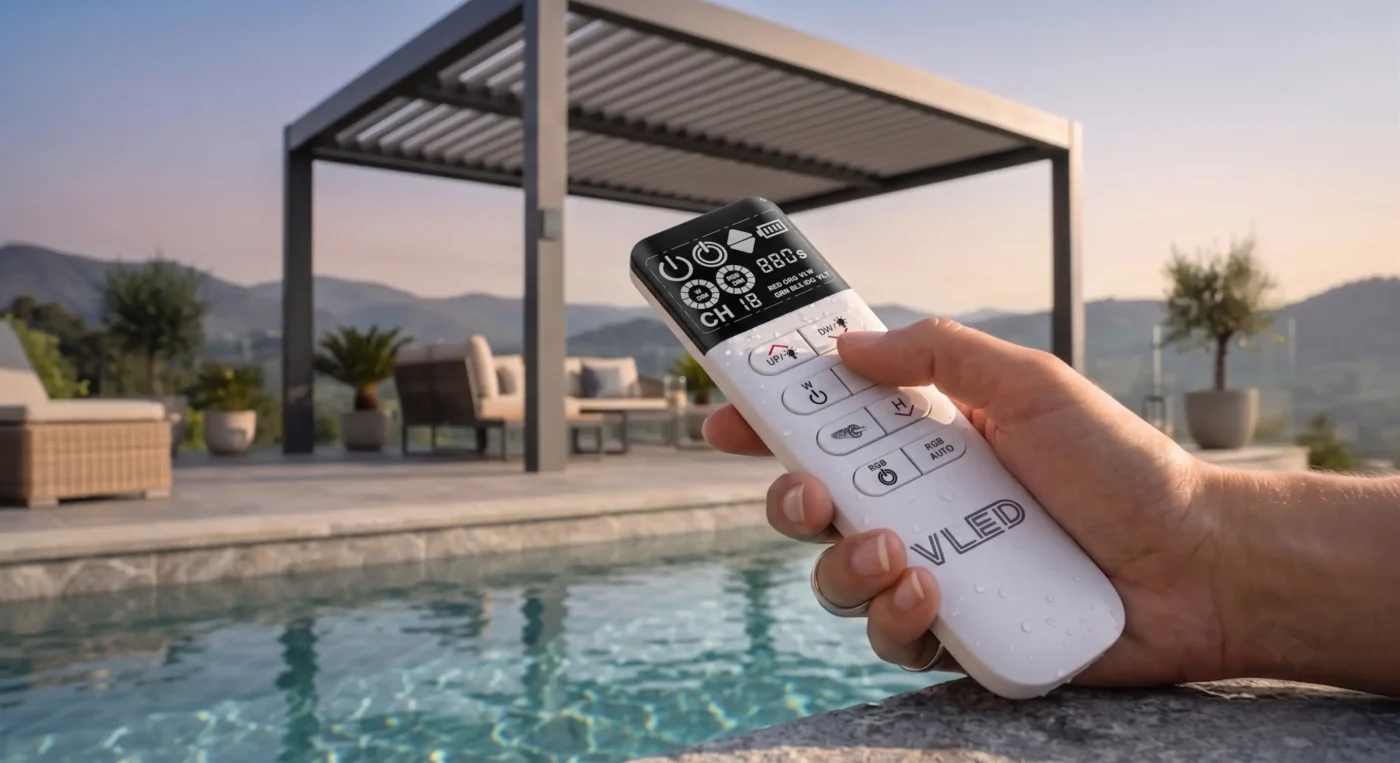
The tactile confirmation of mechanical buttons greatly reinforces the sense of certainty in operation. A high-quality 24V DC dual-motor drive system, upon receiving an RF command, can ensure dozens of heavy aluminum louvers complete a full-range rotation from 0° to 130° within 10 to 15 seconds. The engineering design of the gear drive and linkage system ensures the first and last louver move in perfect synchrony at identical speeds — and the extremely low signal latency of the RF remote is the critical factor guaranteeing this instant response experience.
However, traditional RF protocols such as Somfy RTS use one-way communication. This means the remote can only send commands and cannot receive status feedback from the motor, which creates a technical barrier when integrating with deep smart home ecosystems (such as displaying precise percentage-based open/close position readings).
Mobile App Control: The Nerve Center of Panoramic Command and Scene Automation
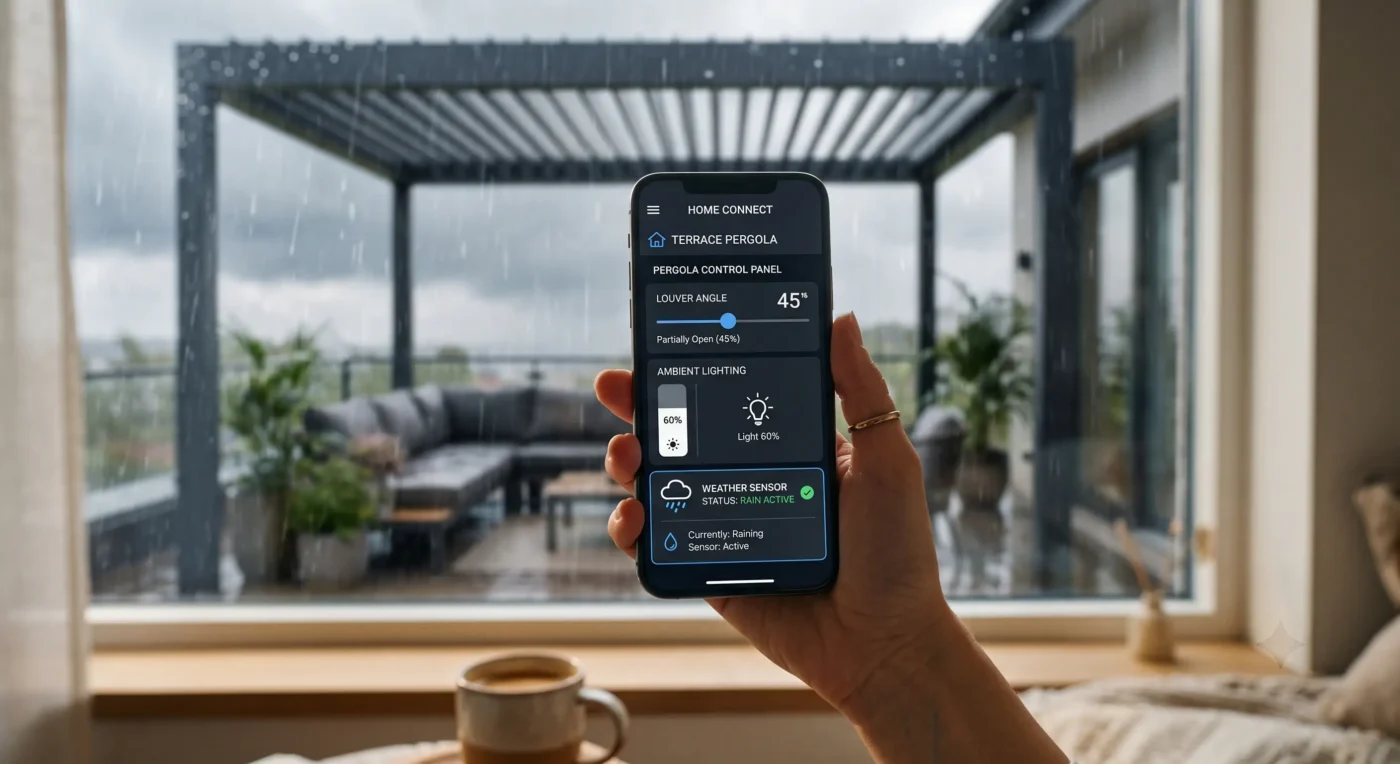
Applications such as TaHoma, Renson Connect, and Smart Pierre transform smartphones or tablets into a pergola’s super control center. Through Wi-Fi or cloud server bridging, apps completely break the spatial limits of control.
The greatest strategic advantage of app control lies in remote access and pre-processing capability. Users can open the pergola louvers and activate ambient lighting in advance via app while still commuting home, completing a scene preset. More importantly, app control provides a platform for multi-source data linkage and weather awareness. By integrating rain/snow sensors, anemometers, and even third-party weather APIs (such as Weather Sense technology), the system can automatically close the louvers before heavy rain arrives, or automatically retract the wind-resistant screens when gusts exceed a set safety threshold (such as 60 MPH), effectively preventing extreme weather from damaging the pergola structure.
For oversized modular pergolas in large apartments or commercial spaces, apps allow different zones (such as the dining area and lounge area) to be controlled independently or in groups. This high-granularity Scene Control management allows the system to operate in a way that aligns far more closely with real human activity patterns. It must be noted, however, that apps are highly dependent on stable network coverage. If the outdoor Wi-Fi signal degrades, app control latency will increase significantly. Additionally, the action chain of unlocking a phone, finding the app, and tapping a button is too long for short-interval spontaneous micro-adjustments.
Voice Control: The Extension of Hands-Free Luxury Experience
With the widespread adoption of Amazon Alexa, Google Assistant, and Apple Siri, voice control has become standard in modern high-end residences. Through Cloud-to-Cloud or Local Network protocols, users can trigger complex mechanical movement and lighting rendering with a single short command.
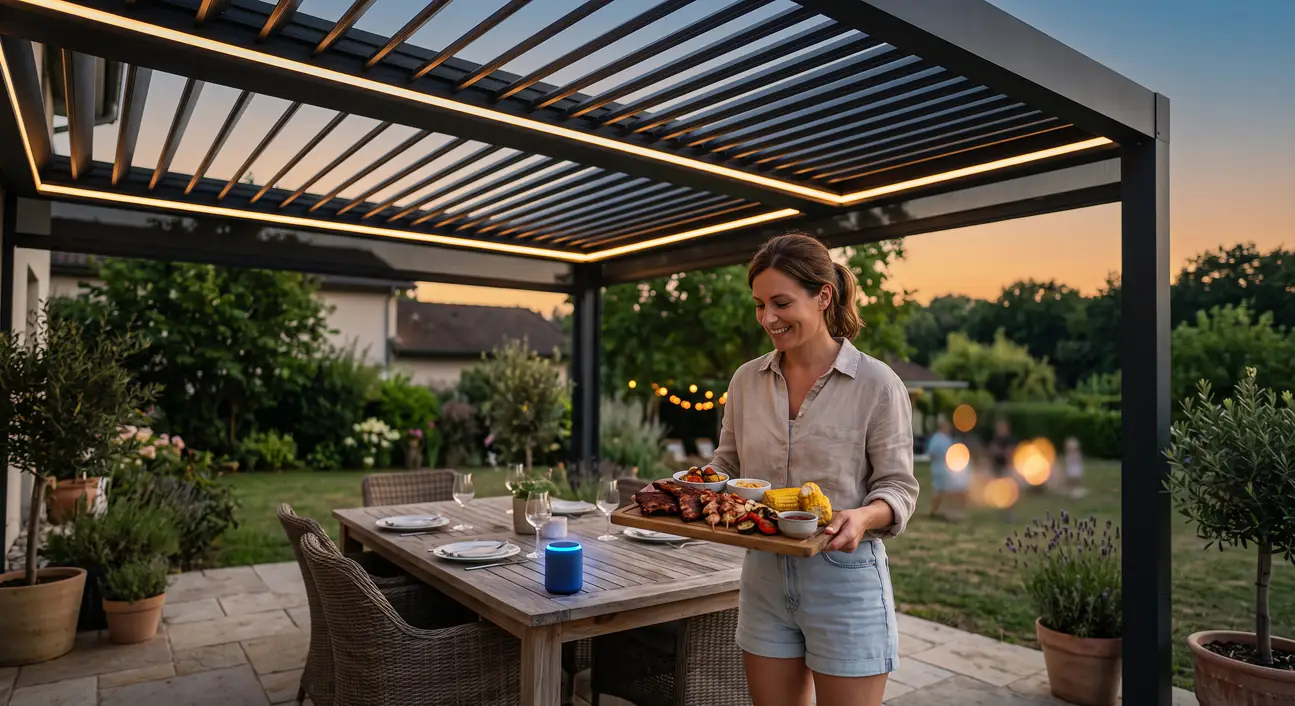
When a user’s hands are occupied holding a barbecue tray or drinks, voice control is the only way to adjust shading and lighting without physical contact. This seamless interaction mode directly amplifies the smart attributes of the pergola, delivering a powerfully futuristic technological experience to the end user. Voice assistants, acting as the master orchestrator of the smart home, can deeply bind pergola actions to the Routines of other devices. For example, triggering “Movie Mode” closes the louvers, dims the LED strips to low light, and starts the outdoor speakers.
However, the complexity of the acoustic environment is the core challenge for voice recognition systems. Outdoor wind noise, water feature sounds, and the din of gatherings will all significantly reduce the accuracy of microphone array pickup. Since most voice commands must be processed through cloud servers via natural language processing (NLP) before being relayed to local devices, this process inevitably produces one to two seconds of latency. Voice control must therefore be positioned as a supplementary interface rather than the sole control pathway.
Wall Switch: The Absolute Cornerstone of Infrastructure and Guest-Friendliness
Whether it is a hardwired smart glass panel or a battery-powered RF wireless wall-mount switch, the control terminal fixed to the wall remains the most fundamental anchor point in any electrical system.
Wall switches offer the interaction mode most aligned with human historical habit, with an enormous advantage of zero learning curve. When a guest or an elderly family member unfamiliar with smart home systems needs to turn on the pergola lighting, no app download is required, no specific voice command syntax needs to be memorized — press, and it works. As numerous industry cases point out, handheld remotes are extremely easy to lose in sofa cushions or garden shrubs, while a fixed wall switch is always exactly where it should be.
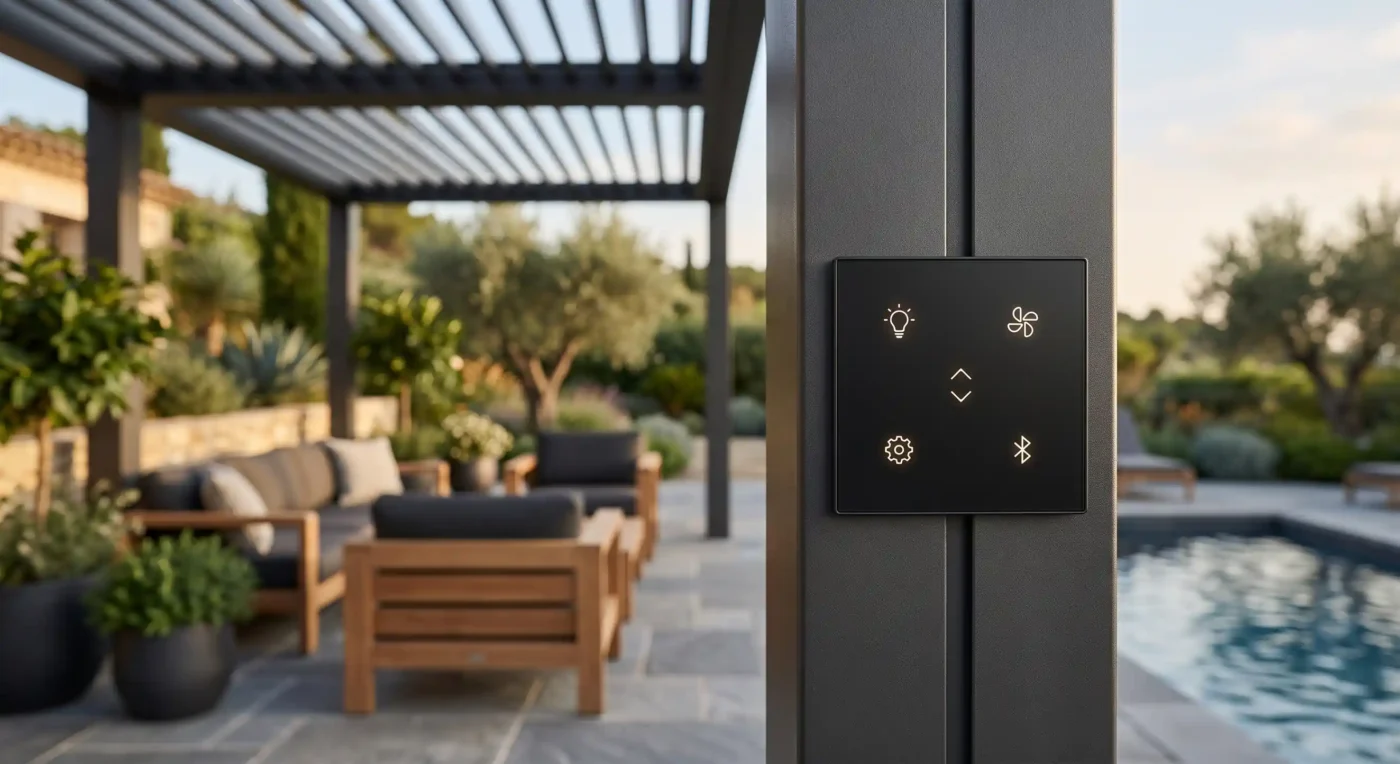
Modern wireless RF wall switches represent a major engineering innovation in installation. These switches require no channel-cutting or re-wiring inside existing walls — simple pairing connects them to the receiver at the top of the pergola, providing tremendous convenience for renovation of existing homes. For new construction projects, hardwired panels deliver inexhaustible power support and more stable backlit displays.
| Interface | Response Latency | Install / Integration Cost | Network Dependency | Core Use Case | Key Technical Limitation |
|---|---|---|---|---|---|
| Télécommande RF | Extremely low (ms-level) | Faible | Zero (fully local) | Poolside, offline environments, spontaneous micro-adjustments | Easily lost; no system-state feedback |
| Mobile App | Medium (network-dependent) | Medium / High (gateway dev required) | Very high | Remote control, scene programming, zone management | Long interaction chain; requires screen unlock |
| Voice Control | Higher (cloud processing) | High (ecosystem certification costs) | Very high | Hands-free use, cross-ecosystem device linkage | Outdoor acoustic noise degrades recognition accuracy |
| Wall Switch | Extremely low | Low (wireless) to High (wired) | Zero (by connection type) | Guest use, fixed-routine node control | Fixed location; lacks advanced programming capability |
The War of Underlying Communication Protocols: RTS, io-homecontrol, Zigbee, and Matter
Control interfaces are just the surface. What truly determines the scalability and stability of a pergola’s smart architecture are the underlying communication protocols beneath them. When European and North American manufacturers select motors and mainboards, they must make a strategic choice among the dominant protocols — a choice that affects not only BOM cost but also the product’s market lifespan over the next five to ten years.
Somfy’s product line — the global leader in tubular motor manufacturing — clearly illustrates the path of protocol evolution. RTS (Radio Technology Somfy), as the representative one-way communication technology, dominated the outdoor shading market for decades. Its advantages include extremely simple installation, strong interference resistance, and low cost. However, because the controller cannot retrieve the real-time louver angle, it falls short when integrating with high-end ecosystems like Apple HomeKit that require “state tracking” — often requiring complex open-source code conversions using Home Assistant and RF Bridge, which is highly unstable in commercial mass production.
To address this pain point, io-homecontrol was developed. This two-way communication protocol (868.95 MHz), jointly developed by Somfy, Velux, and other giants, was designed specifically for the high-end market. Its bidirectional attribute means the motor not only receives commands but also feeds back execution results to a central gateway (such as the TaHoma Switch). This allows users to see the precise louver tilt percentage on their smartphones and provides higher-level security encryption — making it the preferred choice for premium pergolas in Europe today.
In the mesh networking space, Zigbee and Thread represent the current technical frontier. Zigbee operates on the 2.4 GHz band, and every constantly powered node in the network (such as LED controllers and louver motor receivers) can act as a routing node to relay signals. This means the more devices inside the pergola, the wider the signal coverage. Its extremely low power consumption and capacity for up to 65,000 nodes make it the ideal pairing for outdoor sensors (such as door/window contacts and light-intensity sensors).
Thread, as a newer-generation low-power mesh network, is distinguished by its native IPv6-based internet protocol. Thread devices require no dedicated protocol conversion gateway — a single Border Router enables direct end-to-end data exchange with the internet, with excellent network self-healing capability.
Matter is not a new radio frequency technology but a unified application-layer framework running on Wi-Fi and Thread networks. Once a pergola control box passes Matter certification, the end user can freely choose to connect it to any mainstream platform — delivering true cross-platform plug-and-play at the hardware level.
For manufacturers exporting pergola kits to global markets, the past requirement of obtaining separate costly certifications from Apple, Google, and Amazon has been ended by the Matter standard, led by the Connectivity Standards Alliance (CSA). By embracing Matter, a pergola manufacturer’s software engineering team only needs to develop once to cover all major global smart ecosystems, dramatically shortening time-to-market for new products and reducing ongoing firmware maintenance costs.
North American Market Compliance Deployment Guide: NEC Electrical Codes and IP Protection
No matter how advanced the software protocol, a pergola kit that fails to pass local electrical codes and environmental protection tests will ultimately become a customer complaint disaster. Understanding the Code national de l'électricité (NEC) and IP protection ratings in depth is the lifeline for suppliers seeking to enter or deepen their presence in the North American market.
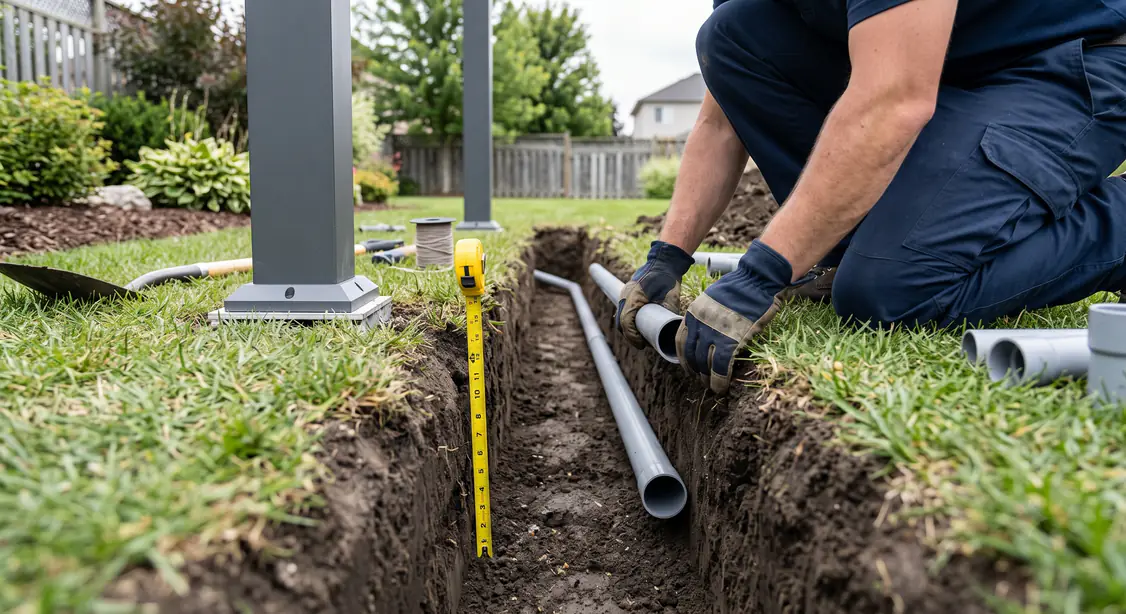
A pergola is not a temporary tent — it is a permanent outdoor structure with high-power electrical loads. The combination of louver drive motors, anti-snow heating elements, high-power fans, and multi-channel LED power supplies means its power circuits must strictly comply with NFPA 70 (NEC) requirements. Kit installation manuals must provide clear underground cable routing guidance for installers. Per NEC 300.5, rigid metal conduit (RMC) must be buried at a minimum depth of 6 inches; PVC conduit (Schedule 40/80) requires 18 inches; and directly buried UF-B cable must reach 24 inches. For 120V residential branch circuits not exceeding 20A with GFCI protection, the PVC burial depth requirement may be relaxed to 12 inches. Shallow burial that fails to meet these standards is easily severed during backyard landscaping, causing serious short circuits or electric shock hazards.
All outlets installed on pergola posts or beams must be equipped with Ground Fault Circuit Interrupter (GFCI) protection and use weatherproof (WR) outlets with in-use covers per NEC 210.8 and 406.9. When a pergola is built near a swimming pool, the electrical clearance and equipotential bonding requirements of NEC 680 must be strictly followed to eliminate electrocution risk entirely. Additionally, for motorized pergolas with a reserved center-fan mounting position, the kit must include a fan-rated electrical box compliant with NEC 314.27 to withstand the dynamic torque and static load generated by fan operation.
In terms of hardware protection, controllers, receiver boxes, and LED drivers must face not only extreme temperature fluctuations but also resist rain infiltration and salt-spray corrosion in coastal environments. For B2B manufacturer procurement, the main control board must achieve at least IP65 protection. In high-humidity and hurricane-prone areas such as Florida or California, all LED controllers exposed in unshielded areas (such as RGBW DMX decoders and SPI signal amplifiers) are strongly recommended to use fully-potted IP67-rated products. IP67 means the device can withstand brief submersion without ingress of water, dramatically reducing the probability of component burnout from condensation accumulation or storm flooding. For components applied directly at the water-feature edge, an upgrade to IP68 full-submersion rating is mandatory.
| Standard / Protection | Applicable Object | Core Technical Requirements | Risk if Non-Compliant |
|---|---|---|---|
| NEC 300.5 | Underground power cable burial | RMC: 6 in.; PVC conduit: 18 in.; direct-burial cable: 24 in. | Cable severed during excavation, causing fatal electric shock or fire; installer bears legal liability. |
| NEC 210.8 & 406.9 | Outdoor electrical outlets | Must have GFCI protection with weatherproof (WR) covers and in-use hoods. | Rain infiltration causes repeated circuit trips or human electrocution. |
| NEC 314.27 | Ceiling fan mounting position | Must use a fan-rated electrical box fixed to structural beam. | Fan collapses due to excessive dynamic torque during high-speed operation. |
| IP67 / IP68 | LED drivers & motor control boxes | IP67: full potting, tolerates brief immersion; IP68: long-term submersion. | Condensation and salt-spray corrosion short-circuit PCB, causing widespread hardware failure and high warranty costs. |
Light Environment Design: Seamless Control and Layered Rendering of the Lighting Ecosystem
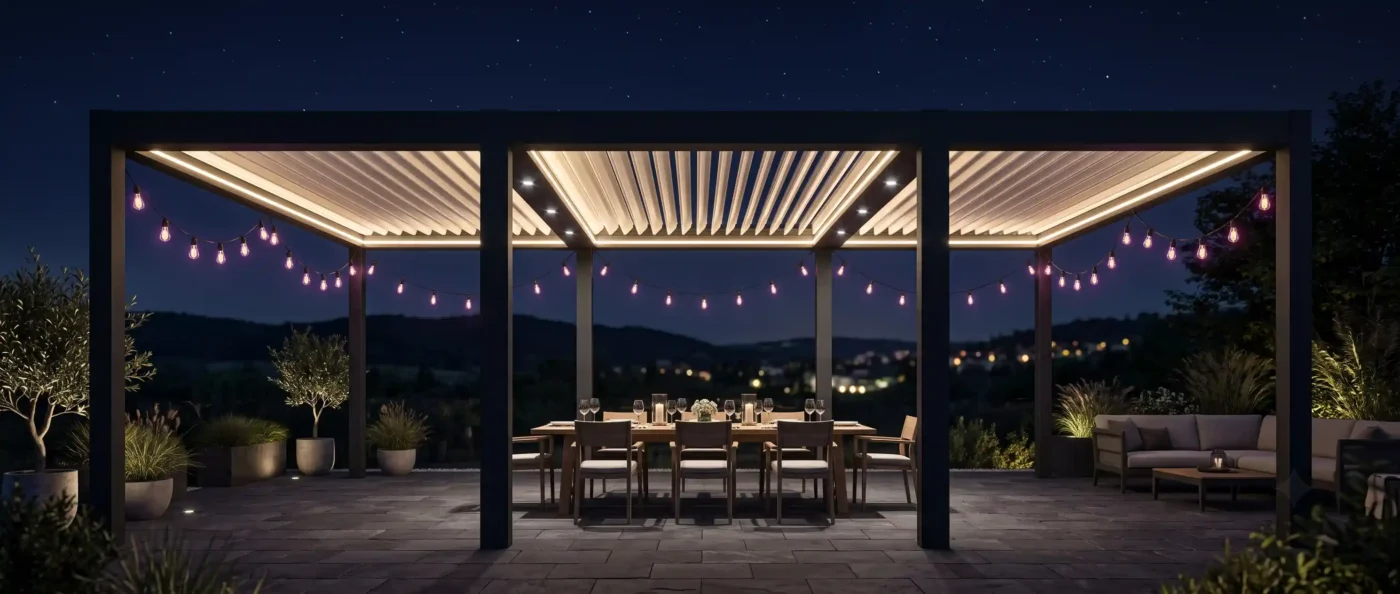
Beyond blocking sunlight, the most directly value-generating experience for a control interface is illuminating the night. High-standard pergola kits must provide an integrated low-voltage (12V/24V) smart lighting system. A single-channel lighting solution makes the outdoor space feel flat and harsh. A professional system should divide lighting into three layers and allow independent dimming through a multi-zone controller.
Ambient Lighting typically refers to LED strips embedded around the pergola perimeter or uplighting wash fixtures. Using PWM modulation technology, the controller achieves smooth dimming from 1% to 100%, establishing a soft foundational light environment across the entire pergola area. Task Lighting refers to recessed spotlights installed beneath the beams. When users are cooking, barbecuing, or reading under the pergola, these fixtures provide high-illuminance, high-CRI directional light. Accent / Atmosphere Lighting gives the pergola its personalized soul — whether suspended vintage Edison string lights or RGB/RGBW full-color LED strips integrated into the louver gaps, all can be paired with DMX512 decoders or SPI controllers to enable seamless transitions across chase effects, music-reactive modes, and holiday-themed color palettes.
The long-standing pain point of separating lighting from motor control has been that end users face two completely different control systems. Pergola kit manufacturers should source composite central control boxes with integrated high-power dimming outputs. For example, smart receivers have already appeared on the market that simultaneously offer two motor control channels and an RGBW LED dimming interface. When these loads converge at the same hardware node, users can achieve one-button linkage operations such as “louvers open to 45° + main light at 60% brightness + atmosphere lighting switches to warm tone” through a scene key on a smartphone app or RF remote. This high degree of hardware-software synergy is the watershed dividing premium custom pergolas from low-end assembled products.
Systematic Control Matrix Construction Strategy for OEMs
Drawing on the deep analysis of human-machine interfaces, communication protocols, and physical compliance standards, we offer the following control matrix optimization blueprint for European and North American pergola manufacturers to guide future product R&D and procurement decisions.
The foundation of any competitive control matrix begins at the component sourcing level. As we detail in our in-depth guide to OEM vs. white-label vs. off-the-shelf sourcing models for pergola lighting, manufacturers who rely on white-label control components face a critical risk: the BOM silently changes between production batches without notification, and a receiver or LED driver that passes your first qualification run may carry inferior driver chips in its second batch. For a control matrix that must deliver consistent RF signal decoding, stable PWM dimming output, and reliable motor torque — forensic BOM freezing through an OEM manufacturing agreement is not a luxury, it is the baseline requirement for a low-complaint product.
First, manufacturers must make an RF- or RTS-protocol handheld remote a mandatory standard inclusion in every shipped pergola kit. In any scenario of extreme network outage or even cloud service collapse, users can still command their physical space with the RF remote. Simultaneously, integrating an emergency manual override switch into the control circuit — to handle the lockout risk during power failure in catastrophic weather such as hurricanes — is a critical measure for guaranteeing basic safety.
Second, offer differentiated smart upgrade packages. Introduce multi-mode gateways capable of simultaneously decoding RF signals and bridging to Wi-Fi or Thread, releasing remote App control and scene scheduling capabilities to users. More critically, mainboard R&D should actively converge on the Matter standard, reserving hardware computing interfaces for full integration into Apple, Google, and Amazon ecosystems. This will dramatically reduce the cost of cross-ecosystem certification.
Connecting solar-powered rain and wind sensors to the highest priority of the control logic is an effective means of reducing customer complaints. Without human intervention, once heavy rain is detected, the system should override the current scene mode, forcibly close the louvers, and trigger the motor protection threshold. Achieving physical protection of assets through automation saves manufacturers a large volume of post-sale warranty disputes.
On the engineering implementation side, manufacturers should dramatically simplify the installation process for terminal dealers or DIY buyers. Eliminate the traditional bare-wire crimp-connection approach and fully transition to potted IP67 waterproof aviation connectors and quick distributors. Ensuring foolproof design at the assembly stage eliminates electrical faults caused by improper installation at the source — reducing technical requirements on installation crews while dramatically improving the long-term reliability of the system.
The control architecture we describe throughout this article — layered interfaces, protocol-agnostic hardware, and NEC-ready electrical design — is precisely what an integrated solution like our Système de commande de pergola VLEDSTAR is engineered to deliver out of the box, giving OEMs a pre-validated platform to build their kit around rather than assembling a fragmented matrix from disconnected components.
Command Light and Shadow — Reshape Value
In today’s wave of intelligent transformation, the physical aluminum structure of a pergola is merely the skeleton that holds an outdoor lifestyle. The precise electrical architecture and multi-dimensional control interface are the nervous system that breathes a soul into that skeleton. By deeply fusing the rock-solid reliability of RF communication, the panoramic vision of app control, the futuristic feel of voice control, and the intuitive simplicity of wall switches, pergola manufacturers are not merely delivering a shading solution — they are delivering a premium lifestyle liberated from weather constraints.
From understanding NEC’s stringent underground conduit codes to selecting IP67-rated RGBW lighting controllers, to embracing the Matter standard that is set to rewrite the rules of industry connectivity — every precise decision in technical selection will directly translate into the brand’s premium pricing power and user loyalty in the end market. In this winner-take-all market, the era of competing purely on aluminum thickness is over.
If you are looking for an outstanding lighting and control system solution for your next generation of pergola kits, our professional engineering team is ready to provide you with full-stack support — from underlying protocol development to waterproof hardware customization. Let’s work together to build a highly competitive control matrix and jointly define the future standard for outdoor luxury living. Explore our integrated pergola control system or contact our technical specialists to begin your product upgrade journey.

Ping de retour: Comment les fabricants de pergolas peuvent remplacer les télécommandes distinctes par un système intégré de commande de l'éclairage et des lames
Ping de retour: Liste de contrôle de la nomenclature du système de commande de pergola destinée aux fabricants de toits à lamelles
Ping de retour: Commande des LED RGB, RGBW et mono pour les pergolas à lamelles : guide des spécifications
Ping de retour: Commande d'actionneurs et de moteurs tubulaires pour les lamelles de pergola : guide d'intégration OEM
Ping de retour: Pergola Motor Control: Actuator vs Tubular Motor OEM Guide
Ping de retour: Designing a Dealer-Friendly Control Kit for Motorized Pergolas
Ping de retour: Qu'est-ce qu'un système de commande intelligent pour pergola ? L'explication d'un fabricant