









Do you really know how to assess the beam angle of an outdoor floodlight?
A query has been raised: In the technical requirements for LED nightscape illumination applications, within the luminaire efficacy table for white light LED floodlights, Note 1 states: ‘B10% denotes the beam angle calculated based on 10% of the maximum luminous intensity value, while B50% denotes the beam angle calculated based on 50% of the maximum luminous intensity value.’ How exactly should B10% be interpreted in this context?
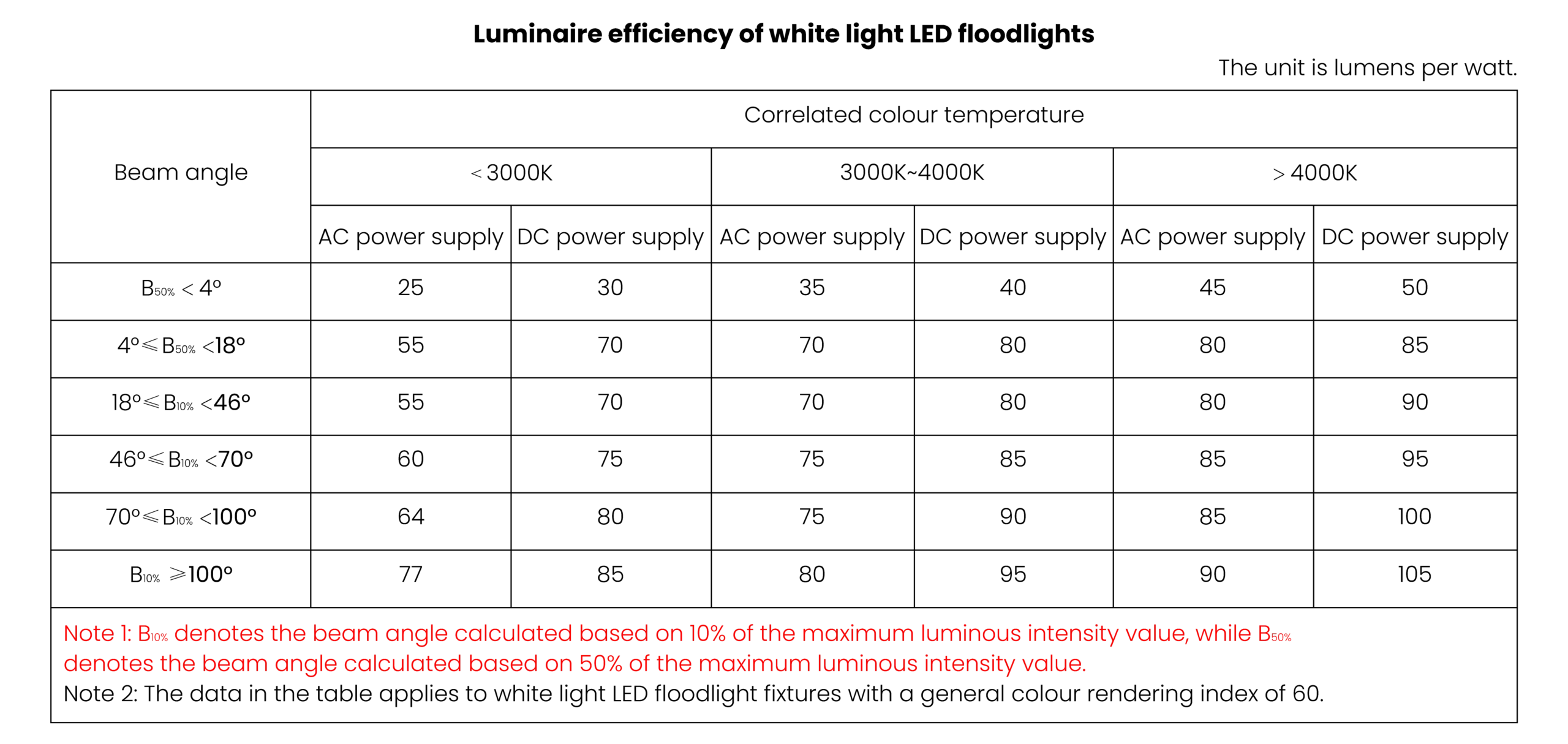
B10% actually refers to a 10% luminous intensity angle, also known as the 1/10 luminous intensity angle, commonly denoted as Field Angle. In practical applications, it frequently appears in the North American IES standards and is often encountered in the specification sheets of factory outdoor floodlights. It is also utilised in the technical requirements for LED nightscape illumination applications.
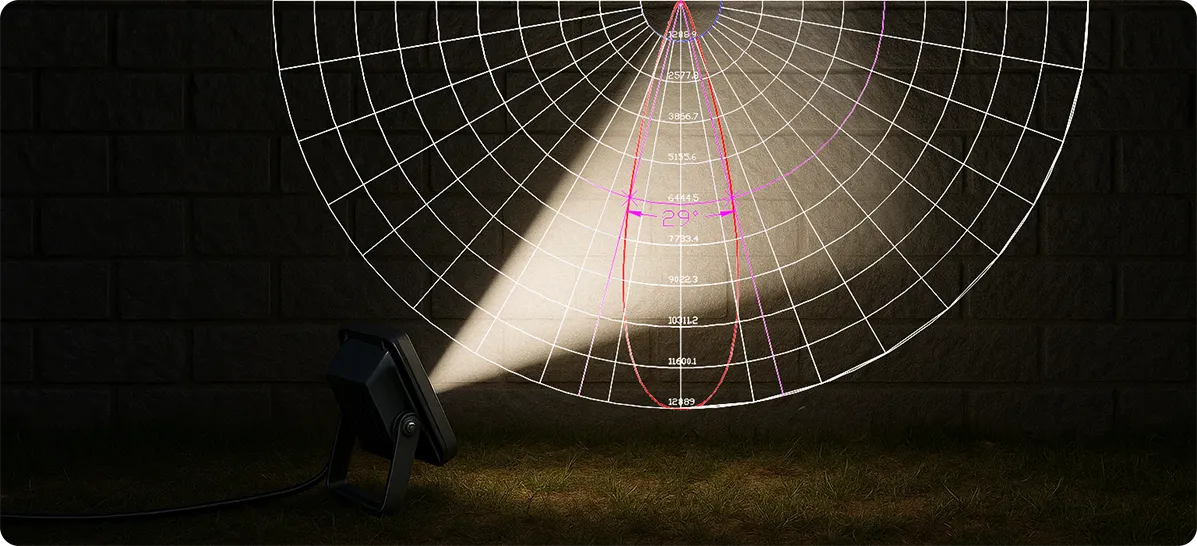
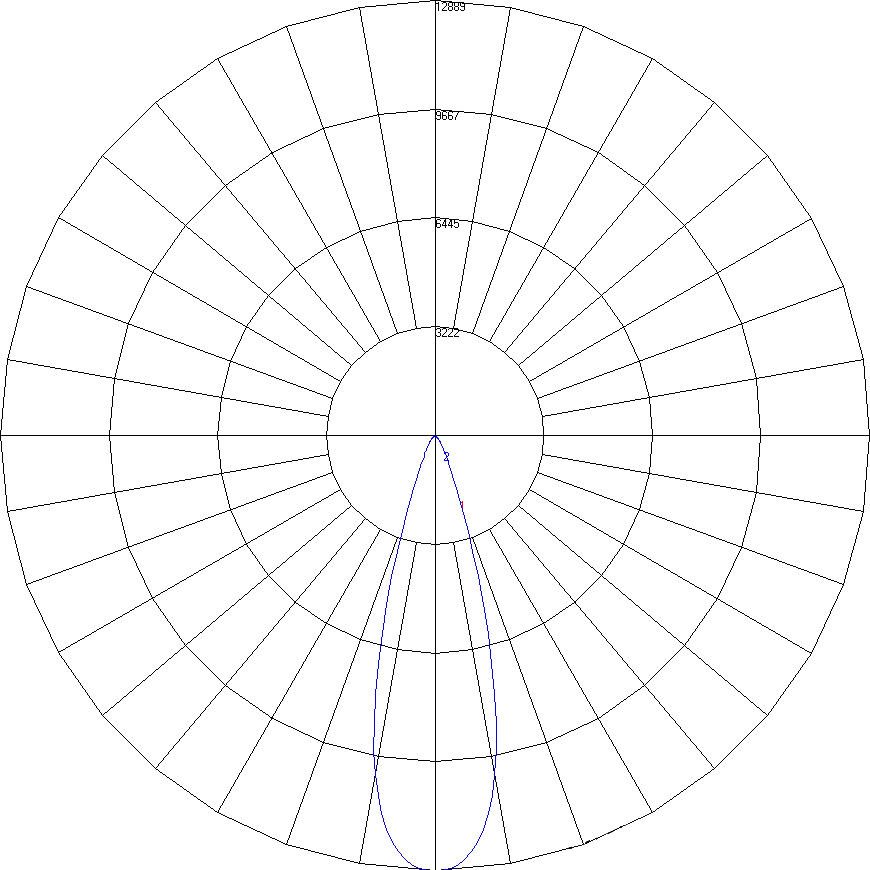
We typically examine the beam angle, most often the half-intensity angle—that is, the angle corresponding to the luminous intensity value equal to half the maximum luminous intensity. Taking the diagram below as an example, the maximum luminous intensity value of the light distribution curve is 12,889 cd. I have divided the intensity range into ten equal segments. Thus, the position of 50% intensity corresponds to the circle at the fifth segment. The angle formed between the line connecting the intersection point of the fifth segment circle with the light distribution curve and the origin is the half-intensity angle. In the diagram below, the half-intensity angle of the light distribution curve is 29°.
Similarly, the 10% light intensity angle is determined by dividing the maximum light intensity value into ten equal parts, then taking the angle formed by the line connecting the intersection point of the first equal segment circle with the light distribution curve and the origin. As shown in the figure below, the 10% light intensity angle is 47°.
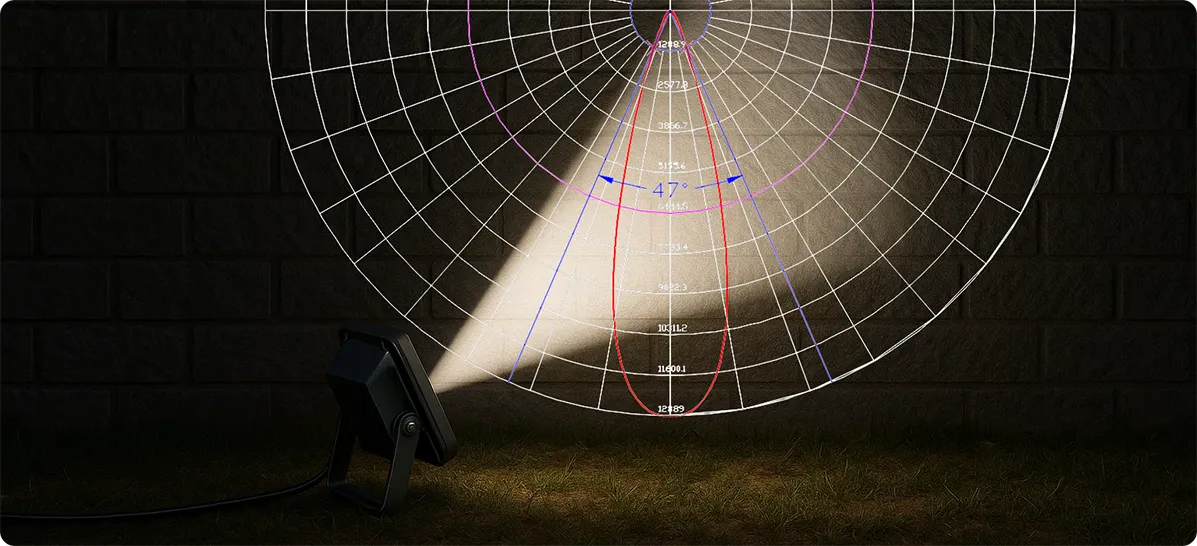
The above explains how to read the angle for the 10% luminous intensity angle.
Many might say that a luminous distribution curve alone is rather difficult to interpret; those in printed catalogues tend to be quite small, making it hard to discern the angles.
If we have the manufacturer-provided IES file, opening it directly in software for reading is quite convenient. Taking the luminous distribution curve mentioned earlier as an example, when opened in software, it displays as shown in the figure below.
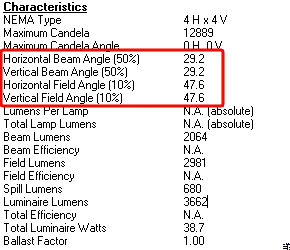
Upon opening the parameter readout via software, the following parameters will be displayed, including the 50% light intensity angle and the 10% light intensity angle. The image below shows 29.2° and 47.6° respectively, which aligns closely with our manual readings.
Classification and Selection of Outdoor Floodlights
As the beam angle of outdoor floodlights is measured at the angle where 1/10th of the luminous intensity is recorded, the classifications below are also categorised according to the 1/10th luminous intensity angle.
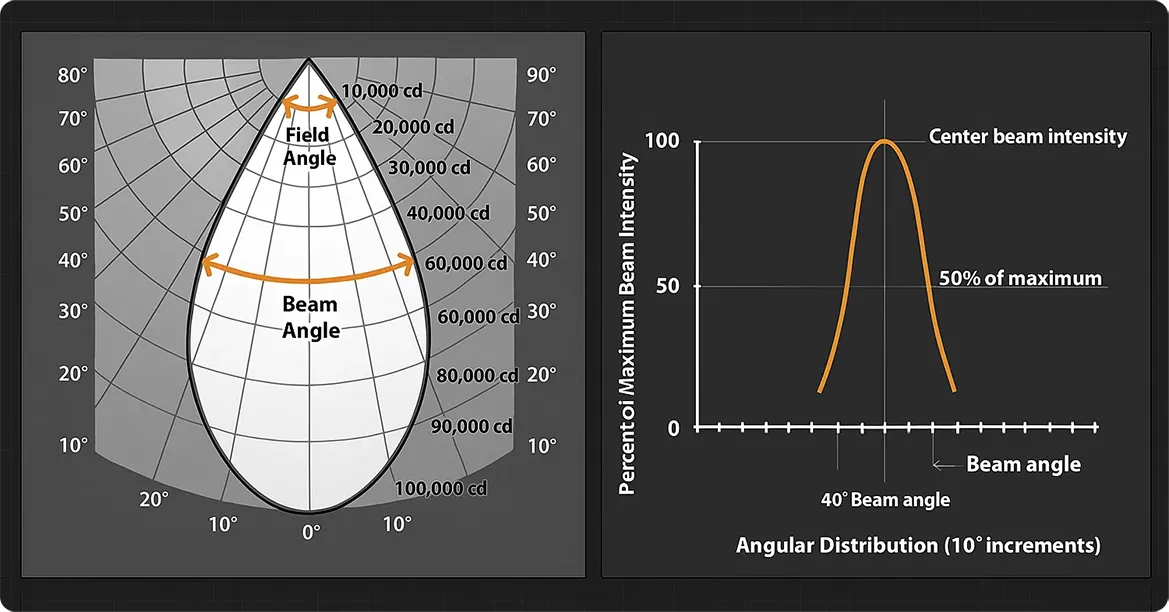
According to the classification of floodlights by NEMA (National Electrical Manufacturers Association), the beam angles of standard floodlights are categorised as follows.
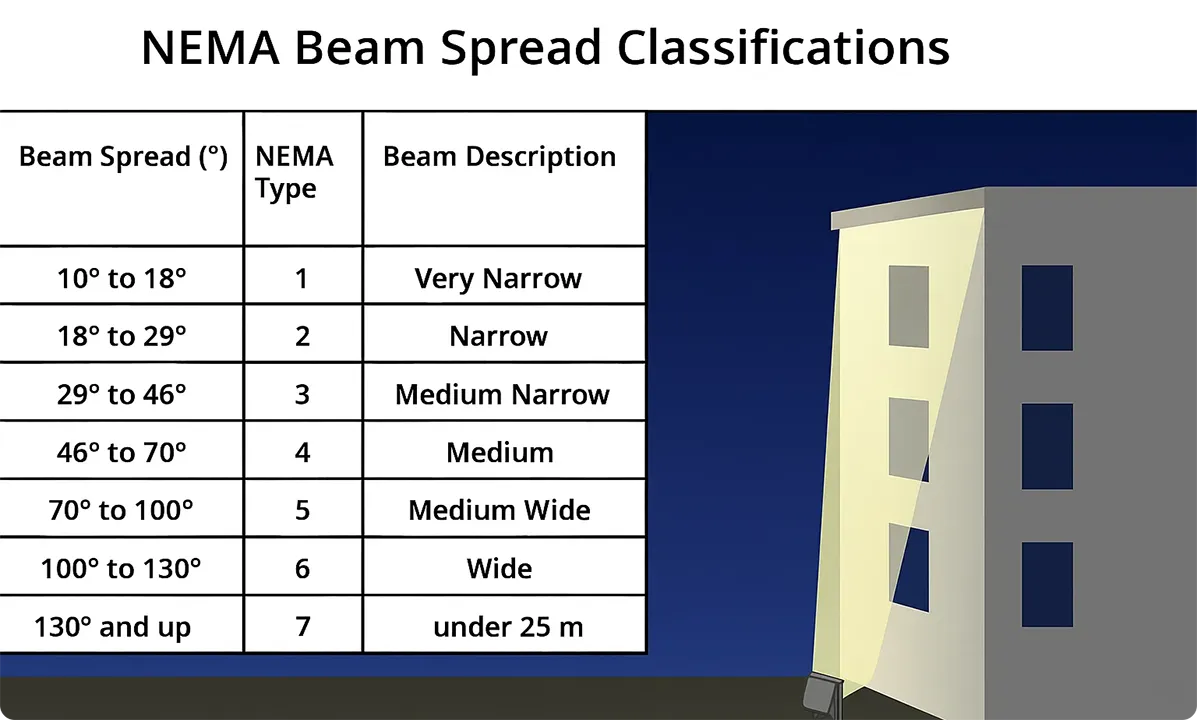
The table categorises floodlight beam angles into seven classes, each with its own specified angle range
The projection distances listed in the table may serve as a general reference; most floodlights in North America are categorised according to these specifications.
For example, floodlights with a beam angle of 1/10th, ranging from 10° to 18°, can project over 75 metres; those with a beam angle of 18° to 29° have a projection distance of 65 to 75 metres, and so forth.
For outdoor floodlighting applications, this angle and distance may serve as a reference.
However, outdoor luminaires often do not produce a circular symmetrical light pattern; frequently, they generate an asymmetrical light pattern. Take linear wall-washing luminaires used on exterior building facades, for instance. Theoretically, these wall-washing luminaires for outdoor facades are also floodlights, specifically floodlights with asymmetrical light distribution. How, then, is this asymmetrical light distribution classification represented?
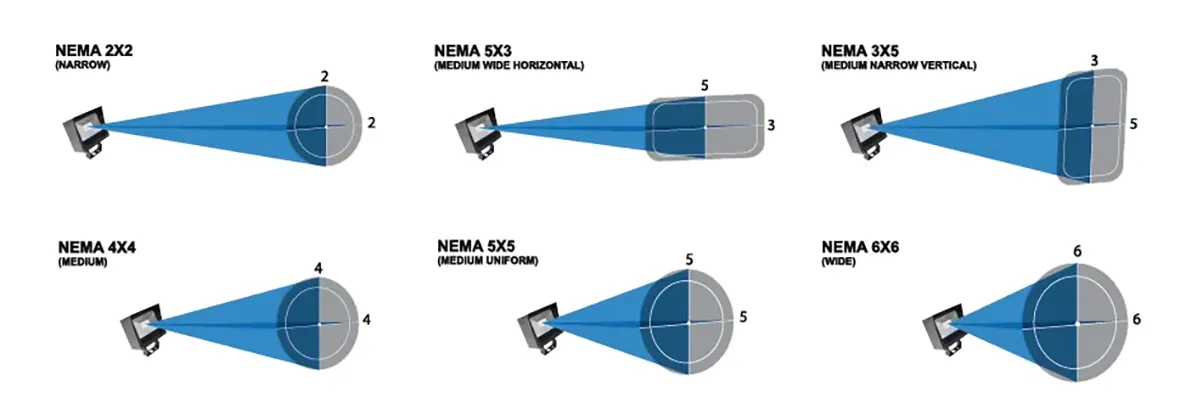
We may classify the beam angles in both directions according to the NEMA classification system, as illustrated in the diagram above. For instance, the beam pattern of a 20°×60° wall-washing luminaire for exterior facades can be denoted as NEMA 2×4. The wall-washing distance may still be referenced from the projection distance table; NEMA 2×4 typically achieves a wall-washing distance of approximately 65 metres in height.
What about sports lighting? We categorise it within the same angular range, though there are slight variations in classification and application.
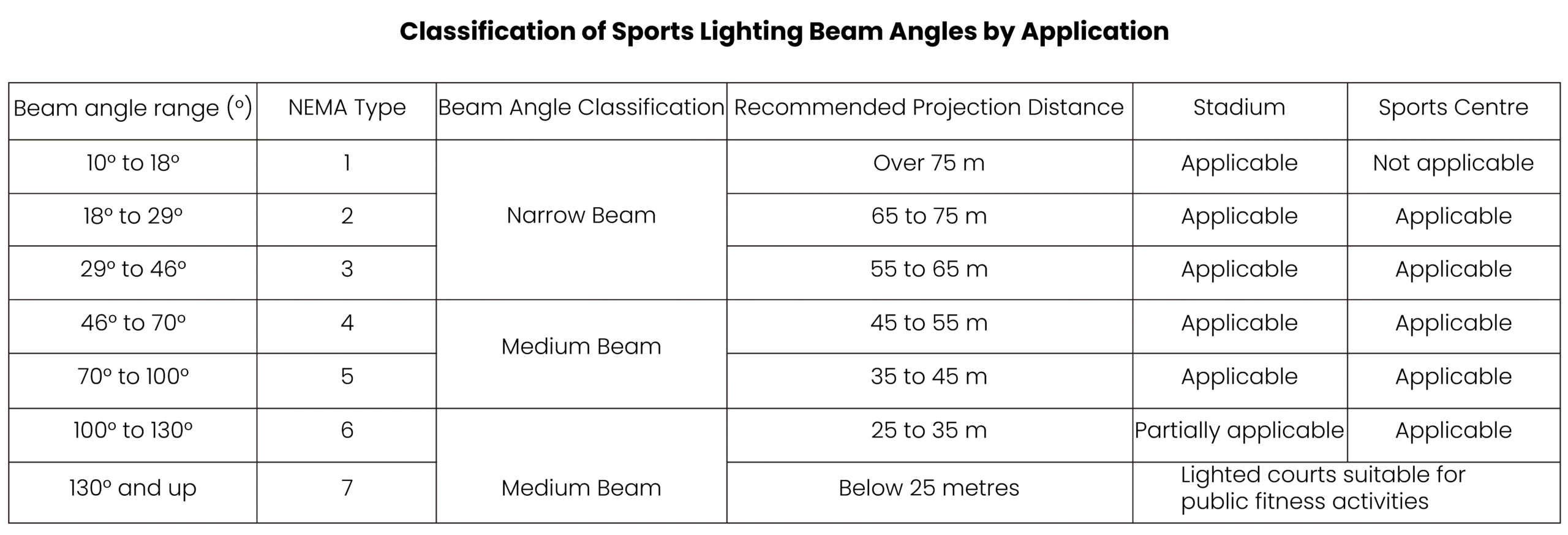
In sports lighting, we categorise beam angles directly into narrow, medium, and wide types, then adapt them to their respective applications. In practical use, this can serve as a general reference.
Author

Andy Gao
With 15 years in the LED lighting industry, I’ve witnessed its evolution from general fixture production to today’s highly specialized segments. As Co-Founder of Veldstar, my journey mirrors this shift – driving our exclusive focus on pergola and garden lighting solutions. Through dedicated innovation, we develop controllers and systems rivaling leaders like Somfy and Teleco. Here, I share insights and showcase products engineered to elevate outdoor spaces with style, functionality, and advanced control. Learn more via linkendin profile:https://www.linkedin.com/in/pergolalights/

Share This Article:
Send Us your Request