


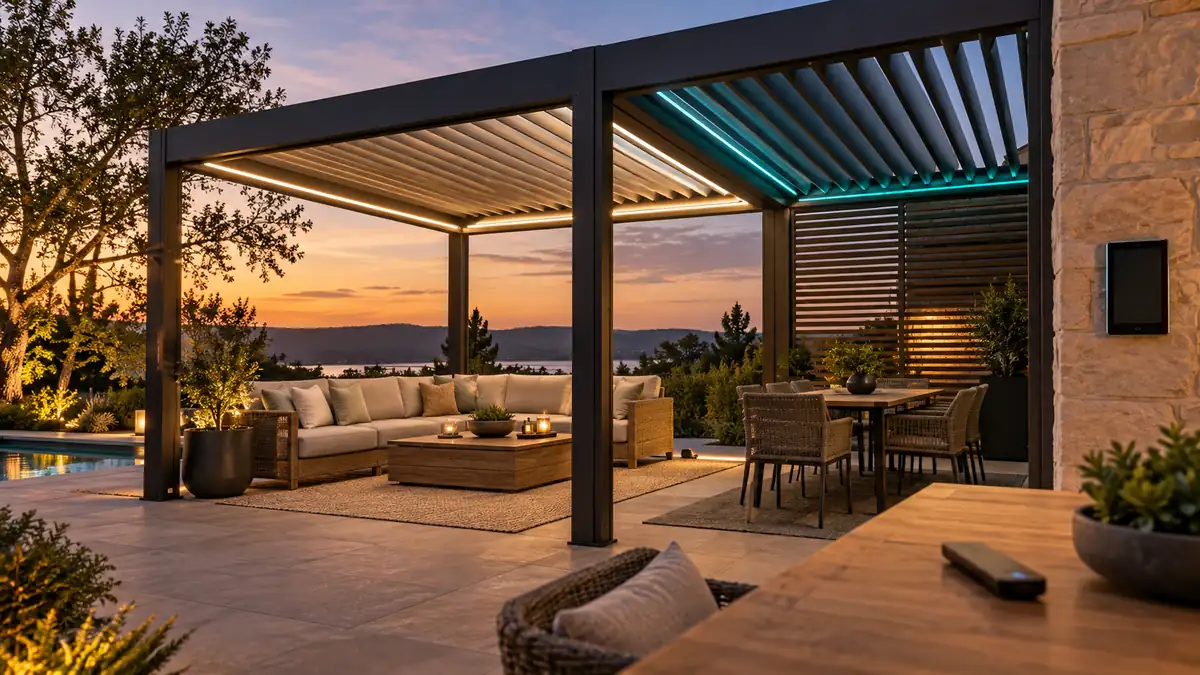
A pergola buyer may notice the roof profile first, but the control experience is what they live with every day. One remote that opens the louvers, adjusts the screens and dims the lights feels like a finished product. Three remotes, an unreliable app and a sensor that was added after installation feel like a collection of parts.
That distinction matters to manufacturers. Control architecture influences the bill of materials, wiring plan, installation time, dealer training, warranty exposure and the number of upgrade options that can be offered across a product range. It also shapes the way a brand is remembered after the pergola has been installed.
The market is moving in this direction already. Established outdoor-living brands such as Renson and Somfy present remote, app, lighting and sensor control as part of the pergola experience rather than as an afterthought. For manufacturers building the next generation of pergolas, the strategic question is not whether controls belong in the product. It is whether the control layer is good enough to differentiate the product.
A pergola control system should be designed with the same discipline as the roof, drainage and motor drive: as a core product platform that creates value across the entire manufacturing and ownership lifecycle.
Controls define the product experience
Two pergolas can use similar aluminum profiles, louvers and motors yet deliver very different customer experiences. The difference is often in the control logic.
A well-designed system lets the user make small, natural adjustments: tilt the louvers to reduce glare, turn on a warm lighting scene, lower a privacy screen or close the roof when rain begins. It makes the structure feel responsive. The controls translate mechanical capability into comfort.
This is why control decisions should be made during product design, not after the roof and lighting have already been specified. The manufacturer needs to define:
- Which functions belong in one user interface.
- How many zones the system must operate independently or in groups.
- Which actions should remain available through a physical remote if the app or network is unavailable.
- How lighting scenes, motor movement and weather events interact.
- What the installer and service technician can diagnose without dismantling the structure.
These are product decisions. They affect usability, perceived quality and brand trust just as directly as a visible finish or a quiet motor.
Why fragmented controls create avoidable product problems
Fragmentation usually begins with reasonable short-term choices. A motor supplier provides one receiver, a lighting supplier provides another, a screen supplier adds a third and a smart-home gateway is specified at the end. Each component may work on its own. The complete pergola becomes difficult to operate and difficult to support.
The costs appear in several places:
| Fragmented approach | Manufacturer impact | Integrated approach |
|---|---|---|
| Separate remotes for roof, screens and lights | More user confusion, more pairing steps and more service questions | One clear control model with group and independent operation |
| Controls selected after the structure is designed | Late wiring changes, crowded cavities and installation rework | Control dimensions, connectors and harnesses planned with the frame |
| Independent sensor and motor logic | Inconsistent behavior during rain, wind, snow or power recovery | Defined system-level rules for safety, comfort and manual override |
| Different suppliers for every control component | Unclear fault ownership and slower warranty resolution | One technical partner accountable for the control architecture |
Our own engineering work at VLEDSTAR repeatedly points to the same conclusion: the controller is where otherwise good components either become a coherent system or remain a box of independent functions. A dedicated integrated controller can reduce the number of interfaces that installers must understand and service teams must troubleshoot.
Integration is a manufacturing advantage, not only a user benefit
Manufacturers often evaluate integration through the customer-facing features: one remote, app access or automatic rain closure. The operational benefits are just as important.
Fewer parts and clearer assembly
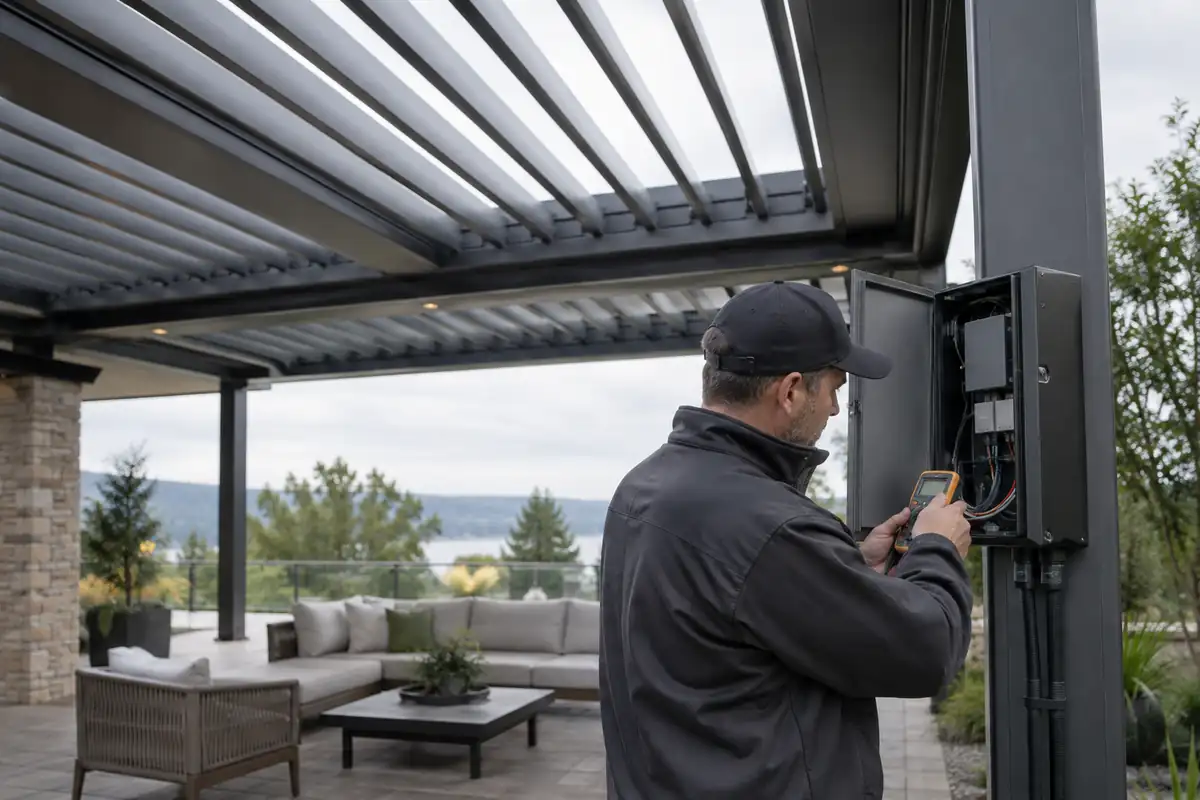
A unified controller can combine lighting outputs, actuator channels, tubular motor channels and sensor inputs within a planned enclosure. That makes the wiring diagram easier to standardize and gives assembly teams a repeatable harness and connector strategy. VLEDSTAR’s pergola control unit is built around this ready-to-integrate model rather than treating the control box as a loose PCB.
Shorter commissioning
Commissioning is where many hidden costs surface. Installers must pair remotes, define motor direction, set limits, verify lighting zones and test sensor responses. A control platform with defined channels and documented pairing procedures gives the installer a repeatable process. The result is not merely a faster installation; it is a lower chance of inconsistent behavior between projects.
More predictable service
When the control architecture is standardized across a product family, technical teams can diagnose recurring issues faster. They know where power enters, how outputs are grouped, which sensor has priority and what the manual override should do. This is one reason we focus on wiring, connector solutions, firmware and enclosure options as part of the supply partnership.
Detailed control planning can also reduce installation labor. The practical relationship between integration, wiring and site work is discussed in this guide to how integrated controls reduce pergola installation labor.
Weather automation should be designed as system logic
A rain sensor is not a complete weather strategy. A manufacturer must decide what the pergola should do when rain, wind, sun, snow and a manual command occur close together. Those decisions belong in the control architecture.
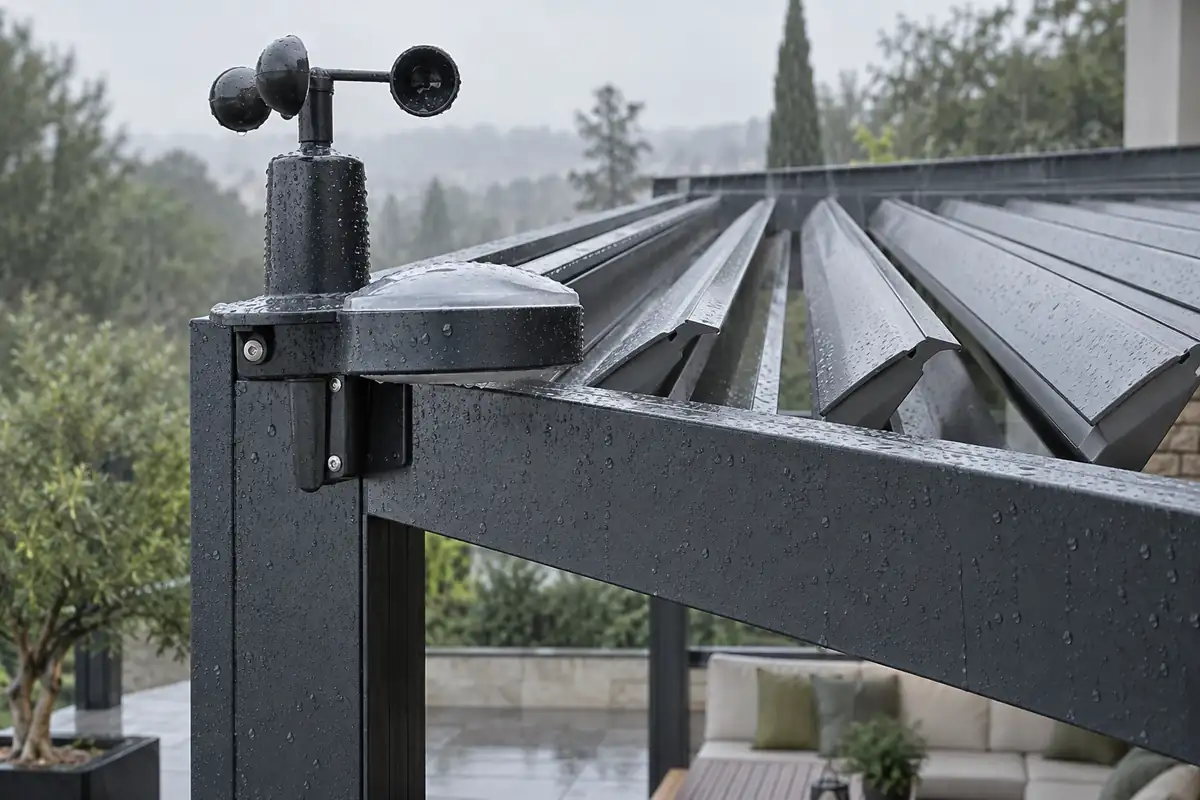
For example, a rain event may require the louvers to close while keeping the lights on. A high-wind event may require a screen to retract while the roof moves to a defined protective position. Snow or frost may call for a different response from rain. The controller must interpret the input and coordinate the output, rather than simply passing along an on/off signal.
This is particularly important for European and North American manufacturers serving changing climates and higher-expectation outdoor-living markets. A useful system needs clearly documented thresholds, fail-safe behavior, manual override and recovery behavior after a power interruption.
Our sensor integration guide explains why conditional scene logic is more capable than separate relay actions. The principle is straightforward: sensors should trigger coordinated system behavior, not isolated component reactions.
Weather automation also needs a physical design that can survive the environment. Enclosure protection, connector selection, drainage, cable routing and signal performance should be validated together. Manufacturers evaluating protection levels can use this IP rating guide for pergola controllers and sensors as a starting point.
Controls create a stronger product ladder
A core control platform gives manufacturers a practical way to build a product ladder without redesigning the entire pergola for every price tier.
An entry model might offer a single-color lighting channel and RF remote. A mid-range model can add multiple motor zones, dimming and a mobile app. A premium model can add RGB scenes, screens, weather sensors, touchscreen control and smart-home integration. The physical structure can remain largely consistent while the control package creates meaningful differences between tiers.
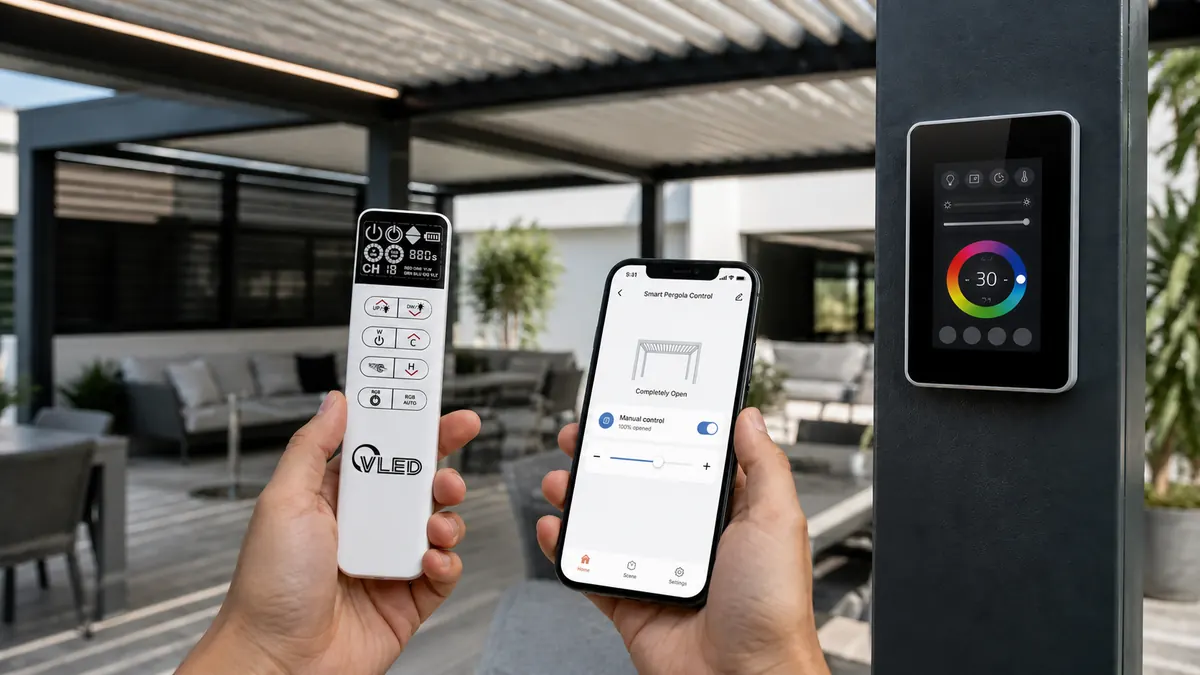
This approach is more powerful than adding decorative options at the end of the sales process because the upgrade is functional. Customers are paying for better control of shade, privacy, lighting and weather response. Dealers can explain the value in use rather than presenting a long list of unrelated accessories.
It also creates a clearer path for future products. Once the control platform supports multi-channel operation, the same architecture can be adapted for larger pergolas, multi-bay systems, verandas, awnings or outdoor kitchens. VLEDSTAR’s broader pergola lighting solutions are designed around this idea: lighting and control should be configurable enough to serve different product families while retaining a consistent integration logic.
Private-label controls help manufacturers own the customer relationship
The controller is one of the few parts of a pergola that customers interact with every day. If the remote, app and touchscreen carry another supplier’s identity, the control experience can pull attention away from the pergola brand.
Private-label control is not only a branding exercise. It can include the enclosure, remote layout, channel naming, firmware behavior, app presentation, installation documentation and support workflow. These details help manufacturers present the system as one product instead of a structure assembled from outside components.
There is a commercial reason to care about this ownership. The company that owns the control experience is more likely to receive the follow-up questions, upgrade requests and service feedback. That information can improve the next product revision. A control platform designed for OEM and ODM use makes that learning loop easier to manage.
Manufacturers considering proprietary or private-label lighting controls can also review this practical discussion of proprietary lighting control systems for pergola brands.
What manufacturers should specify before choosing a control supplier
Control selection should begin with a product specification, not a catalogue comparison. The following questions expose whether a supplier can support a real pergola program.
- Architecture: Can the unit manage the required lighting types, actuators, tubular motors, screens and sensors within one documented system?
- Zones: Can users operate multiple bays together or separately, and can the channel structure scale to the planned product range?
- Electrical design: Are voltage, load, dimming behavior, driver compatibility and protection requirements clearly defined?
- Outdoor reliability: Has the complete assembly been checked for water exposure, dust, temperature, vibration, signal interference and cable-connector performance?
- Aluminum-frame performance: Does the RF design remain reliable when the controller and receiver are installed inside or near metal structures? Our guide on preventing RF signal problems in aluminum pergolas covers the design factors that deserve attention.
- Safety behavior: What happens when a sensor fails, a motor reaches an obstruction, communication is lost or power returns after an outage?
- Integration: Can the system work with the motors and smart-home ecosystem the target market already expects? For larger connected projects, it is useful to understand the role of established platforms such as StruXure operating systems and their integration approach.
- Manufacturing support: Can the supplier provide samples, wiring diagrams, firmware changes, branded components, production testing and technical support?
The right supplier should be able to discuss the complete path from engineering sample to mass production. If the conversation stops at a product photo and a nominal output rating, the manufacturer is still carrying the integration risk.
Why VLEDSTAR treats controls as a platform
VLEDSTAR entered the LED lighting industry in 2010 and has expanded its work into integrated lighting and control solutions for pergola and outdoor-living systems. That background matters because a control unit cannot be evaluated separately from the lights it drives, the motors it coordinates and the frame that houses it.
Our approach combines product engineering and in-house manufacturing around the requirements manufacturers face: DC24V lighting, RGB and monochromatic outputs, actuator and tubular motor control, weather sensor inputs, multi-channel RF operation, mobile-app control and outdoor protection. The integrated pergola control system page provides the current system-level overview, while the smart pergola controller page focuses on the control platform and OEM use case.
For a manufacturer, the practical value is not any single feature. It is the ability to specify one control logic across a product line, test it with the intended motors and lighting, and receive technical support from a factory that understands the complete assembly.
The strategic decision is bigger than choosing a remote
Controls influence the product before the first unit reaches a showroom. They shape the frame cavity, connector layout, harnesses, assembly instructions, commissioning procedure, warranty process and future upgrade options. Treating them as a late-stage accessory transfers those decisions to suppliers and installers, where they become harder and more expensive to change.
Treating controls as a core product feature gives the manufacturer control over the opposite outcome: a simpler installation, a clearer customer experience, more coherent product tiers and a stronger relationship with dealers and end users.
The best time to make that decision is before the next pergola range is frozen. Define the control experience alongside the roof, motor and lighting specification. Test the complete system in a representative aluminum structure. Then choose the supplier that can support engineering, customization, quality control and production at the same level.
Build the control layer into your next pergola range
Share your motor type, lighting configuration, sensor requirements, target markets and expected quantity with the VLEDSTAR engineering team. We can review the control architecture, recommend a suitable integrated unit and support sample evaluation before production.
Request pergola control specifications and OEM support or explore the complete pergola lighting and smart-control range.

Send Us Your Request