


Automated sensor integration is one of the fastest-growing specification requirements in the pergola manufacturing market. A decade ago, motorised louvers were a premium differentiator. Today, that bar has moved: buyers across Northern Europe, the Alpine region, and North America increasingly expect their louver system to respond automatically to changing weather — closing in advance of rain, retracting at high wind loads, adjusting to direct sun, and doing all of this without a human in the loop.
For pergola manufacturers, this shift creates a clear product opportunity — but it also introduces a layer of engineering complexity that demands serious decisions: wired or wireless sensors? Which parameters to monitor? How do sensors interface with motor controllers? What happens at a mountain resort when there’s nobody on site to respond to a snow accumulation event?
This guide walks through the four core sensor parameters — rain, wind, light, and snow load — and explains how to architect each one into a complete pergola louver and lighting control system. The insights here are drawn from direct customer conversations with manufacturers, installers, and specifiers across Europe, North America, and Latin America.
💡 Summary for specifiers: A fully integrated pergola sensor system monitors wind speed, rainfall, light intensity, and snow accumulation and automatically drives louver position and lighting state in response. When architected correctly — with appropriate wired or wireless signal paths — this system operates without manual input, including at unoccupied or seasonal properties.
Why Sensor Integration Is Now a Product-Tier Requirement
Premium pergola buyers in the European market are increasingly sophisticated. Specifiers for high-end residential and hospitality projects review the sensor specification as closely as they review the aluminium profile geometry or the slat actuation mechanism. An aluminium louver pergola positioned as a luxury outdoor living product — and priced accordingly — is expected to behave intelligently when the weather changes.
There is also a structural protection argument that goes beyond comfort. Motorised louver slats are engineering components with defined load ratings. A flat-open louver array in a 60 km/h wind event is at significant risk of damage. Rainfall pooling in an improperly closed configuration can create standing water that accelerates finish degradation. These are warranty-exposure issues that proper sensor automation prevents.
From a commercial standpoint, sensor integration is a clean upsell path: a base pergola structure, a motorised louver version, and a fully automated sensor-integrated version represent three distinct product tiers with defensible price steps between them. Manufacturers who build the automation architecture properly at the design stage are much better positioned to capture that premium tier than those attempting to retrofit sensors into an existing controller specification.
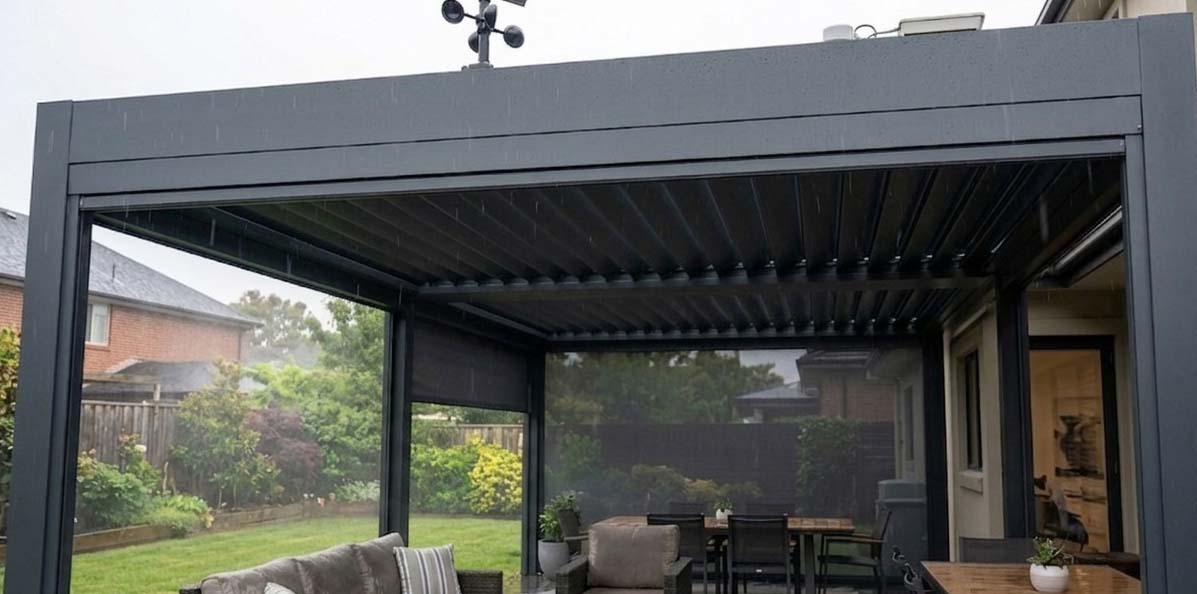
The ISO 9972 and EN 13830 standards governing facade and roof system weatherproofing provide a useful regulatory reference point. While pergola structures fall outside the scope of those standards in most jurisdictions, the underlying performance expectations — resistance to water ingress, wind-driven rain, and structural load — are directly applicable to how the louver automation logic should be configured.
Rain Sensors: Protecting Louvers and Lighting from Water Ingress
Rain detection is the most commonly specified sensor trigger in pergola control systems, and for good reason: rain arriving on an open louver array creates an immediate problem both for the occupant beneath and for the electrical components integrated into the pergola structure — LED strip circuits, driver housings, and motor wiring runs are all at risk from water ingress that proper louver closure would have prevented.
How Rain Sensors Work in a Pergola Context
The most widely deployed technology in outdoor automation is the resistive rain sensor: a PCB with an exposed grid of conductive tracks. When raindrops bridge the tracks, resistance drops and the controller interprets this as a rain event. Response time from first drop to trigger is typically under two seconds on well-engineered sensors — fast enough to begin louver closure before meaningful water ingress occurs in most rainfall scenarios.
A secondary option gaining traction in premium installations is the capacitive rain sensor, which detects the dielectric change caused by a water film over the sensing surface. Capacitive sensors are less susceptible to false triggers from condensation and surface debris, making them preferable in heavily vegetated installations or coastal environments with high ambient humidity.
🌧️ Design consideration: Mount rain sensors on an unobstructed horizontal surface — not beneath an overhang or in a location where adjacent louvers would shadow the sensor before it reads actual rainfall. A common installation error is mounting the sensor too close to the pergola frame, where partial roof closure delays the trigger by several minutes.
Wireless Rain Sensor Architecture
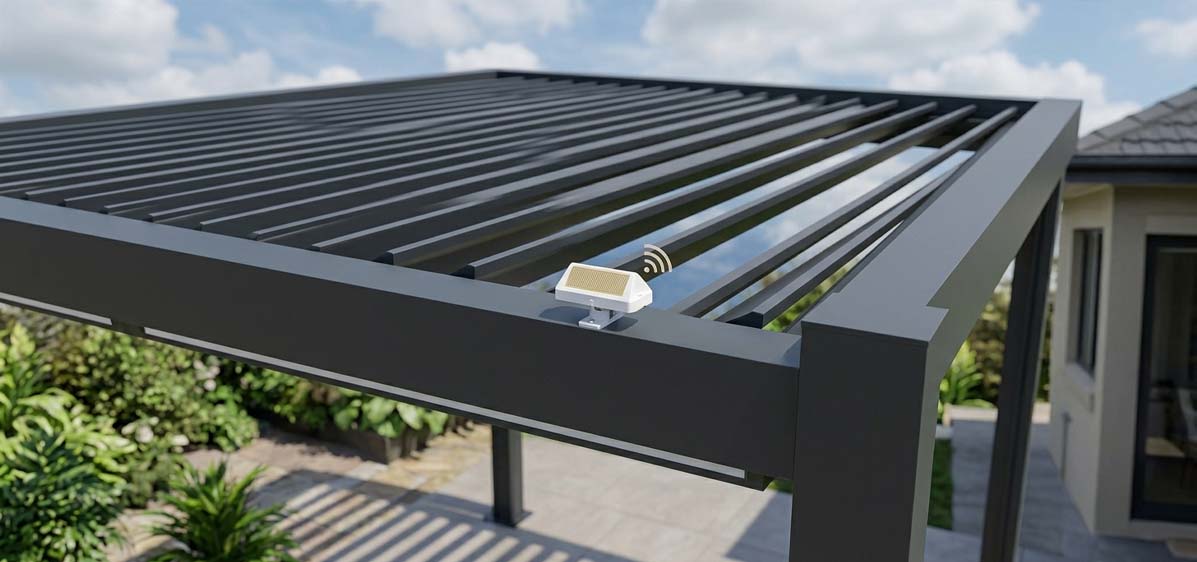
In our current pergola control architecture, we have implemented a wireless rain sensor that pairs directly with the control box via RF protocol. The primary technical advantage here is system expandability — by standardising on a wireless communication framework, the control box is not limited to rain detection alone. The same architecture supports integration of additional nodes: single-colour LED drivers, RGB lighting controllers, and motorised louver actuators can all be added to the network without requiring additional wiring infrastructure. The rain sensor essentially becomes one node in a broader, unified control ecosystem rather than a standalone peripheral.
For outdoor pergola deployments in typical residential and light commercial settings, RF-based rain detection performs reliably. The ETSI EN 300 220 standard governing short-range devices at 433 MHz provides the regulatory baseline for this type of sensor-to-controller communication in European markets.
Rain Trigger Logic: What Should Happen When It Rains?
The control response to a rain event should not be a blunt “close everything” command. A well-configured rain response sequence typically includes: (1) begin louver closure to weatherproof position, (2) hold louver closure state for a defined post-rain period to allow the sensing surface to dry before re-opening, and (3) optionally switch the lighting state to a pre-configured evening scene. The post-rain hold timer is critical — without it, a system with intermittent light rainfall will cycle the louvers repeatedly, causing unnecessary actuator wear.
Wind Sensors: The Safety-Critical Input
Wind sensing carries a different engineering weight than rain or light detection. Where a missed rain trigger results in wet occupants, a missed wind trigger in a structural exceedance event can result in permanent deformation or failure of the louver frame and slat assembly. This is not a comfort-automation problem — it is a structural safety problem, and it shapes every decision about sensor technology, signal path architecture, and trigger thresholds.
Anemometer Types for Pergola Applications
The dominant technology for pergola wind sensing is the cup anemometer: three or four hemispherical cups mounted on a rotating spindle. Rotational speed is converted to wind velocity through a calibrated pulse output. Cup anemometers are robust, inexpensive, and perform reliably across a wide temperature range — well-suited to the outdoor exposure conditions of a pergola installation.
A more recent alternative is the ultrasonic anemometer, which measures the time-of-flight differential of sound pulses between transducers to calculate wind speed and direction. Ultrasonic sensors have no moving parts, which eliminates the bearing wear that degrades cup anemometers in very dusty or pollinated environments. The trade-off is cost: ultrasonic anemometers sit at a significantly higher price point, which limits their adoption in standard residential pergola specifications.
⚠️ Critical engineering note: Wind speed at louver height is not the same as wind speed at weather station height. Standard meteorological data is recorded at 10 metres above ground level. A pergola installation at 2.5–3 metres height in an open garden setting will experience meaningfully different wind loads, particularly for gust events. Trigger thresholds should be set against on-site sensor readings, not regional weather data alone.
Wind Speed Thresholds: Industry Reference Points
Most louver manufacturers define a maximum operational wind speed for the slat assembly — typically in the range of 40–80 km/h depending on slat width, profile depth, and frame geometry. The sensor trigger threshold should be set conservatively below this maximum: triggering louver closure at 60–70% of the rated maximum gives the actuator time to complete closure before the structure reaches its operational limit.
For reference on structural wind load classification, the Eurocode 1 (EN 1991-1-4) Wind Actions standard provides the European regulatory framework for wind load on structures. The wind zone classification maps in EN 1991-1-4 are a useful reference when advising customers on installation suitability in exposed locations.
KM/H Rated Max (Typical Slat)
Target Trigger Latency
Min. Sensor Enclosure Rating
Preferred Signal Path
Wired Signal Path for Wind: The Reliability Argument
Our primary concern with wireless sensor implementations for wind response is RF signal stability. In certain installation environments, interference from competing 2.4GHz networks, structural shielding, or adjacent electronic systems can interrupt the sensor-to-controller communication chain. For a safety-critical function like wind response, an intermittent signal is not acceptable. Wired sensors eliminate that variable entirely: the signal path is fixed, latency is consistent, and there is no dependency on radio frequency conditions.
That said, the right architecture genuinely depends on the installation context. For open outdoor environments with clean RF conditions and consistent line-of-sight between the sensor and the control box, wireless can perform reliably. The decision should not be made on installation convenience alone — it needs to be driven by the specific deployment environment and the consequences of a missed trigger.
Sun / Light Sensors: Comfort Automation and Shading Logic
Light sensing occupies a different operational role in the pergola automation hierarchy. Where rain and wind sensors are primarily protective, light sensors are primarily comfort-enabling: they allow the louver system to maintain a defined shading response as solar angle and intensity change throughout the day, and they provide the trigger logic for automatic lighting activation at dusk.
Photoresistor vs. Photodiode: Choosing the Right Sensor Technology
The two most common light-sensing technologies in pergola automation are photoresistors (LDRs) and photodiodes. LDRs are low-cost, easy to interface, and respond across a wide illuminance range — they are well-suited to the binary “bright / dim” logic used for dusk-triggered lighting. Photodiodes offer faster response and better spectral linearity, which becomes relevant if the system needs to make proportional louver-angle adjustments based on solar intensity rather than simple on/off transitions.
For basic pergola applications — louver closure when direct sun exceeds a threshold, lighting activation at dusk — an LDR-based sensor provides more than adequate performance at a fraction of the cost of a photodiode-based system.
Combining Sun Sensing with Lighting Scene Automation
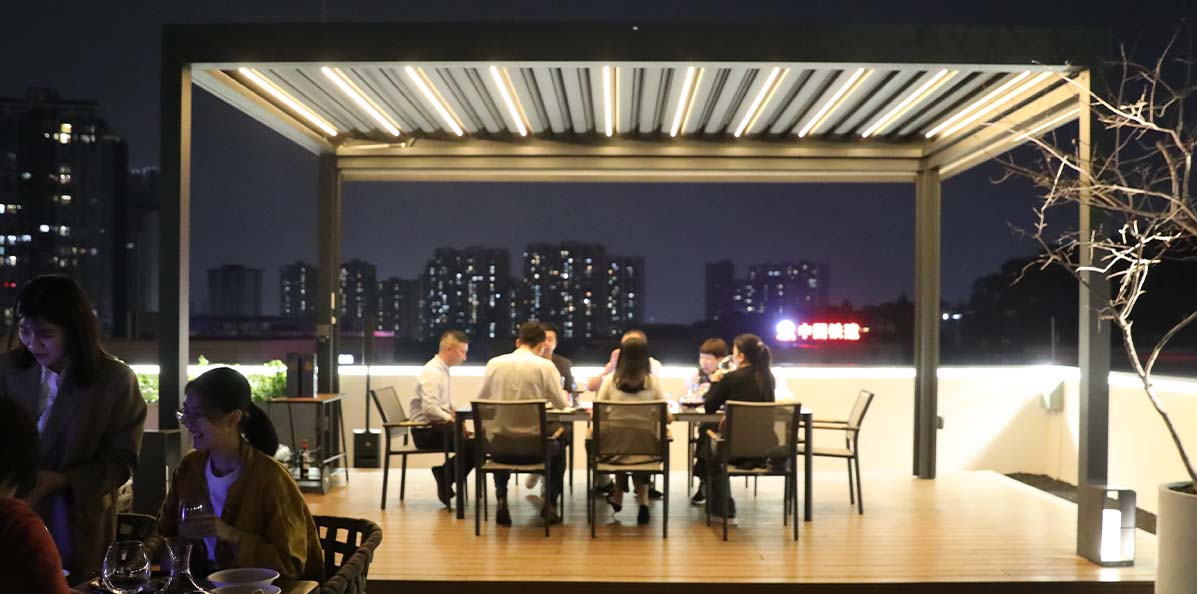
The logical integration of sun sensing into the lighting control architecture creates a seamless user experience: as natural light fades below the dusk threshold, the control system automatically transitions to a pre-configured evening lighting scene without any manual input. This is a feature that resonates strongly with residential buyers and hospitality operators alike — the pergola environment responds to the time of day as naturally as the outdoor space itself.
“The moment guests don’t have to think about the lighting — it just feels right as the evening comes — that’s when the product becomes genuinely premium.”
— Hospitality specification customer, Southern France
For reference on photometric standards relevant to outdoor lighting system design, the Illuminating Engineering Society (IES) outdoor environmental lighting guidelines provide a useful baseline for specifying appropriate illuminance levels across different pergola use cases.
Snow Load Sensors: The Underspecified Risk
Snow load detection was not part of our original sensor specification — frankly, it was not something we had considered necessary until a conversation with a customer from Serbia reframed the problem entirely. He walked us through a real-world scenario that exposed a significant engineering gap in standard pergola control systems.
🏔️ The Mountain Resort Problem
Mountain and ski resort properties across Europe regularly experience one to two metres of snow accumulation in winter. Without an automatic open response, that static load builds directly on the louver slats, and the structural stress exceeds what most standard pergola frames and slat profiles are engineered to handle — resulting in deformation or outright failure.
The compounding factor is that many of these properties are seasonal or vacation-owned, meaning there is no on-site operator to trigger a manual response. A resort pergola that closes in autumn and remains in position unattended through a heavy Alpine winter is in serious structural jeopardy without an automated snow-response mechanism.
Snow Load Sensing Technology
Snow load sensing in automated building envelope systems most commonly uses strain gauge load cells or capacitive pressure sensors mounted at structural connection points to measure the actual weight loading on the louver assembly. A secondary approach uses temperature plus precipitation detection in combination: if the ambient temperature is below a defined threshold and the rain sensor triggers, the control system infers a snow accumulation risk and opens the louvers as a precautionary measure.
The combination approach — temperature + rain — is simpler to implement and more cost-effective than direct load measurement, but it carries the risk of false positives in cold rain events and false negatives in dry snow accumulation scenarios where precipitation has stopped but load continues to build from existing snow. For high-risk installations (large louver spans, heavy winter snowfall regions, unoccupied properties), direct load measurement is the more reliable architecture.
R&D Roadmap: Four-Parameter Integrated Sensor Module
We have added snow load sensing to our formal R&D roadmap, with the objective of developing a single integrated sensor module capable of automatically responding to wind speed, light intensity, rainfall, and snow accumulation — a true four-parameter environmental control system. The goal is to eliminate the need for separate sensor devices and the integration complexity that comes with them, bringing all four environmental inputs into a single hardware module with a unified signal output to the pergola control unit.
For manufacturers specifying pergola installations in mountain regions, the Eurocode 1 (EN 1991-1-3) Snow Loads standard provides the definitive European reference for characteristic ground snow loads by region — essential data for evaluating whether a given installation site warrants snow load sensing as a mandatory specification item.
Wired vs. Wireless Sensors: Choosing the Right Architecture
The wired-versus-wireless question is one of the most practically consequential decisions in a pergola control system specification. It affects installation cost, long-term reliability, maintenance requirements, and — critically — the consequences of a communication failure in a safety-relevant scenario.
The Case for Wired Sensors
Wired sensors eliminate RF signal variability as a failure mode entirely. The signal path is fixed, latency is deterministic, and there is no dependency on battery condition, RF interference from other networks, or structural shielding effects from the pergola frame itself. For wind and snow load sensing — both safety-critical functions where a missed trigger has structural consequences — wired signal paths are the technically preferred architecture.
The Case for Wireless Sensors
Wireless sensors offer genuine advantages in installation scenarios where wiring is impractical: existing structures, rental properties, or deployments where the pergola is sold and installed as a self-contained unit without pre-routed conduit. Modern RF protocols at 433 MHz and 868 MHz (the primary ISM bands used in European automation products) offer reliable performance across typical garden and terrace distances of up to 50–100 metres in open outdoor conditions.
The 868 MHz band used in Z-Wave and some proprietary pergola control protocols offers better building penetration than 2.4 GHz Wi-Fi and is subject to less interference from consumer electronics. The ETSI Short Range Devices technical committee maintains the regulatory framework for both 433 MHz and 868 MHz operation in European markets — a relevant reference for manufacturers exporting sensor-integrated pergola products across the EU.
| Criterion | Wired Sensors | Wireless Sensors |
|---|---|---|
| Signal Reliability | ✔Fixed path, deterministic latency | ⚠RF-dependent; interference risk in dense installations |
| Installation Cost (new build) | ⚠Higher — conduit and labour | ✔Lower — no wiring infrastructure |
| Installation Cost (retrofit) | ✗High — structural penetrations required | ✔Minimal — surface mount or clamp |
| Suitable for Wind / Snow (safety-critical) | ✔Preferred | ⚠Acceptable only with redundancy measures |
| Suitable for Rain / Light (comfort) | ✔Yes | ✔Yes — standard practice |
| System Expandability | ✗Each new sensor requires new wiring run | ✔Add nodes without infrastructure changes |
| Maintenance | ✔No battery replacement | ⚠Battery monitoring required |
| Unoccupied / Seasonal Properties | ✔Recommended | ⚠Battery discharge risk over winter |
🔧 Architect’s rule of thumb: Use wired sensors for wind and snow (safety-critical inputs where a missed trigger has structural consequences), and wireless sensors for rain and light (comfort inputs where a missed trigger is inconvenient but not structurally damaging). In new-build pergola products with designed cable management channels in the extrusion profile, running all sensors as wired is the cleanest long-term architecture.
Integrating Sensors with Lighting Control
Sensor inputs do not only drive louver actuators — they also provide natural trigger events for lighting state changes. A well-integrated system uses weather events and ambient light readings to create fluid, automatic lighting transitions that enhance the user experience without requiring manual intervention.
Rain Event → Lighting Scene
On rain trigger: louvers close, lighting switches to a warm enclosed-ambience scene. When rain clears and post-rain hold timer expires, louvers re-open and lighting reverts to daytime state.
Auto-Comfort
Wind Alert → Safety State
On wind exceedance: louvers close to minimum resistance position, LED circuits dim or hold. System latches in safety state until wind drops below reset threshold for a defined hold period.
Safety Logic
Dusk Threshold → Evening Scene
Light sensor output falling below the dusk threshold triggers automatic transition to the pre-programmed evening lighting scene — no manual input required. Louver angle may also adjust for evening use pattern.
Scene Trigger
High Sun → Shading + Dimming
Bright-sun threshold triggers louver closure to shading position and dims or deactivates overhead LED circuits to reduce glare and heat load under the pergola.
Comfort Auto
The Control Logic Architecture
Implementing this sensor-lighting integration requires the controller to support conditional scene logic: the ability to evaluate a sensor state and execute a defined output command (louver position + lighting scene) as a compound action. Simple on/off relay-based controllers do not support this architecture. A true multi-parameter pergola control system needs a controller capable of handling both analogue sensor inputs and multi-channel output commands simultaneously.
The KNX building automation standard provides a well-established protocol framework for exactly this type of conditional automation logic in European commercial installations. For residential pergola products, purpose-built controllers with native sensor input ports offer a simpler integration path than full KNX implementations.
PergoProMax: An Integrated Four-Parameter Control Architecture
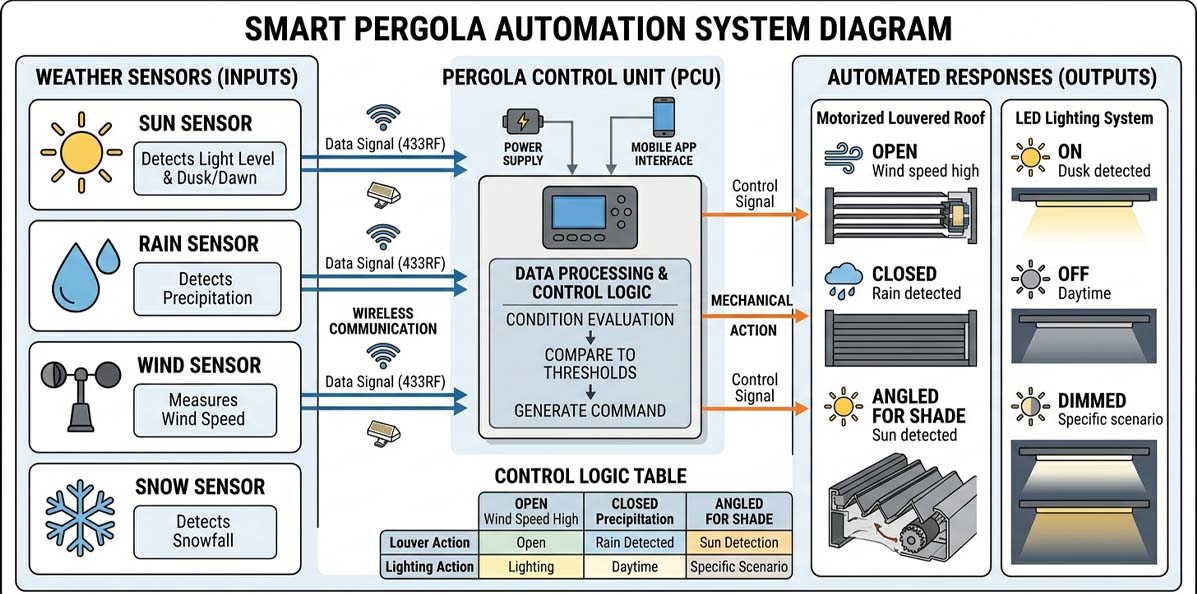
PergoProMax is our most ambitious pergola control architecture to date, and it is currently in active development. The system is being designed to address a core limitation we have consistently observed in the market: fragmented control across multiple independent systems on a single pergola installation.
PergoProMax Architecture Overview (In Development)
On the sensing side, wind, light, and rain sensors will be hardwired into the control unit, ensuring stable, low-latency signal transmission for automatic louver response — removing any RF dependency for safety-critical inputs. On the output side, the architecture integrates single-colour and RGB lighting control, motorised louver management, and curtain actuator control within a single unified platform. All device communication runs over RF 433MHz. The entire system — sensors, lighting, motors, and curtains — is operable from a single remote.
Motor Compatibility as a Design Objective
A key design objective is broad motor compatibility — the system is being engineered to support Somfy, Dooya, and other third-party motor brands without requiring proprietary hardware, which will significantly reduce installation constraints in the field. This is a deliberate response to the fragmentation we observe in the market, where controller lock-in to a single motor brand forces installers to manage multiple remotes and protocols on the same structure.
For reference on motor compatibility considerations, Somfy’s integration partner programme and Dooya’s product documentation outline the RF learning protocols their motors support — relevant background for any manufacturer evaluating multi-brand motor compatibility in their control architecture.
Sensor Parameters
MHz RF Output
Remote for All Devices
Safety Sensor Inputs
Motor Compatibility
Frequently Asked Questions
What is the correct wind speed threshold for triggering automatic louver closure?
The trigger threshold depends on the specific louver assembly’s rated maximum wind speed, which varies by slat width, profile depth, and frame geometry. As a general guideline, set the trigger at 60–70% of the rated maximum to give the actuator adequate time to complete closure before the structural limit is approached. Always set thresholds based on on-site sensor readings rather than regional weather data, as wind speed at 2.5–3 metres height differs significantly from the standard 10-metre meteorological measurement height.
Can I use a wireless wind sensor in a high-rise terrace or rooftop pergola installation?
We recommend caution. Rooftop and high-rise terrace environments frequently involve structural elements that create RF reflection and shadowing — and these are exactly the high-wind-exposure environments where a missed trigger has the most serious consequences. For rooftop installations, a wired wind sensor with a direct, fixed signal path to the control unit is the technically preferred architecture.
Is a rain sensor sufficient for snow protection, or do I need a dedicated snow load sensor?
A rain sensor combined with a temperature sensor can provide a basic level of snow risk detection. However, this approach has known failure modes: it will miss dry snow accumulation events after precipitation has stopped. For high-risk installations in heavy-snowfall regions or at unoccupied seasonal properties, a dedicated snow load sensor or direct load measurement system is the more reliable architecture.
Do sensors from different manufacturers work with any pergola control box?
Not automatically. Sensor compatibility depends on the communication protocol and signal voltage output of the sensor versus what the control box expects at its input terminals. Wired sensors using standard dry-contact (volt-free relay) outputs are the most universally compatible. Proprietary wireless sensors are generally locked to their manufacturer’s control ecosystem.
Is 433 MHz RF compliant across EU, North American, and Australian markets?
433 MHz ISM band operation is permitted for short-range devices across the EU under ETSI EN 300 220, and in the US under FCC Part 15. In Australia and New Zealand, 433 MHz is similarly permitted under the ACMA Short Range Device standard. Exporters to specific markets should verify local type-approval requirements with the relevant national telecommunications authority before shipping sensor-integrated products.

Pingback: Outdoor Kitchen Pergola Control Packages: Lighting, Louvers, Fans, and Sensors
Pingback: Retractable Louvered Pergola Control Systems: Motor, Remote, and Sensor Requirements
Pingback: Integrated Pergola Control Systems: A Manufacturer’s Guide to Louvers, Lighting, and Sensors
Pingback: How Pergola Manufacturers Can Replace Separate Remotes with One Integrated Lighting and Louver Control System
Pingback: Pergola Control System BOM Checklist for Louvered Roof Manufacturers
Pingback: Why Pergola Lighting Controls Fail Outdoors and How Manufacturers Can Prevent It
Pingback: Wind Sensor Thresholds for Pergolas: How to Balance Safety, Noise, and User Comfort
Pingback: Rain Sensor Placement for Motorized Louvered Roofs: Factory and Installer Guidelines
Pingback: Rain Sensor Placement for Motorized Louvered Roofs
Pingback: Snow and Frost Protection Logic for Motorized Louvered Pergolas
Pingback: Actuator and Tubular Motor Control for Pergola Louvers: OEM Integration Guide
Pingback: Designing a Dealer-Friendly Control Kit for Motorized Pergolas
Pingback: What Is a Smart Pergola Control System? A Manufacturer’s Explanation
Pingback: IP65, IP66, or IP67 for Pergola Controllers and Sensors What Really Matters
Pingback: Pergola Controls: A Core Product Feature for Manufacturers
Pingback: The Evolution of Motorized Pergolas: From Simple Remotes to Weather-Responsive Systems
Pingback: Pergola Lighting Controls for Outdoor Kitchens and Dining Areas
Pingback: Smart Pergola Upgrade Packages: Basic Remote, App Control, Sensors, and Premium Lighting