


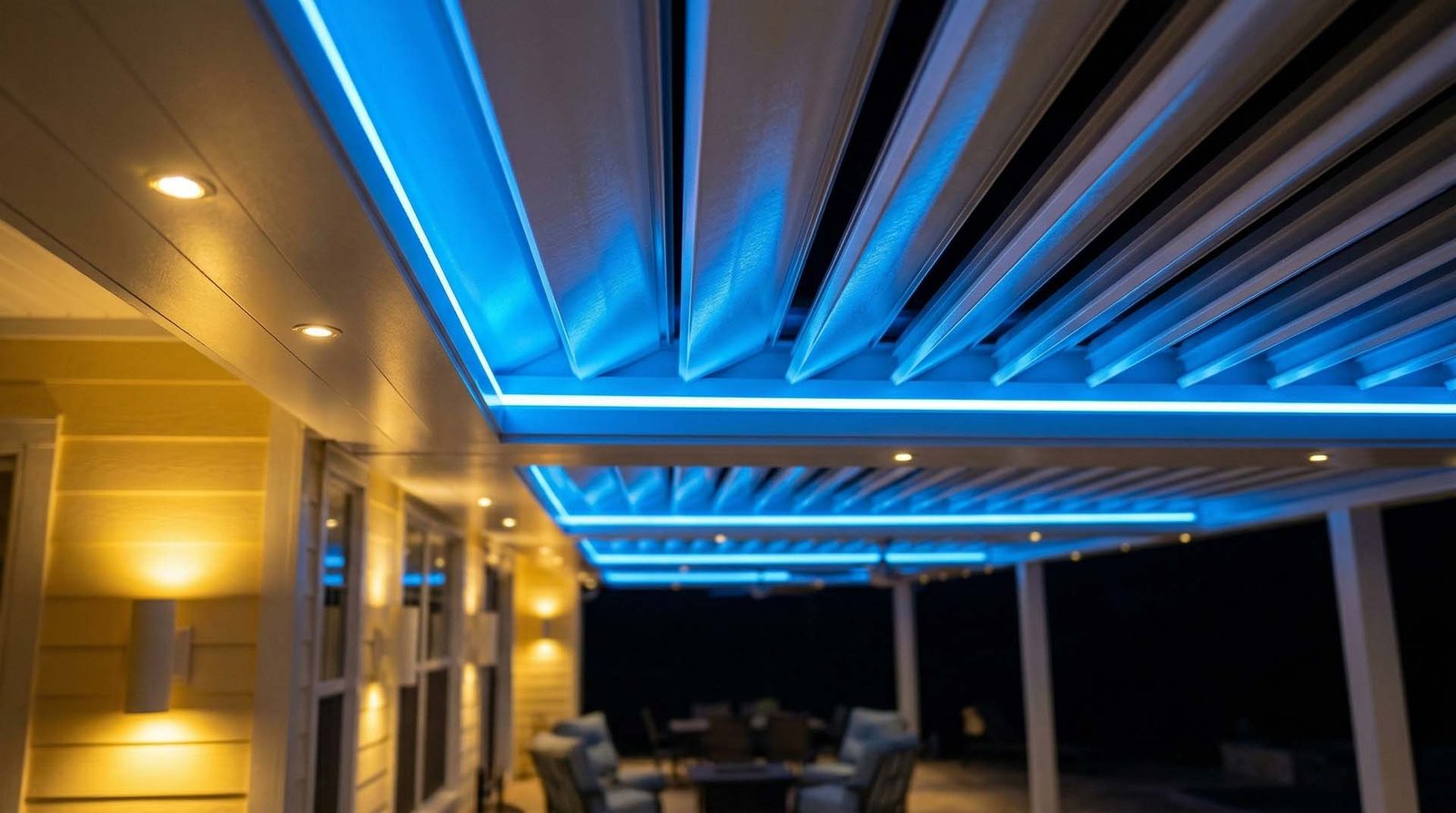
As the design language of high-end outdoor leisure spaces continues to evolve worldwide, the traditional passive shading structure is being reshaped by a profound technological and experiential transformation. By 2026, the bioclimatic pergola has firmly established itself as the central hub of premium outdoor architecture and landscape design. These aluminum structures — engineered with precision mechanical systems whose louvers typically rotate dynamically from 0° to 150° — do far more than intelligently modulate solar angle, encourage natural ventilation, and provide absolute rain protection. They are gradually evolving into “microclimate ecosystems” that integrate precision climate control, premium audiovisual entertainment, and systematic architectural lighting.
Within this evolution, the lighting system has long shed its role as a peripheral accessory. It has risen to become a core dimension that determines the emotional atmosphere of the space, extends the all-day usability of the installation, and directly lifts overall asset value. For brand owners, manufacturers, and high-end custom service providers in the outdoor shading industry (pergolas and gazebos), the central strategic question is now: how do you scientifically and systematically integrate Strip Lights, Spotlights, and Recessed LEDs into the complex structural framework of a pergola at the upstream industrial-design and manufacturing stage? Answering this question correctly is what builds a technical moat and lifts the average order value (AOV). This report deconstructs the underlying logic of these three mainstream lighting solutions across optical characteristics, mechanical architecture, thermal management, smart-control protocols, and photometric standards — offering a forward-looking R&D and application guide for the industry.
Spatial Light Reconstruction: The Optical Hierarchy of a Bioclimatic Pergola
Before systematically evaluating lighting hardware for a bioclimatic pergola, it is essential to first clarify the specific visual and psychological functions that different light sources perform inside an open-air architectural space. Sophisticated architectural lighting is never about stacking light sources; it achieves visual balance through precise hierarchical layering. The industry-standard lighting logic is typically divided into three interwoven layers: Ambient Lighting, Task Lighting, and Accent Lighting. LED strips, spotlights, and recessed LEDs play irreplaceable roles in each of these layers, and their selection profoundly shapes how the user perceives the space.
Ambient lighting forms the visual base layer of the space — it eliminates harsh shadows and provides baseline navigational visibility. Task lighting demands very high illuminance and color rendering and serves focused activities such as cooking or reading. Accent lighting is intentionally dramatic, used to outline architectural geometry or accentuate landscape textures. In the symphony of these three optical layers, the manufacturer’s hardware choices directly determine the ceiling of the final spatial experience delivered to the end user.
Strip Lights: Linear Aesthetics and an Engineering Revolution in Ambient Lighting
With their exceptional physical flexibility, continuous light output, and outstanding energy efficiency, LED strips have become — without dispute — the most popular and foundational ambient-lighting option for bioclimatic pergolas. Their core optical advantage lies in producing an extremely uniform, soft, and shadowless continuous glow, which perfectly satisfies the demanding modern-minimalist aesthetic of “seeing the light without seeing the source.”
Structural Innovation in Mounting and the Evolution of Dedicated Aluminum Channels
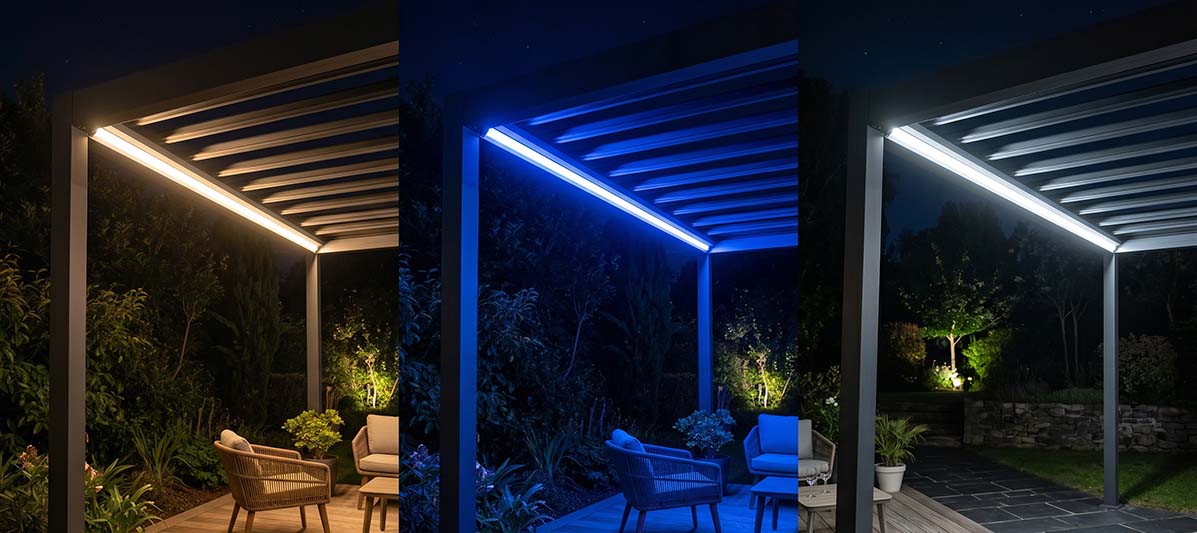
In real-world OEM manufacturing and system integration, the mounting position and fixing method of an LED strip is where a manufacturer’s engineering depth becomes obvious. Traditional approaches often stick the strip directly to a metal surface with adhesive backing — which, when exposed to extreme outdoor temperature swings and high humidity, easily leads to glue aging, peeling, and rapid lumen depreciation. Through deeper industrial design, LED strips are typically installed inside the pergola’s gutter channel or in extruded grooves on the main beam, or by adding a dedicated LED strip aluminum channel to the pergola — enabling a far more stable, photometrically predictable installation inside the gutter.
Different aluminum channels not only provide physical protection; their internal reflector geometry and external diffusing covers also precisely shape light distribution — for horizontal wash or upward wall-grazing. This flexibility gives designers significant creative range. To address this long-standing engineering pain point in the industry, we have developed two innovative dedicated channels for the pergola strip-lighting category (see our pergola lighting kits) that achieve seamless and efficient strip integration. Through a pre-extruded aluminum track, the strip is safely encapsulated — solving installation durability concerns at the root — while a custom polycarbonate (PC) diffuser converts the harsh point-source LEDs into a silk-smooth linear wash.
COB Technology and the Underlying Logic of Polymer Sealing
Looking upstream at component-level specifications, high-density COB (Chip-on-Board) LED strips are replacing traditional SMD (Surface-Mounted Device) strips at an astonishing pace. By performing ultra-high-density flip-chip placement on PCB substrates with double- or even quadruple-ounce copper foil (integrating, for example, 480 to as many as 840 LED chips per meter), COB technology physically eliminates the cheap “dotting” or “pixelation” that traditional strips produce at close range or in reflected light.
In addition, outdoor-rated LED strips must survive brutal weathering. A simpleIP20 or IP44 ingress rating is nowhere near sufficient for a custom pergola that requires field cutting (For more detailed information on water resistance, please refer to “IP Rating Guide for Outdoor Pergola Lighting & Control Components: IP44 vs IP65 vs IP67?”). The moment the strip is cut to fit a specific beam length, the factory waterproof seal at the cut end is instantly compromised. The professional integration standard requires installers to re-seal every cut with industrial-grade clear RTV silicone together with dedicated silicone waterproof end caps, and to wrap every solder joint with adhesive-lined heat-shrink tubing for double insulation. This is the only way to truly block condensation from reaching the internal circuitry.
Spotlight & Recessed LED: Precision-Controlled Task and Accent Lighting
Unlike the wide-angle diffusion pursued by LED strips, spotlights and recessed LEDs are engineered to deliver high-intensity, highly focused directional light — the canonical role of task and accent lighting. In the mechanical ecosystem of a top-tier bioclimatic pergola, spotlights and recessed downlights are both physically compact and are typically mounted directly on the rotating louvers, or discreetly arranged along the supporting columns and the edges of the main frame.

Mechanical and Electrical Engineering Challenges of Louver Integration
Integrating lighting hardware into pergola louvers represents the current pinnacle of outdoor-shading manufacturing. Because brise-soleil blades must rotate from 0° to 150° in response to sunlight and rainfall, any external cabling attached to them will suffer from metal fatigue or even short-circuit fracture under sustained mechanical shear.
For this reason, top manufacturers reserve precisely engineered hollow cable channels inside the louver at the aluminum-extrusion tooling stage. Compact recessed spotlights are then snap-fit or threaded directly into pre-machined apertures. To preserve the minimalist exterior geometry of the pergola, the entire wiring system is concealed inside the louver cavity and the structural struts running along both sides. To bridge the rotating pivot between louver and main beam, engineers must use specialty flexible cables with extreme tensile and torsional fatigue resistance — typically silicone-jacketed — combined with dedicated waterproof rotary connectors, ensuring rock-solid power transmission from the static beam to the dynamic louver.
The Optical Balancing Act of Illuminance Distribution and Glare Control
This kind of embedded zenithal lighting produces a strikingly dramatic vertical cone of light. When the pergola shelters professional outdoor kitchen equipment (stainless-steel grills, prep stations) or a premium teak dining table, this high-intensity downlight delivers the surface illuminance and visual clarity that fine knife work and reading absolutely require.
But high intensity carries high risk. The narrow beam angles typical of spotlights (usually 15° to 40°) easily produce intolerable direct glare if poorly aimed — destroying the relaxed mood of an evening on the patio. Professional recessed spotlights therefore use deep-recessed black baffle reflectors, or are paired with honeycomb louvers, ensuring light lands on the working plane while the bright source remains invisible from a normal seated sight line.
Lighting Types and Manufacturing Dimensions: A Structured Comparison
To give brand owners and manufacturers a more direct technical decision framework, the table below details the core differences between the three lighting solutions across optical performance and manufacturing integration:
| Evaluation & Manufacturing Dimension | LED Strip (with dedicated aluminum channel) | Recessed LED Spotlight (louver-mounted) | Surface-Mounted Spotlight (column / wall) |
|---|---|---|---|
| Photometric Role | Foundational ambient light; sets the emotional baseline of the space | Vertical task light; high-clarity illuminance on the work plane | Accent / landscape lighting; sculpts architectural and botanical texture |
| Typical Mounting Position | Inside the gutter, pre-extruded grooves in the main beam, perimeter edges of the deck | Inside the dynamic louver profile or on the flat underside of the main beam | Static columns, adjacent exterior walls |
| Beam Form / Distribution | 120° wide-angle continuous diffusion; uninterrupted linear glow | Narrow downward cone (15°–40°) | High-intensity, multi-axis adjustable directional beam |
| Assembly & Integration Complexity | Moderate — depends heavily on channel fit and proper end-cut sealing | Very high — requires across-pivot wiring and high-frequency micro-vibration resistance | Lower — mature hardwiring and surface-bolt mounting |
| Glare Control (UGR) | Very easy — PC diffuser and diffuse reflection naturally tame the source | Harder — depends on deep-baffle optics and louver angle | Hardest — needs physical shielding and precise aiming |
| Thermal Dissipation Path | Heavily reliant on the aluminum channel and the pergola’s main frame as a passive heat sink | Reliant on die-cast aluminum body fins and louver-cavity airflow | Reliant on the fixture’s own all-metal housing for convective cooling |
| Manufacturing Cost | Low to moderate; material cost is easily amortized at scale | Very high; tooling investment and complex assembly labor | Moderate; fixed hardware cost, moderate install labor |
The Philosophy of Light Direction: Uplighting vs. Downlighting
Having examined the physical form of each light source, we now need to look at how the direction of light projection deeply shapes both the psychology and physiology of the outdoor space. The directional choice is often what separates a pergola project that reads as “high-end and luxurious” from one that feels “cheap and temporary.”
Uplighting: The Restrained Aesthetic of Diffuse Reflection
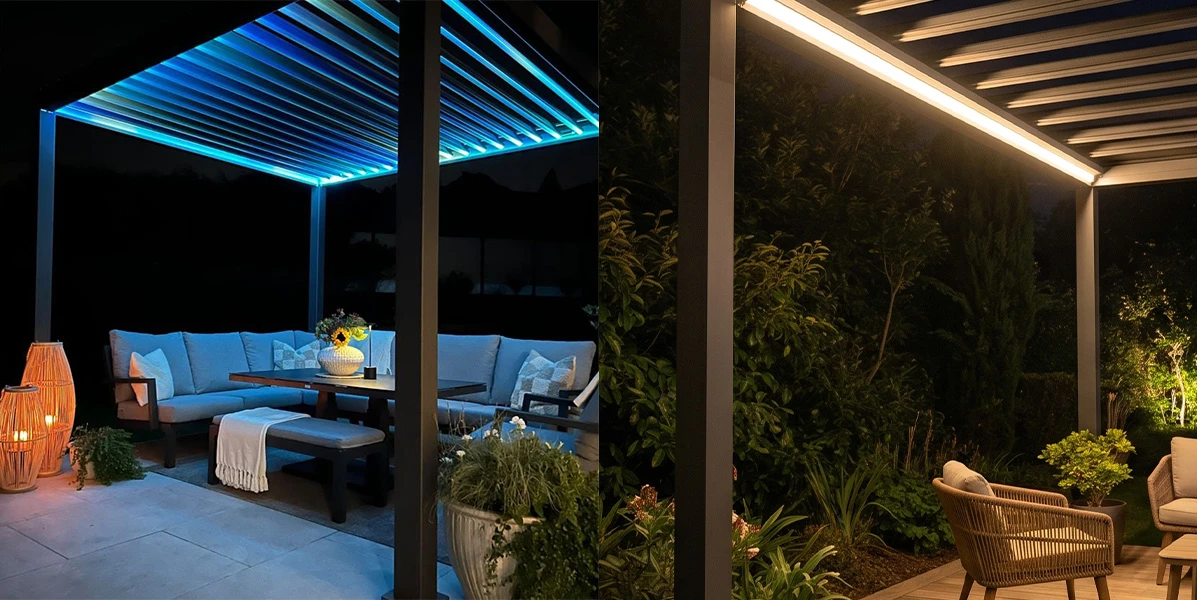
Uplighting is a highly restrained, spatially expansive photometric strategy that always reads as upscale. In the specific context of a bioclimatic pergola, dedicated up-firing strip channels are installed inside the main beam or along the gutter — the light is never directed at the user’s eyes but instead aimed at the aluminum louver array overhead.
When the louvers are fully or partially closed, the entire undulating aluminum roof surface instantly becomes a giant, richly textured secondary reflector. Light striking the matte powder-coated aluminum surface undergoes a soft diffuse reflection and cascades down into the activity area below like sheer silk. The genius of this indirect lighting design is that it physically eliminates the visual oppression and glare that any direct source can produce. The reflected light is exquisitely soft and forgiving, never casts harsh artificial shadows, and is ideally suited to dinner parties, deep conversation, or meditative ambience — anywhere intimacy and relaxation matter. Viewed from outside, uplighting also visually lifts the perceived vertical height of the pergola, making an otherwise heavy metal structure feel light and almost floating at night.
Downlighting: The Pragmatic Boundary of Clarity
In direct contrast to the moody ambience of uplighting, downlighting is about establishing pragmatic spatial boundaries and absolute safety. Mounted under the beams or recessed directly into the louvers, downlights drive their beam through the air and onto the ground or worktop with full force.
This direct light defines the texture of stone paving, the silhouette of outdoor furniture, and the edge of every step with razor sharpness — the single most important optical means of ensuring nighttime safety and security. For flagship pergolas with a full outdoor kitchen, a premium grill island, or a large dining area, sufficient vertical downward illuminance is a non-negotiable baseline. The best contemporary outdoor lighting designers never confine themselves to a single direction — they precisely layer ambient diffuse uplight (as a baseline mood) with focused downlight (as functional reinforcement), creating a three-dimensional outdoor lightscape that is both maximally functional and visually deep.
Electrical Engineering and Thermal Architecture for Harsh Outdoor Environments
Exposing fragile electronic components to volatile outdoor weather is a slow, unending war. For pergola manufacturers, electrical reliability is a direct stand-in for brand longevity. UV-driven polymer degradation, thermal expansion and contraction from large temperature swings, the physical force of wind and rain, and the chemical corrosion of coastal salt spray all pose lethal threats to the long-term survival of any lighting system.
Step-Down Safety and Cable Management
In an all-metal pergola structure that humans and moisture can readily touch, electrical safety is a non-negotiable red line. The U.S. National Electrical Code (NEC, NFPA 70) — together with most mainstream international building codes — strongly recommends, and often mandates, low-voltage distribution for outdoor structures accessible to people.
All LED arrays inside a bioclimatic pergola (strips and spotlights alike) should run on a 12 V or 24 V DC architecture — full stop. Compared to bringing in 110 V or 220 V AC mains directly, low-voltage DC offers absolute safety: even if a cable’s insulation is accidentally cut and the exposed copper shorts to the aluminum frame, no one touching that frame is at risk of fatal shock. In system planning, the unavoidable problem of voltage drop over long runs gives 24 V a decisive advantage over 12 V. The higher drive voltage suppresses current attenuation along long conductors, so the very last LED at the end of a 20-foot beam still maintains the same brightness and color temperature as the first — no cheap-looking dim zones.
Compliant, professional OEM integration requires that all AC-DC converters and wireless control hubs be centrally housed inside a purpose-designed beam chase (with ventilation but rain-blocked) or an external NEMA-rated waterproof enclosure — preserving easy serviceability for a decade or more.
Aluminum Passive Thermal Management as Applied Physics
At the semiconductor level, LED lumen maintenance is strongly negatively correlated with the junction temperature of the emitter. If heat cannot be conducted away rapidly and effectively, the phosphor layer ages irreversibly — producing the dreaded color shift where a premium warm white drifts toward cheap green or blue — and chip lifetime collapses by a multiple.
Fortunately, the high-strength extruded aluminum profiles used in bioclimatic pergolas (typically 6063-T5 aerospace-grade aluminum) are not just rigid structural elements — they are also outstanding thermal conductors. The deepest engineering meaning of the dedicated LED strip channel discussed earlier is not just mechanical retention or aesthetics — it is a highly effective passive heat-spreading system. The high thermal conductivity of the channel rapidly draws dense heat away from the back of the strip and conducts it seamlessly into the pergola’s vast, cool main frame. Using the building’s total surface area for natural convection with night breezes, even a high-brightness task strip running at full power can hold extremely stable lumen maintenance through a hot summer outdoors. Leveraging the building’s own physics for thermal management is exactly the kind of detail that separates premium manufacturers from mediocre competitors.
Smart Connectivity: Extending the Whole-Home Ecosystem Outdoors
By 2026, the era of controlling lights with a standalone wall switch is over. Consumers no longer accept isolated devices. As the leading edge where the premium smart home extends into the natural outdoor environment, a bioclimatic pergola’s lighting and climate-control systems must speak fluently with the larger building automation stack.
The Dominance of Closed-Loop Control Systems
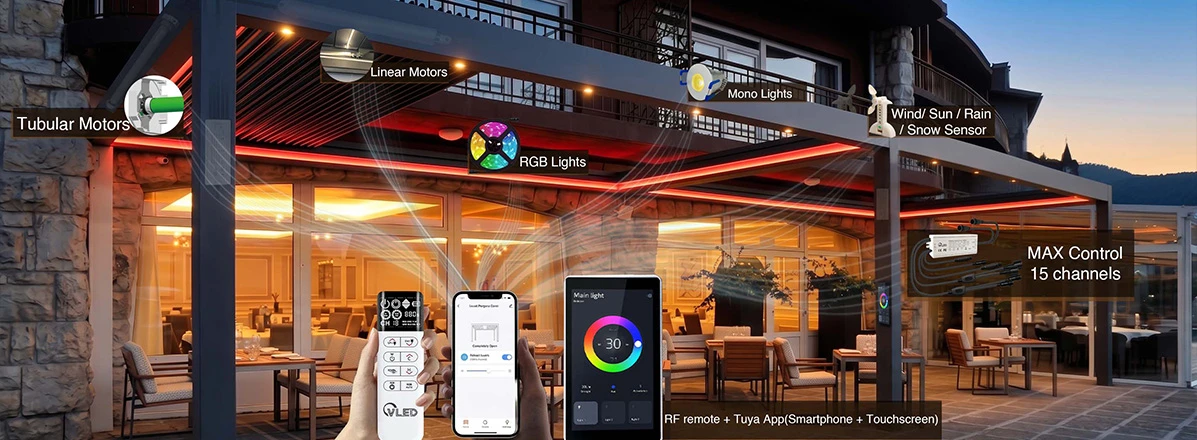
After years of development and accumulated field experience, our pergola control systems offer powerful, deeply integrated functionality in the professional outdoor-shading category. These highly integrated systems creatively unite louver-rotation motors, zip-screen motors, and LED dimming drivers under a single computing and control core.
To give a concrete scenario: by configuring our pergo pro max professional control system, an end user can use a smartphone app or a single elegant physical remote (such as a Tuya-protocol device) to simultaneously dim the lights (0%–100%) and rotate the louvers with extremely low latency, and even define complex scene automations. When a sensor detects an incoming storm, the system can trigger “storm protection mode” within one second: louvers slam shut to waterproof the canopy, perimeter zip screens drop automatically, and the warm-white strip along the main beam fades up to a 40% safety glow — giving everyone sheltering underneath an instant sense of psychological safety. This kind of mature, resilient OEM-grade turnkey automation dramatically reduces a pergola manufacturer’s R&D cost on low-level firmware.
Circadian Lighting and Tunable White as Applied Optical Biology
Frontier lighting design is now introducing a biological dimension. Light is no longer a binary on/off parameter. With tunable white technology in high-end LED controllers and multi-channel RGBW strips, the color temperature of ambient light inside a pergola can be transitioned smoothly along a continuous gradient. Paired with AI-driven astronomical clocks and circadian-lighting algorithms, color temperature and illuminance can automatically and continuously mirror the spectral progression of natural sunlight from dawn to dusk. Mid-afternoon, the light holds at a crisp 4000 K neutral white to sustain alertness; late at night, the system slowly drifts down to 2700 K or lower — physiologically suppressing cortisol, promoting deep relaxation and melatonin release. This fusion of optics, psychology, and IoT is becoming a core value anchor of luxury outdoor projects in 2026.
Industry Photometric Standards and the Optics of Surface Interaction
Having explored hardware and software innovation, manufacturing and design must return to the most basic physical standards of lighting engineering. A commercial, scaled-up product line means every pergola has to meet strict optical and electrical compliance. This is not just a defense against engineering claims and legal risk — it is the mandatory ticket of entry to municipal permits and large commercial bids (luxury resort terraces, Michelin-starred patios, top golf clubs).
IES Standards for Outdoor Illuminance
The Illuminating Engineering Society (IES) — together with national standards bodies — has set rigorous minimum and recommended illuminance thresholds for every category of outdoor space. When designing the initial light-distribution model for a pergola, engineers must not chase rendered glamour alone — they have to make sure the effective lumens actually delivered to the ground meet real-world performance demands.
According to the latest IES guidance, a residential patio or commercial terrace used for general social interaction, dining, and leisure should maintain an average horizontal illuminance on the ground of roughly 10 to 20 foot-candles (approximately 100 to 200 lux). Anything below that lower bound creates blind spots at steps and table edges — a serious trip-and-fall hazard. Conversely, brute-forcing the design with oversized fixtures and overshooting illuminance produces uncomfortable glare and serious light pollution that harms neighboring ecosystems and the people next door.
For these reasons, serious manufacturers send their fully assembled louver and beam modules — already populated with strips and spotlights — to a third-party photometric lab for distribution testing on a goniophotometer or integrating sphere, producing authoritative LM-79 and LM-80 reports for lumen maintenance and luminous efficacy. Only this documentation lets an architect or contractor verify that, after factoring in the physical obstruction of the aluminum profiles, the system still lands the ground-plane illuminance squarely inside the legally permitted target zone.
Material–Optics Interaction: How Light Reacts to Surface Texture
Finally, an excellent lighting integration must account for the optical chemistry between light and the pergola’s construction materials — the absorption and reflection that defines what the eye actually sees.
Powder-coated metal: The body of a bioclimatic pergola is aluminum. Powder-coated metal surfaces have meaningfully high reflectivity. As discussed earlier, the aiming angle of any directional spotlight must be handled with care — favor diffuse reflection or active glare control — to avoid producing hot specular spots on bright metal and to keep the light spread even.
Wood accents: Some hybrid pergolas wrap or splice rot-resistant wood into the main beams for natural warmth. Because wood is a natural light absorber, its dark surface swallows a lot of output. In this material mix, the lighting engineer needs to dial up strip power density appropriately, or pack in extra recessed spots to wash the wood surface — effectively waking up its deep, warm grain.
Translucent materials (glass / polycarbonate): Some pergolas use glass or polycarbonate panels above the louvers or on the side walls. These materials are excellent light-mixing media in their own right. By tucking LED strips along their structural edges, you can use the material’s own total internal reflection and refraction to make the entire panel glow with a crystalline, ambient luminescence at night — creating a refined, almost sci-fi, non-invasive lighting effect.
Conclusion
Looking across the evolution of the entire category, the bioclimatic pergola has gone from a static piece of shading hardware that simply blocks sun and rain to a fully technology-augmented vehicle for premium outdoor living. A thoughtful, deeply integrated lighting system is the single most important catalyst behind that upward leap.
Having systematically deconstructed and compared LED strips, directional spotlights, and recessed LEDs across multiple dimensions, the conclusion is unambiguous: in the complex ecosystem of outdoor lighting, no single “perfect light source” can do the entire job. Leading commercial R&D practice has made it absolutely clear: the only correct path to a top-tier outdoor space is a hybrid lighting strategy that combines channel-mounted diffused strip light (delivering the warm baseline mood), recessed louver-mounted spotlights (delivering precise functional illuminance), and intelligent orchestration that ties them together.
For brand owners, manufacturers, and high-end custom contractors in the outdoor-shading industry, the cowboy era of relying on the end user or a third-party electrician to bolt cheap fixtures onto a finished pergola in the field is over. Manufacturers must pull lighting deep into their core R&D agenda — photometric calculation models, aluminum-extrusion-based thermal design, concealed weatherproof cable channels, and smart-home-ready drive modules — and complete a thorough “systemic hardcore integration” at the extrusion and pre-assembly stages.
This not only collapses the field rework risk caused by missing standards down to near zero with very low marginal cost — it also defends the pure minimalist architecture of the pergola at its source. In the face of this irreversible industry shift, actively embracing and owning the deep fusion of hardware and luminous environment — for example, by adopting the latest dedicated pergola aluminum channel strip-light kits available on the market — opens up a rich, high-frequency, high-margin revenue stream and builds a technical and brand moat that competitors will struggle to cross in the global outdoor-shading market. Take action: let every inch of precision-extruded aluminum, reshaped by light, redefine what luxury outdoors means.

Pingback: Commercial Pergola Projects: Lighting & Control Specs for Restaurants, Hotels & Resorts