


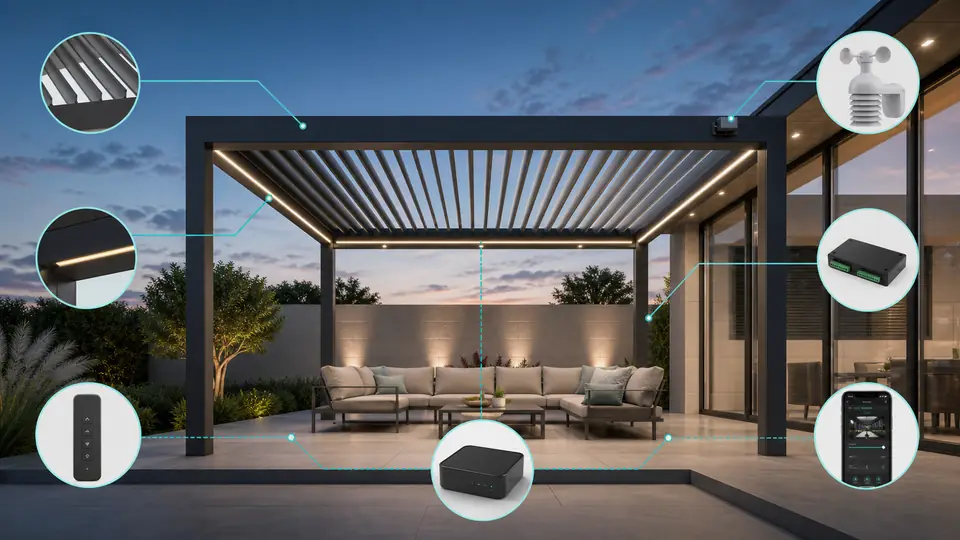
A pergola control system is no longer a small electrical add-on hidden at the end of the bill of materials. For manufacturers selling motorized louvered pergolas, it has become the product’s operating system: the layer that decides how the roof moves, how the lights behave, how the structure responds to weather, and how much support work your dealers inherit after installation.
That shift changes the sourcing question. The issue is not simply whether a remote can open louvers or dim LEDs. The real question is whether the complete control architecture is stable enough to be repeated across models, climates, dealer teams, and future smart-home expectations.
Key Takeaways
- Manufacturers should treat controls as a standard platform, not a project-by-project accessory.
- Louvers, lighting, and sensors need one shared logic hierarchy to avoid conflicting commands.
- Waterproof wiring, labelled channels, and serviceable pairing matter as much as app features.
- The strongest OEM strategy is to own the specification, even when electronics are sourced from a specialist partner.
Why Should Manufacturers Rethink Pergola Controls?
Manufacturers should rethink pergola controls because the control system now defines perceived product quality as much as the aluminium frame. Search results for smart pergolas focus heavily on comfort features, but OEM buyers need a deeper answer: how to make those features repeatable, safe, serviceable, and profitable.
Most public content about smart pergolas is written for homeowners. It talks about convenience: tap the phone, close the louvers, change the lighting color, or let a rain sensor react automatically. That content reflects real market demand, but it misses the manufacturer’s risk.
For an OEM, every extra function adds operational responsibility. A rain sensor that closes too late becomes a complaint. A lighting channel that flickers becomes a warranty claim. A remote that loses pairing becomes a dealer training issue. A controller that only works with one ecosystem can block a sale to a builder, hotel, or distributor.
This is why integrated control deserves board-level attention inside a pergola company. It affects product line planning, installation time, electrical certification, spare parts, dealer documentation, and the premium price a brand can defend.
If your product roadmap already includes motorized roofs, lighting, fans, heaters, screens, or connected apps, the control system is not a late-stage option. It is the architecture that holds the pergola offer together.
What Should an Integrated Pergola Control System Actually Control?
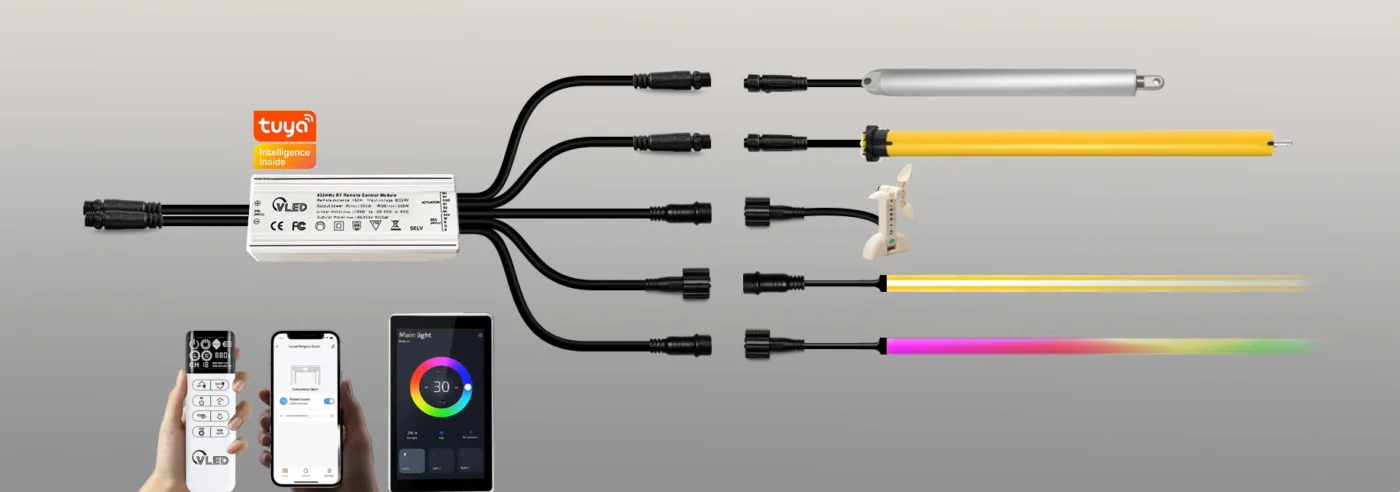
An integrated pergola control system should coordinate motion, lighting, sensors, power distribution, and user interfaces from one planned architecture. A strong system does not merely combine components in one box; it defines how each component behaves when commands, weather inputs, and user expectations compete.
At minimum, a manufacturer-grade system should control four categories.
1. Motion control
Motion control covers louver rotation, retractable louver travel, zip screens, curtains, and sometimes actuated side elements. It must handle limit positions, obstruction strategy, motor direction, grouped movement, and manual override.
The louver channel is the most sensitive part of the system because it moves structure. A lighting fault annoys the customer. A motion fault can damage components, trap water, or create a safety concern.
2. Lighting control
Lighting control includes single-white LEDs, tunable white, RGB, RGBW, spotlights, strip lights, wall lights, and zone dimming. For OEM programs, lighting must be designed with driver capacity, voltage drop, waterproof connectors, channel naming, and thermal placement in mind.
A useful starting point is the product architecture described in VLEDSTAR’s pergola lighting and smart control kit page, where lighting, accessories, drivers, and controls are treated as one product system rather than scattered parts.
3. Sensor response
Sensor response includes rain, wind, sun, temperature, snow, and sometimes light-level detection. Sensors should never be treated as simple triggers. They need thresholds, delays, priority rules, and service settings that match the structure’s actual mechanics.
A separate weather module can be technically impressive and still cause field problems if it is not matched to the louver geometry, drain path, and motor timing.
4. User interfaces
User interfaces include RF remotes, wall switches, handheld multi-channel transmitters, app control, voice assistants, building automation relays, and hospitality-grade central control. The best interface stack gives daily reliability first and smart-home flexibility second.
A homeowner may love app control. A hotel manager may prefer wall panels and zone groups. An installer may need a simple pairing procedure with no cloud dependency. The system should support all three without turning every order into a custom engineering project.
How Should Louvers Be Prioritized in the Control Logic?
Louvers should receive priority because they affect shelter, water management, motor load, and user safety. Lighting can follow scene logic, but louver movement needs stricter rules: confirmed direction, calibrated limits, weather override, and predictable recovery after power loss or signal interruption.
For manufacturers, the louver question starts before electronics. The control supplier needs to understand whether the roof uses linear actuators, tubular motors, synchronized multiple motors, retractable blades, or mixed louver and screen movement.
A simple open-close command is not enough. A professional louver control package should define:
- Motor type, voltage, current profile, and starting load.
- Open, close, stop, and preferred intermediate positions.
- Limit switch behavior and calibration procedure.
- Safe response after rain, wind, snow, or overload signals.
- Manual operation options for service and power interruption.
- Group control rules for multi-bay installations.
This is where many smart pergola projects become fragile. The app may look polished, but the field reliability depends on low-level motion behavior that homeowners never see. If two motors drift, if a limit is misread, or if the command hierarchy is unclear, the brand suffers.
Manufacturers planning retractable or motorized louver programs should compare their BOM against the hardware list in this louvered pergola control hardware guide. It is a practical reference for deciding what must ship as standard rather than optional.
Why Is Lighting More Than an Aesthetic Option?
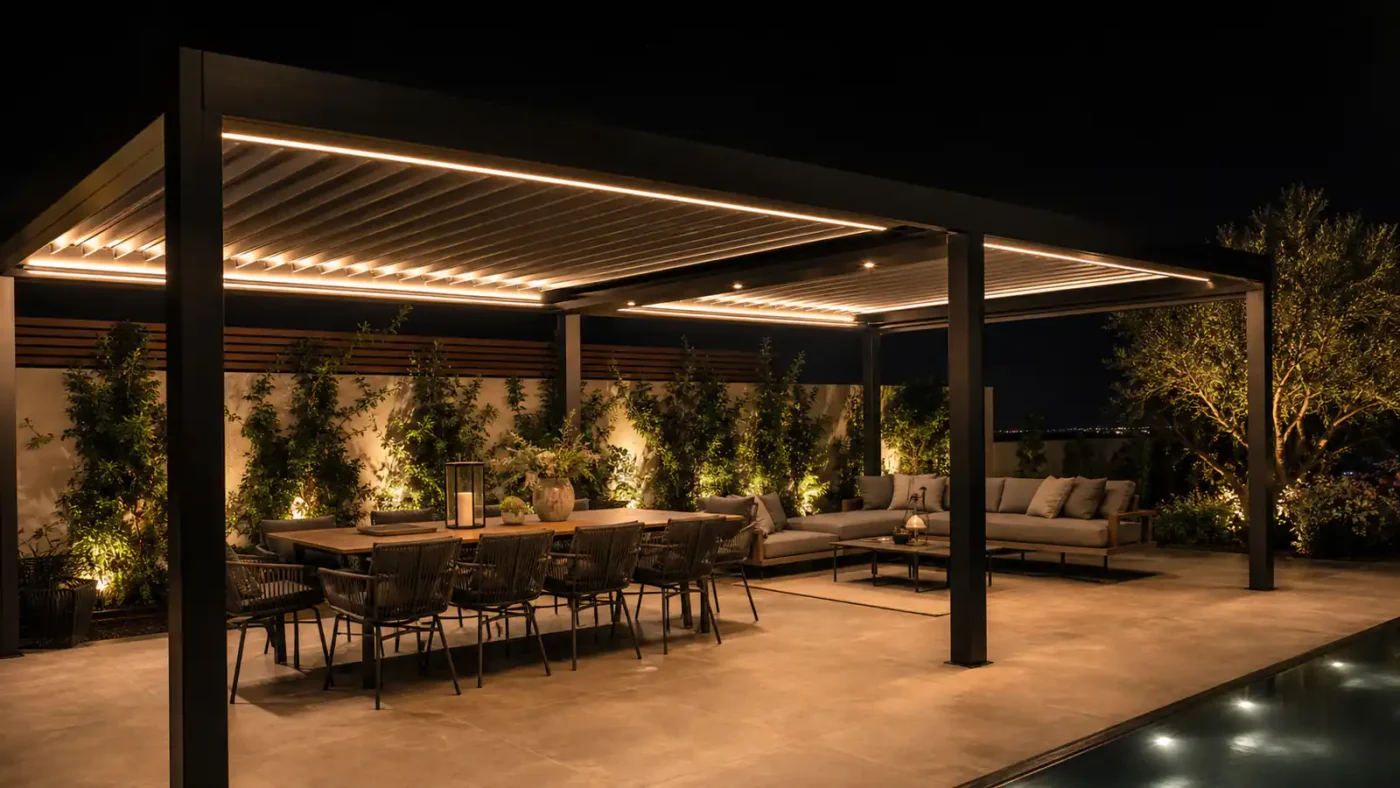
Lighting is more than an aesthetic option because it changes installation labor, product differentiation, and the perceived value of the pergola after sunset. For OEMs, integrated lighting should be engineered as a controlled electrical package, not selected as a decorative accessory during final assembly.
Lighting is often the fastest way to make a pergola feel premium. But it is also one of the easiest places to create inconsistency. Different strip lengths, mixed driver brands, poor connector discipline, and unclear channel mapping can make the same pergola model behave differently from one dealer to another.
A manufacturer-grade lighting system should answer five questions before the first sample is approved.
| Design Question | Why It Matters | OEM Decision |
|---|---|---|
| Which lighting zones are standard? | Standard zones simplify wiring, manuals, remote labels, and dealer training. | Define roof, beam, post, wall, and accessory channels early. |
| Which LED type fits the product tier? | Single white, CCT, RGB, and RGBW serve different price and experience levels. | Use one spec per product tier to avoid scattered inventory. |
| How will power be distributed? | Long runs can create voltage drop and uneven brightness. | Plan driver location, cable gauge, and splitter topology. |
| How is dimming controlled? | Driver and controller mismatch causes flicker or limited dimming range. | Validate dimming before launch, not after field complaints. |
| How are connectors protected? | Outdoor failures often start at cable exits and junction points. | Use rated connectors and repeatable assembly procedures. |
For outdoor electrical design, ingress protection needs to be specified carefully. The Sistema de clasificación IP de la IEC describes protection against solid objects and water ingress. In pergola projects, the practical question is not only the rating printed on a component. It is whether the whole installed path keeps water away from vulnerable contacts.
Manufacturers can use VLEDSTAR’s IP rating guide for outdoor pergola lighting and control components to align product choices with real installation zones, including sheltered beams, gutter-adjacent areas, exposed posts, and cable connection points.
How Should Rain, Wind, Sun, and Snow Sensors Behave?
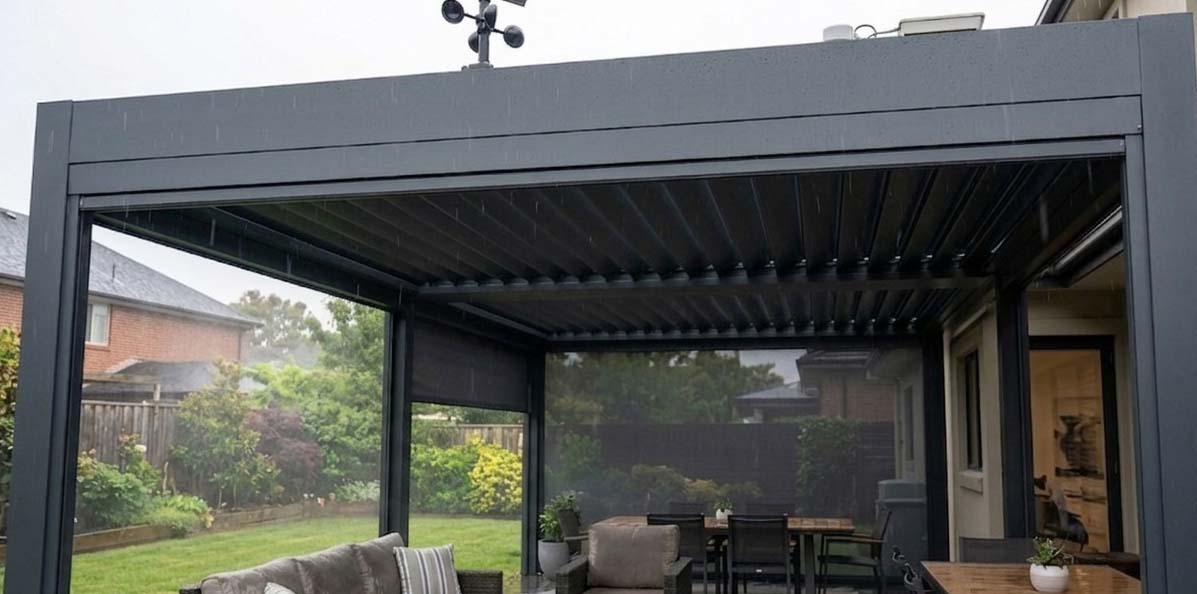
Sensors should behave according to a clear priority hierarchy, not as equal inputs. In a pergola control system, wind protection and snow load response usually deserve higher priority than comfort scenes, while rain response must match the roof’s drainage design and closing time.
The mistake is to sell sensors as magic. A rain sensor does not make a pergola waterproof by itself. It detects a condition, sends a signal, and relies on the controller, motor, louver position, and gutter design to finish the job.
That means manufacturers should define sensor logic in the same engineering review as the roof system. Important decisions include:
- Whether rain closes louvers fully or moves them to a drainage position.
- Whether high wind opens, closes, retracts, or locks movement based on structure type.
- Whether sun input changes louver angle, lighting scene, or both.
- Whether snow or low-temperature logic disables movement until conditions are safe.
- How long the system waits before reacting, resetting, or accepting manual override.
The same sensor can be right or wrong depending on the roof. A louvered roof with strong gutters may close during rain. A retractable fabric or blade system may need a different wind strategy. A restaurant terrace may require manager override for service reasons, while a residential system may prioritize automatic protection.
For a deeper implementation view, see the guide on integrating rain, wind, and sun sensors with pergola louvers. It is especially useful when defining sensor placement, wireless signal planning, and automation behavior for OEM kits.
Which Interface Stack Works Best for OEM Pergolas?
The best interface stack uses RF or wired control as the reliable base, then adds app and voice control where they improve the user experience. Manufacturers should avoid making cloud connectivity the only way to operate core louver and lighting functions.
Smart-home expectations are rising. The Connectivity Standards Alliance’s Matter standard exists to improve interoperability across smart-home ecosystems, and many homeowners now expect devices to work across major platforms. That expectation is real, but outdoor pergola control has different reliability needs from indoor lighting.
A robust OEM stack usually has layers.
Layer one: local control
Local control should operate louvers and essential lighting without the internet. This may be RF, a wall switch, dry contact, or another local method. It gives installers a dependable commissioning path and gives users confidence when Wi-Fi is weak outdoors.
Layer two: grouped and scene control
Grouped control lets a user manage multiple zones: louver bay one, louver bay two, warm white lights, RGB accent lights, screens, and fans. This matters in commercial pergolas and larger residential systems where one button cannot represent the whole installation.
VLEDSTAR’s multi-zone pergola lighting control guide shows why channel planning matters when the system must manage several pergolas or multiple functions from one controller.
Layer three: app and ecosystem control
App control is valuable when it handles schedules, naming, scenes, firmware settings, and integration with wider outdoor living packages. It should not be the only interface for daily operation, especially in hospitality sites or dealer showrooms.
The most durable control strategy is not “RF versus app” or “voice versus wall switch.” It is a hierarchy where each interface has a clear role.
How Should Manufacturers Think About Somfy, Nice, Teleco, Tuya, and Matter?
Manufacturers should think in terms of compatibility policy, not brand attachment. Somfy, Nice, Teleco, Tuya, Matter, RF, and wired inputs each solve different problems. The OEM task is to decide which integrations are standard, optional, documented, and supported by the factory.
Many pergola makers already use established motor ecosystems. Somfy, for example, is widely known in shading and outdoor automation, and its own professional materials cover motorized exterior products and automation categories. That does not mean every lighting and sensor function must be locked inside one motor brand’s environment.
In practice, manufacturers need three levels of compatibility.
| Compatibility Level | What It Means | Best Use Case |
|---|---|---|
| Electrical compatibility | The controller can safely work with the motor, driver, sensor, and switching loads. | Core OEM reliability and warranty control. |
| Control compatibility | Commands can be mapped between remotes, receivers, relays, apps, or gateways. | Dealer flexibility across regional motor brands. |
| User-experience compatibility | The customer experiences the pergola as one system, not a pile of separate devices. | Premium residential, hotel, restaurant, and showroom projects. |
For lighting kits that need to work beside existing motor brands, the article on Somfy, Nice, and Teleco lighting kit compatibility gives a more focused view of signal matching, relays, receiver logic, and installation expectations.
My view is simple: a pergola manufacturer should never give away the customer experience to whichever component brand happens to dominate the project. Use strong ecosystems where they help, but keep the pergola brand’s own control architecture clear.
What Electrical and Environmental Details Decide Field Reliability?
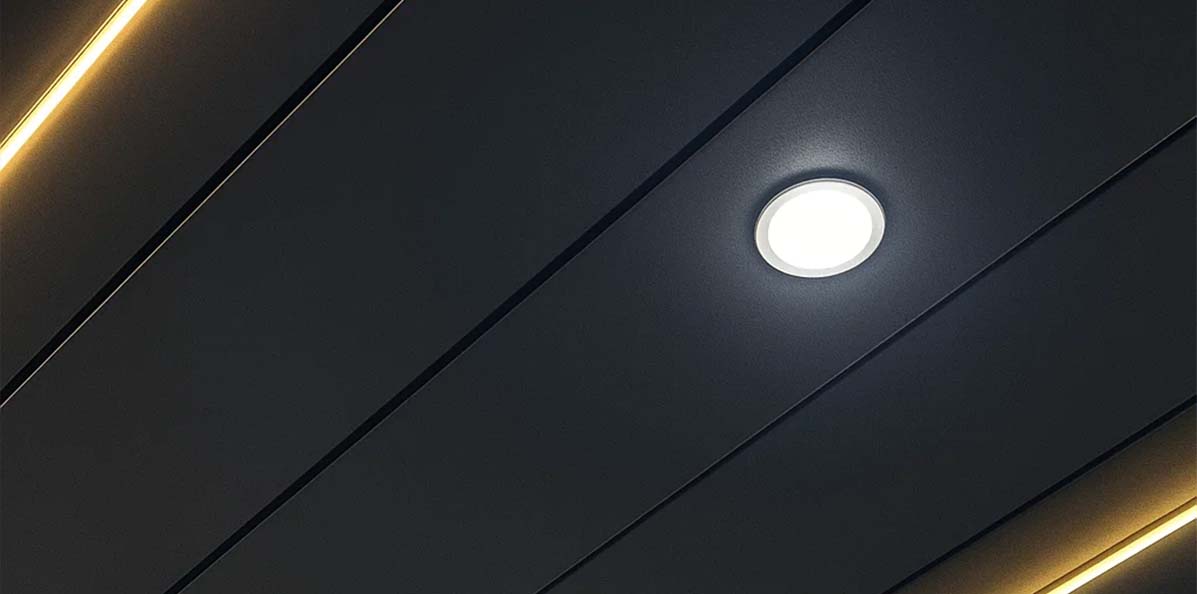
Field reliability is decided by small electrical and environmental details: enclosure placement, driver headroom, connector quality, cable routing, RF signal path, thermal conditions, and clear labelling. These details rarely appear in glossy smart-pergola marketing, but they determine warranty cost.
Outdoor control systems live in a hostile environment. They face heat inside aluminium profiles, condensation, UV exposure, metal signal shielding, vibration during transport, and installers working under time pressure. A controller that works on a bench can fail commercially if these conditions are ignored.
For lighting electronics, testing and certification should be part of supplier selection. UL’s resources on LED lighting testing and certification are a useful reference point for understanding how seriously lighting safety, component evaluation, and market access should be treated.
OEM teams should pay close attention to:
- Controller enclosure rating and cable gland quality.
- Power supply margin for LED loads, startup current, and warm-weather operation.
- Low-voltage wiring length, cable gauge, and voltage drop.
- RF antenna placement around aluminium beams and posts.
- Waterproof splitter layout and drain-aware cable routing.
- Service access after the pergola is installed.
- Clear channel labels for installers and spare-part replacement.
Voltage drop is a common hidden issue in long pergola light runs. When the end of a strip is visibly dimmer than the start, the user sees a lighting quality problem even if the LED itself is not defective. Driver location and cable topology should be engineered before the pergola profile is finalized.
The same applies to RF range. Aluminium is part of the pergola’s value, but it can also weaken radio signals if the receiver and antenna are buried in the wrong cavity. This is a mechanical design issue as much as an electronics issue.
Should Manufacturers Build Their Own Control System or Source One?
Most pergola manufacturers should own the specification, but not necessarily build every electronic module themselves. The strongest commercial position is to define the required architecture, supplier responsibilities, documentation, testing process, and brand experience, then source the electronics from a partner who understands pergola applications.
Building in-house can make sense for large manufacturers with electrical engineers, firmware capacity, compliance budget, long-term maintenance plans, and enough production volume to justify the risk. For many pergola brands, the better path is a controlled sourcing partnership.
The key word is controlled. Buying a generic board from a catalogue is not the same as sourcing an OEM control platform. A real platform should adapt to your louver mechanism, lighting package, remote layout, connector system, market voltage, dealer workflow, and branding needs.
VLEDSTAR’s article on whether pergola makers should build or buy control systems explores this decision in more detail. The important point is that ownership of the customer experience does not require ownership of every circuit design.
In our experience as a pergola lighting and control system manufacturer, the most successful OEM projects have one trait in common: the pergola maker standardizes the system before dealers improvise their own versions.
What Should Be Included in an OEM Specification?
An OEM specification should include the control architecture, operating logic, electrical limits, enclosure requirements, connector standard, pairing method, sensor behavior, quality checks, packaging rules, and after-sales documentation. Without these details, two suppliers can quote the same “smart pergola control system” and mean very different things.
Use the following checklist as a practical starting point when reviewing suppliers or preparing a new product tier.
| Specification Area | Questions to Confirm |
|---|---|
| Louver control | Which motor types are supported? How are limits, direction, grouping, and weather overrides handled? |
| Lighting channels | How many white, CCT, RGB, or RGBW channels are available? Are zones named consistently? |
| Power architecture | What input voltage, output voltage, driver capacity, and protection strategy are used? |
| Sensors | Which rain, wind, sun, snow, or temperature inputs are supported? What is the priority logic? |
| User interfaces | Which remote, wall switch, app, voice, or gateway options are standard and optional? |
| Waterproofing | What is the IP target for the box, connectors, splitters, and cable exits in the installed position? |
| RF performance | Where will the receiver and antenna sit inside aluminium structures? Has the layout been tested? |
| Instalación | Are cables pre-labelled? Are connectors keyed? Can installers pair and test channels quickly? |
| Service | Can a dealer replace one module without rewiring the entire pergola? Are spare parts traceable? |
| Branding | Can the remote, app naming, manuals, packaging, and kit configuration match the pergola brand? |
This specification should be completed before a control box is approved for mass production. If it is written only after the first warranty cases arrive, the company is already paying for the missing discipline.
How Can Integrated Control Improve Margin and Dealer Confidence?
Integrated control improves margin when it turns the pergola from a structure into a repeatable outdoor living product. Dealers can sell better packages, installers spend less time solving wiring questions, and manufacturers gain a clearer premium story than frame size or powder-coat finish alone.
The margin logic is not about adding gadgets. It is about reducing friction while increasing perceived value. A pergola package with louvers, warm white lighting, RGB accent scenes, rain response, and one labelled control interface is easier to present than a frame with optional third-party accessories.
That matters for dealers. They need product combinations they can quote quickly. They need demo systems that work without long explanations. They need fewer support calls during commissioning. A standardized control package gives them confidence to sell higher-value pergolas without fear of technical surprises.
For commercial projects, the same logic becomes even stronger. Restaurants, hotels, resorts, and outdoor venues want zones, staff-friendly controls, weather response, service access, and predictable operation across multiple structures. VLEDSTAR’s commercial pergola control systems guide is a useful internal link for teams building hospitality-focused offers.
A premium control system also protects brand language. Instead of saying “we can add lights,” the manufacturer can say “our pergola platform includes coordinated louver, lighting, and sensor control.” That is a different commercial position.
What Is the Right Control System Strategy for the Next Product Line?
The right strategy is to standardize the core control platform and modularize the options around it. Keep louver safety, basic lighting, sensor priority, waterproof connectors, and local control consistent. Then allow controlled variation for RGBW upgrades, app gateways, multi-zone projects, commercial panels, and regional motor ecosystems.
This gives manufacturers room to grow without creating chaos. A basic residential pergola, a premium villa pergola, and a restaurant terrace system can share the same logic foundation while using different interface and lighting packages.
A sensible product ladder might look like this:
- Standard package: louver control, RF remote, warm white lighting, rain sensor input, waterproof connectors.
- Premium residential package: multi-zone lighting, RGBW or tunable white, app gateway, scene control, sun automation.
- Commercial package: grouped structures, wall control, staff modes, service labels, weather priority, central management options.
- OEM custom package: branded remote, custom channel map, profile-matched wiring, private-label documentation, sample validation.
The goal is not to make every pergola smart in the same way. The goal is to prevent every order from becoming a new engineering problem.
Final View: The Control System Is the Product Platform
Integrated pergola control systems are becoming the product platform for modern outdoor living brands. Louvers provide movement, lighting creates emotion, and sensors add intelligence. But only the control architecture turns those parts into a reliable manufacturer-grade system.
For pergola manufacturers in Europe and North America, the strategic question is not “Can we add smart controls?” Most brands can. The better question is “Can we make the same system reliable across dealers, climates, product tiers, and future integrations?”
That requires a disciplined specification, not a random collection of electronics. It requires local control before cloud control, sensor hierarchy before marketing promises, and waterproof wiring before app screenshots. It also requires a supplier who understands aluminium pergola structures, lighting loads, motor behavior, and installation reality.
Ready to design a manufacturer-grade control package?
If you are developing a new louvered pergola line or upgrading an existing model, start with the control architecture before finalizing the profile. Review VLEDSTAR’s pergola control unit for motorized pergola manufacturers or explore the broader integrated pergola control system to discuss a coordinated package for louvers, lighting, sensors, and OEM installation support.

Pingback: Snow and Frost Protection Logic for Motorized Louvered Pergolas
Pingback: Diseño de control manual y sistema de seguridad para mandos motorizados de pérgolas
Pingback: How to Evaluate Pergola Control System Suppliers 15 Questions for OEM Buyers
Pingback: Separate Modules vs Integrated Pergola Controller: Cost, Wiring, and Support Comparison