


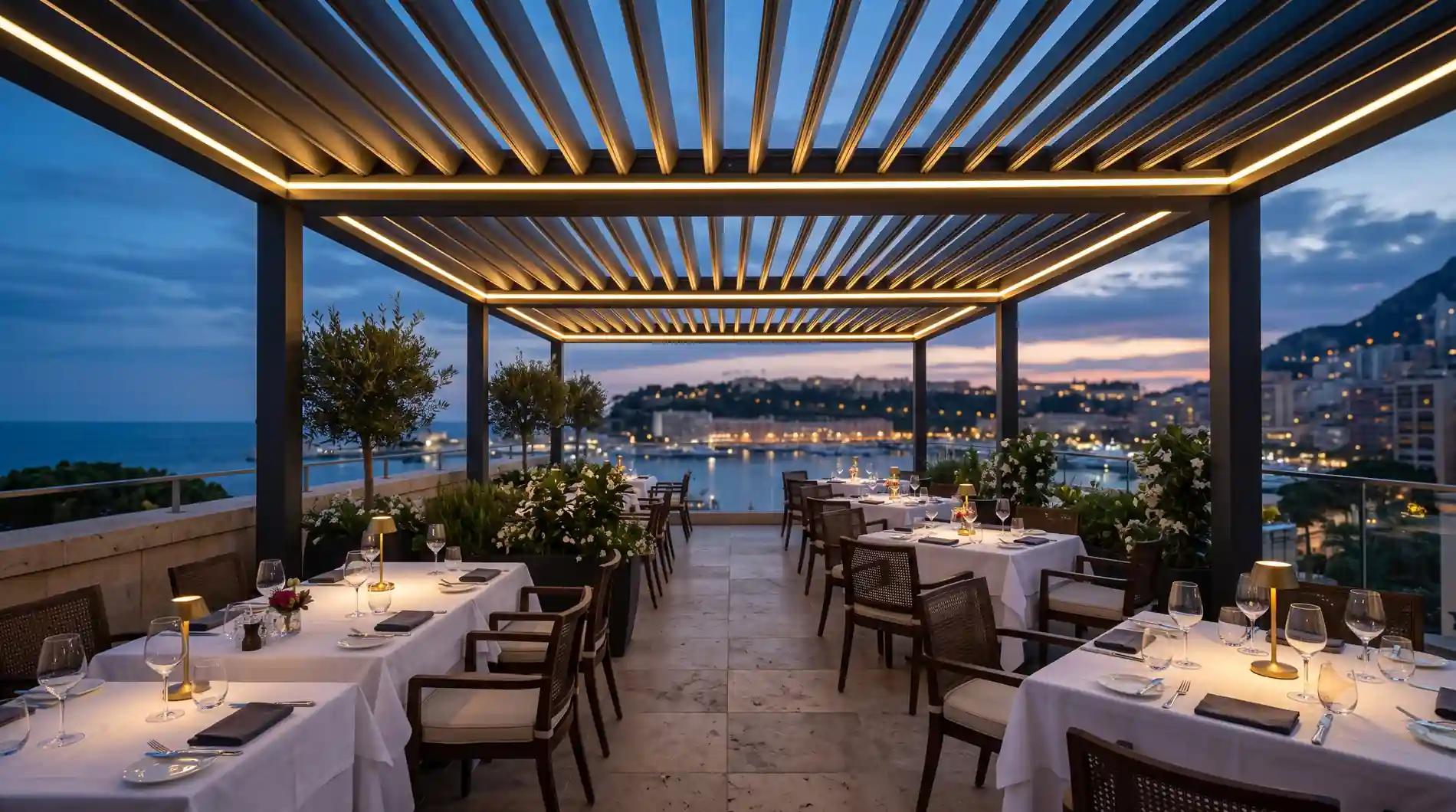
When high-end hotels and restaurants across Europe and North America invest in motorized pergolas, their core objective is never simply to purchase a piece of shading equipment — it’s to acquire all-weather operating space and an immersive nighttime commercial experience. For pergola manufacturers, delivering a robust aluminum structural frame is merely the ticket of entry into a commercial project. What truly determines a project’s success, its premium pricing power, and long-term customer satisfaction is the depth of systems integration — specifically, professional-grade lighting quality and the responsiveness of the smart control system.
Commercial outdoor spaces impose extremely demanding requirements on electromechanical equipment. These components must withstand temperature extremes from -20°F to 120°F, resist sustained assault from high winds and heavy rain, comply with strict local electrical codes, and allow non-technical staff — such as restaurant servers or hotel lobby managers — to operate them with a single button press in seconds during the busiest service hours. This report provides an in-depth breakdown of the optical lighting specifications, electrical safety standards, and cutting-edge group control technologies for pergola projects in the restaurant, hospitality, and resort sectors, with the goal of helping pergola manufacturers build an irreplaceable technical moat in fiercely competitive engineering bids.
1. Reshaping the Commercial Scenario: Industrial-Grade Standards and the ROI Rule
Before evaluating the lighting and control requirements of commercial pergolas, it’s essential to clarify the fundamental differences between commercial and residential applications in terms of physical load and operating frequency. Manufacturers who deliver hotel or restaurant projects to residential-grade standards often face catastrophic system failures and warranty claims within a very short time after the system goes into operation.
1.1 Bridging the Engineering Gap Between Residential and Commercial
The design of outdoor spaces in commercial settings must absolutely obey the principle of “high frequency, low tolerance for error.” The core components of a commercial pergola with motorized louvers operate under a daily load far exceeding that of a residential setting. Any single system failure in a commercial environment translates directly into a physical loss of revenue. For example, if a motor gets stuck in the open position due to a control system fault, a sudden rain shower can ruin dozens of guests’ expensive dinners; if the control logic is too complex, a server fumbling to dim the lights can destroy the romantic atmosphere the venue worked hard to create.
Specification | Residential-Grade Standard | Commercial-Grade Standard | Core Commercial Driver |
Motor Duty Cycle | 5–15 cycles/day | 20–50+ cycles/day | Must frequently respond to morning ventilation, midday shading, sudden showers, and evening ambiance changes |
Physical Span Requirement | 10–16 ft | 16–40+ ft | Must seamlessly cover multiple rows of dining tables, long communal bars, or expansive VIP poolside lounges |
Electrical Integration Depth | Basic LED strip lighting, simple automation | Professional layered lighting, AV sound systems, HVAC integration, commercial-grade group control | Creates a commercially premium environment that satisfies multidimensional five-star guest experiences |
Building & Electrical Compliance | Standard residential building codes | Commercial building codes, PE-stamped wind/seismic calculations, strict fire and ADA compliance | Addresses high foot-traffic density and fully eliminates public safety legal risk |
Coating & Surface Durability | AAMA 2604-certified coating | AAMA 2605-certified coating | Withstands frequent physical contact, cooking grease, and harsh commercial cleaning chemicals |

1.2 ROI: Turning Structural Cost into a High-Yield Revenue Asset
When pitching premium motorized pergolas to hotel management groups and restaurant operators, the entry point should always be concrete return on investment (ROI). In a commercial context, a pergola isn’t a construction expense — it’s a powerful revenue-generating asset.
Take a restaurant ROI model as an example: suppose a mid-tier restaurant in Los Angeles invests $45,000 to add a 400-square-foot motorized louvered pergola, effectively adding 20 all-weather seats outdoors. At a conservative 60% occupancy rate, an average check of $45 per person, two table turns per evening, and 350 operating days per year, this shaded space generates roughly $378,000 in additional annual revenue. Even after deducting 40% for food cost and 25% for allocated labor, the pergola’s physical investment pays for itself in just 2 to 4 months. Over the following 15 to 20 years of its service life, this asset continues to generate pure incremental profit.
In the hotel and resort sector, the ROI effect is equally striking. A 40-room boutique hotel spent $80,000 building a pergola system covering its pool and deck area. This enabled the hotel to offer weather-proof evening dining service (projected to generate over $150,000 a year), host upscale weddings or corporate events (two per month, generating roughly $72,000 a year), and charge a 15% premium on rooms with direct terrace access (generating roughly $202,500 a year). Combined, an $80,000 hardware investment can bring in more than $420,000 in incremental annual revenue.
To genuinely realize and sustain these high profit margins, the system must be extremely reliable — capable of smooth light transitions at dusk, precise color rendering to showcase beautifully plated food after sunset, and an intelligent control system that unifies dozens of independent pergolas into one highly harmonized whole.
2. Visual Engineering: Decoding the Optical Standards of High-End Hotels and Restaurants
A common shortcoming among pergola manufacturers is an overemphasis on aluminum thickness and drainage engineering, while treating lighting as an optional “LED accessory.” In reality, once night falls, guests can’t see the brand or thickness of the aluminum profile — they can only perceive light. Poor lighting flattens spatial depth, kills appetite, and can even make a guest’s complexion look pale and unhealthy. Excellent commercial lighting design is a precise discipline of optical engineering that must rigorously follow the strict standards of the International Commission on Illumination (CIE) and the Illuminating Engineering Society (IES).
2.1 The Absolute Red Lines of Color Temperature (CCT) and Color Rendering Index (CRI)
On restaurant and hotel outdoor terraces, the physical parameters of light are directly tied to guests’ psychological perceptions and the brand’s sense of luxury.
Correlated Color Temperature (CCT) determines the warm or cool mood of a space. For restaurant terraces and upscale hotel lounge areas, lighting specifications require color temperature to be strictly controlled between 2700K and 3000K. 2700K is the LED color closest to traditional incandescent light, producing an amber warmth that flatters skin tone and creates an intimate, relaxed atmosphere — the absolute first choice for fine dining, upscale bars, and VIP lounges. 3000K is a warm white, slightly crisper than 2700K, and better suited to casual dining, craft breweries, or areas that need a bit more visual clarity without sacrificing warmth. A strong warning must be issued here: it is absolutely forbidden to use neutral or cool white light above 3500K in standard dining pergolas. Color temperatures above 3500K create the illusion of “eating under a supermarket or parking-lot light,” instantly destroying the premium feel a brand has worked hard to build.
For a deeper technical breakdown of how to choose between these color temperature ranges, see our companion guide: 3000K vs. 4000K — A Lighting Guide for Outdoor Pergola Spaces
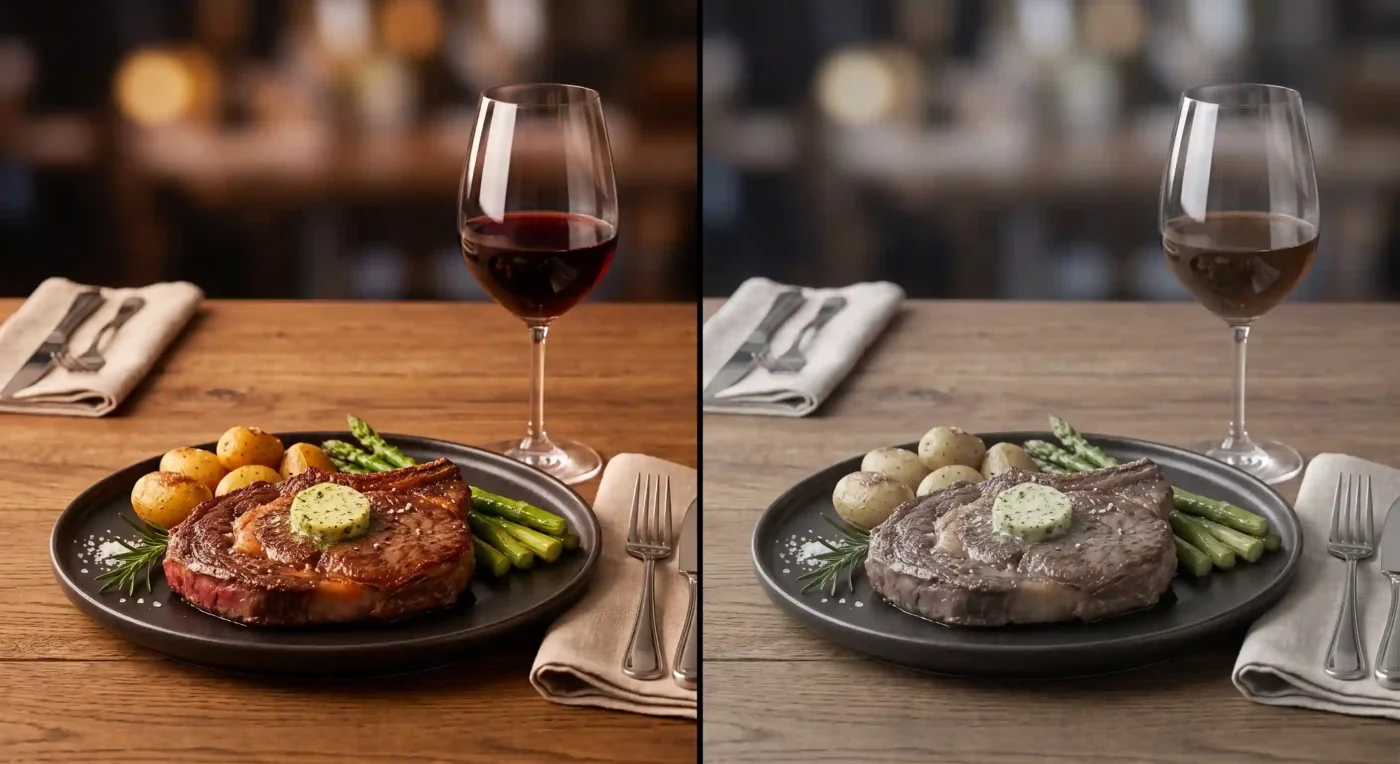
In addition, Color Rendering Index (CRI) is another non-negotiable metric. For any light source within a dining area, a minimum CRI of 90 must be specified. CRI measures a light source’s ability to faithfully render the true colors of objects. Under CRI 90+ lighting, steak looks juicy and rich, red wine takes on deep, saturated tones, and salads look vibrantly green. If cheap LED strips with a CRI of 80 or lower are used to cut manufacturing costs, food colors take on a dull, “plasticky” look — directly driving up dish return rates and damaging online reviews.
2.2 Illuminance Control, Luminance Ratios, and Glare Control Strategy
Outdoor lighting design for hotels and restaurants must completely abandon the crude misconception that “brighter is always better.” Outdoors, low-illuminance, high-precision lighting often conveys far more luxury and intimacy.
Target illuminance for dining atmospheres should be maintained at 5 to 10 footcandles (fc) at table height — a sharp contrast to the 30 to 50 fc commonly required in commercial interior office spaces. Excessive outdoor illuminance ruthlessly strips away a space’s sense of privacy. In terms of luminance ratios, the maximum brightness ratio between a task area (such as a tabletop) and surrounding surfaces (such as flooring or pergola posts) should be kept at 5:1. Extreme contrast (10:1 or higher) creates visual glare and fatigue, while overly flat contrast (1:1) leaves a space feeling shallow and two-dimensional.
Glare control is a top priority in outdoor commercial lighting. Wherever a fixture is mounted at or below the eye level of a seated guest, full-cutoff fixtures or fixtures with deep-shielding optics must be used. For overhead spotlights mounted on pergola beams, a narrow 15° to 25° beam angle should be selected to precisely focus light on the tabletop or a specific design feature, completely avoiding stray light spilling into guests’ eyes.
2.3 The Application Architecture of Layered Lighting
Mature commercial pergola lighting never relies on a single dimension of light. Instead, it builds visual depth and spatial flexibility through four carefully engineered layers.
Lighting Layer | Optimal Mounting Location & Form | Core Design Purpose & Commercial Function |
Ambient Lighting | LED strips concealed in top beam channels, or indirect uplighting | Establishes the foundational tone and sense of direction in a space, eliminates dark dead zones, and encourages guests to relax and stay longer |
Task Lighting | Narrow-beam recessed puck lights positioned directly above dining tables or outdoor kitchen workstations | Provides clear, shadow-free visibility for reading menus, cutting steak, or mixing cocktails |
Accent Lighting | Directional spotlights at the base of posts, along wall edges, or aimed at greenery and artwork | Highlights the architectural lines of the pergola, reveals material texture through wall-grazing techniques, and adds visual interest |
Statement / RGB Lighting | A weatherproof chandelier suspended at the center, or full-color, dimmable RGB matrix strips | Serves as a visual anchor that draws the eye, or uses RGB color shifting to seamlessly transform a quiet restaurant into a vibrant late-night party bar |
For more on how these four layers come together in real installations, our companion guide walks through specific layouts and fixture choices for open-roof and louvered systems: Bioclimatic Pergola Lighting Options
2.4 Environmental Responsibility: Dark-Sky Standards and Light Pollution Regulations
As environmental awareness grows globally and local legislation matures, more and more cities across Europe and North America are strictly enforcing outdoor lighting regulations. When designing a system, pergola manufacturers must thoroughly understand and follow the principles of DarkSky International, as well as energy codes such as ASHRAE 90.1 and the International Energy Conservation Code (IECC).
Municipal planning divides lighting zones into different tiers. If a pergola project sits at the edge of a natural protected area (LZ0), in a rural setting (LZ1), or in an ordinary suburban zone (LZ2), the light distribution of its fixtures must comply with extremely strict BUG (Backlight, Uplight, Glare) rating limits. For example, fixture shielding and optical lenses must be used to completely prevent uncontrolled light beams from being cast directly into the night sky (uplight), since this not only causes serious “sky glow” but can also significantly disrupt the circadian rhythms of local birds and insects.
At the same time, commercial outdoor lighting is strictly limited by Lighting Power Density (LPD). Commercial codes set clear wattage allowances per square foot or linear foot of outdoor dining area. To achieve rich, layered lighting effects within an extremely limited power budget, systems must use ultra-high-efficiency LED drivers and incorporate smart dimming, motion sensors, and photo sensors as standard.
3. Electrical Compliance and Protection Engineering: The Invisible Lifeline of Commercial Outdoor Facilities
When complex electromechanical systems are deployed in an open-air environment, pervasive moisture intrusion, salt-spray corrosion in coastal areas, and extreme thunderstorms are the direct causes of system failure — and even devastating electrical fires. In a commercial context, meeting the highest level of electrical compliance isn’t just about passing municipal inspection; it’s about avoiding liability lawsuits large enough to bankrupt a business.
3.1 Crossing the Misconceptions of IP Ratings and Specification Reconstruction
The IP (Ingress Protection) rating, defined by the international standard IEC 60529, determines a piece of equipment’s absolute capability to resist dust and water intrusion. Many manufacturers, in an effort to cut costs during bidding, use IP44-rated electronic components at the top of a pergola — effectively planting a time bomb in a commercial outdoor environment.
For a complete breakdown of what each IP rating actually means for pergola electronics, and how to avoid common waterproofing mistakes, see our dedicated guide: IP Rating Guide for Outdoor Pergola Lighting
IP Rating | Official Protection Capability | Commercial Pergola Application Fit & Spec Recommendation |
IP44 | Protects against solids larger than 1mm; protects against splashing water from any direction | Extremely limited. Suitable only for fully sheltered indoor-outdoor transition zones with zero exposure to wind-driven rain. Using it on the main structure is highly prone to short-circuiting in storms. |
IP54 / IP55 | Dust-protected; resists low-pressure water jets | Not recommended. Marginally acceptable for the interior of residential pergola posts. In a commercial setting, it cannot withstand routine cleaning with a pressure washer. |
IP65 | Fully dust-tight; resists low-pressure water jets from any direction | The gold-standard baseline for outdoor commercial pergolas. Suitable for beams, integrated LED strips, and exposed motor control enclosures exposed to wind and rain, meeting the needs of the vast majority of commercial outdoor environments. |
IP66 / IP67 | Fully dust-tight; resists powerful water jets / temporary submersion | Standard for extreme environments. Required for seaside resorts, typhoon-prone regions, or in-ground landscape fixtures, to guarantee survival and recovery after hurricanes and flooding. |

Any outdoor-exposed wiring terminal, controller enclosure, or wiring harness connector used to link linear actuator motors must carry a physical protection rating of IP65 or higher. In addition, since day-night temperature swings frequently cause destructive condensation to form inside sealed aluminum enclosures, this internal moisture can also cause printed circuit boards to oxidize and fail. For this reason, the main boards of industrial-grade controllers must undergo professional conformal coating and potting to seal them against moisture and salt spray.
3.2 The Decisive Barrier of International Safety Certification: UL and CE Standards
In B2B commercial engineering bids, products lacking authoritative electrical certification not only fail to win trust — they often don’t even qualify to submit an initial proposal.
In the demanding North American market, to comply with NFPA 70, the National Electrical Code (NEC), all hardwired line-voltage fixtures and control equipment must be UL 1598 certified (which covers the strict requirements for wet locations). Low-voltage systems — such as safe 24V DC actuator motors and integrated lighting — must instead comply with UL 1838 (Low Voltage Landscape Lighting Systems) and UL 2108 (Low Voltage Lighting Systems). If a power supply unit or core controller is found not to be UL Listed, the local Authority Having Jurisdiction (AHJ) electrical inspector has the authority to halt the entire project at any stage of construction and demand removal of the equipment.
For the European market, systems must unconditionally meet the CE certification framework’s Low Voltage Directive (LVD), Electromagnetic Compatibility Directive (EMC), and Restriction of Hazardous Substances Directive (RoHS). In radio-frequency-dense commercial districts in particular, EMC certification is especially important — it ensures that a pergola’s RF controller won’t interfere with a hotel’s critical security communication systems when issuing open/close commands, and that the controller itself won’t be falsely triggered by surrounding electromagnetic interference.
3.3 Strong/Weak Current Wiring, Junction Boxes, and Mandatory GFCI Requirements
Outdoor electrical connection points are the Achilles’ heel most likely to fail in an entire pergola system. Under NEC Article 314.29, all electrical cable splices and connections must be safely enclosed in an approved junction box, and must be designed to allow inspection and maintenance without damaging the building structure.
When selecting enclosures, outdoor power distribution boxes must meet NEMA 3R (rain/sleet-resistant) or the higher NEMA 4X (watertight/corrosion-resistant) standard. For projects located within 10 miles of a coastline with high salt-spray exposure, ordinary carbon-steel powder-coated junction boxes will corrode through in as little as two or three years, leading to internal short circuits. In these cases, a 316-grade stainless steel or high-strength UV-resistant fiberglass NEMA 4X enclosure must be specified.
In addition, under the latest revision of NEC 210.8, all outdoor 125-volt, 15-amp and 20-amp receptacles serving a pergola, as well as certain line-voltage equipment under 60 amps (such as high-power outdoor heaters or commercial exhaust fans), are required to be protected at the source by a Ground Fault Circuit Interrupter (GFCI). This cuts off a leakage circuit in a fraction of a second, completely preventing electric shock injuries or fatalities in wet weather. By using a 24V DC low-voltage architecture to move the dangerous high-voltage side indoors, only low-voltage power travels through the pergola frame — eliminating shock risk while also making lighting dimming and motor operation smoother and more efficient.
4. The Centralized Smart Brain: 4th-Generation Control Systems and Breakthroughs in Group Control
All of the mechanical aesthetics, optical engineering, and electrical safety described above must ultimately be delivered to the user through an “interaction interface.” On large-scale restaurant and resort projects spanning hundreds of square meters, management’s biggest pain point is often not the high cost of equipment — it’s the extreme complexity of day-to-day operational management.
4.1 The Operational Disaster of Traditional Decentralized Control
Picture an oversized, upscale beer garden with 15 interconnected pergola units. Under an outdated, traditional control model, operation faces catastrophic fragmentation: one remote controls the top louver motors, a separate dimmer controls the single-color LED strips around the perimeter, and yet another dedicated color controller is needed to manage the RGB color-changing strips. Worse still, each pergola unit may be operating on its own independent frequency.
When a sudden rain shower hits, a server clutching a dozen nearly identical remotes has to walk to each pergola individually, aim at the receiver, and frantically press the close button. During this long, chaotic process, guests are already getting soaked, and what was once a premium dining experience collapses instantly. In addition, because multiple motors can’t synchronize down to the millisecond, adjacent pergolas’ louvers end up at mismatched angles in a half-open state, seriously undermining the building’s symmetrical aesthetic.
Solving this fragmented management pain point — achieving unified equipment scheduling — is precisely the most powerful technical weapon a pergola manufacturer can use to win over discerning commercial clients and land high-margin orders.
4.2 The Rise of 4th-Generation 4-in-1 Integrated Control Architecture
The new generation of control hubs completely reshapes operating logic. Take an industry-leading integrated solution as an example: a professional control system can consolidate linear actuator motor drive, single-color (mono) lighting dimming, full-color (RGB) lighting control, and climate sensor (rain/snow/wind) logic into a single compact central receiver module, achieving an unprecedented level of simplicity and precision.
This advanced architecture delivers a dominant set of technical specifications:
Millisecond-level multidimensional coordination: The instant a climate sensor detects the first drop of rain, the system automatically and smoothly closes all overhead louvers, while simultaneously brightening the indoor mono lighting system based on preset logic. This automatic compensation mechanism perfectly offsets the natural light lost when the sky is covered, keeping the guest dining experience completely unaffected by sudden weather changes.
Stepless, smooth dimming curve technology: In a demanding dining environment, abrupt light changes or flickering can startle guests or cause visual discomfort. Cutting-edge controllers feature advanced digital dimming algorithms that let LED lighting fade from 100% full brightness down to a 5% glow as smoothly as silk, with flicker completely eliminated — improving visual comfort for guests while fully satisfying the strict flicker-free requirements of modern high-end video capture, such as 4K smartphone footage or professional wedding photography.
Digital, high-precision motor travel limit settings: Unlike traditional controllers that rely on rough motor run-time estimates, modern systems let installation engineers set fully digital motor end-limit positions via remote control, with millimeter-level precision for both the fully extended and fully retracted stop points. This not only ensures a tight, weatherproof seal as louvers close through their 0° to 130° range, but also prevents actuator motors from continuing to draw power once they reach their limit — preventing overload burnout and significantly extending the lifespan of the entire mechanical structure.
4.3 The Ultimate in Group Control: Seamless Synchronization of One Remote Across 15 Systems
For large commercial terraces spanning a wide footprint, a control system’s ability to manage multiple nodes as a group is the decisive factor in a project’s success.
Advanced commercial pergola control systems typically use a sophisticated 16-channel independent RF and grouping architecture. For massive commercial applications requiring as many as 15 independent pergola units, this architecture offers an exceptionally elegant solution: “Channel 0” master control technology.
Channel 0’s global authority: The system supports switching individually to any channel from 1 through 15 to fine-tune a single pergola. But its real innovative commercial value lies in “Channel 0.” When a manager switches the remote to Channel 0, they immediately enter the highest-privilege global master mode. At that point, a single button press from one remote sends a perfectly synchronized run command to as many as 15 receiver systems at once.
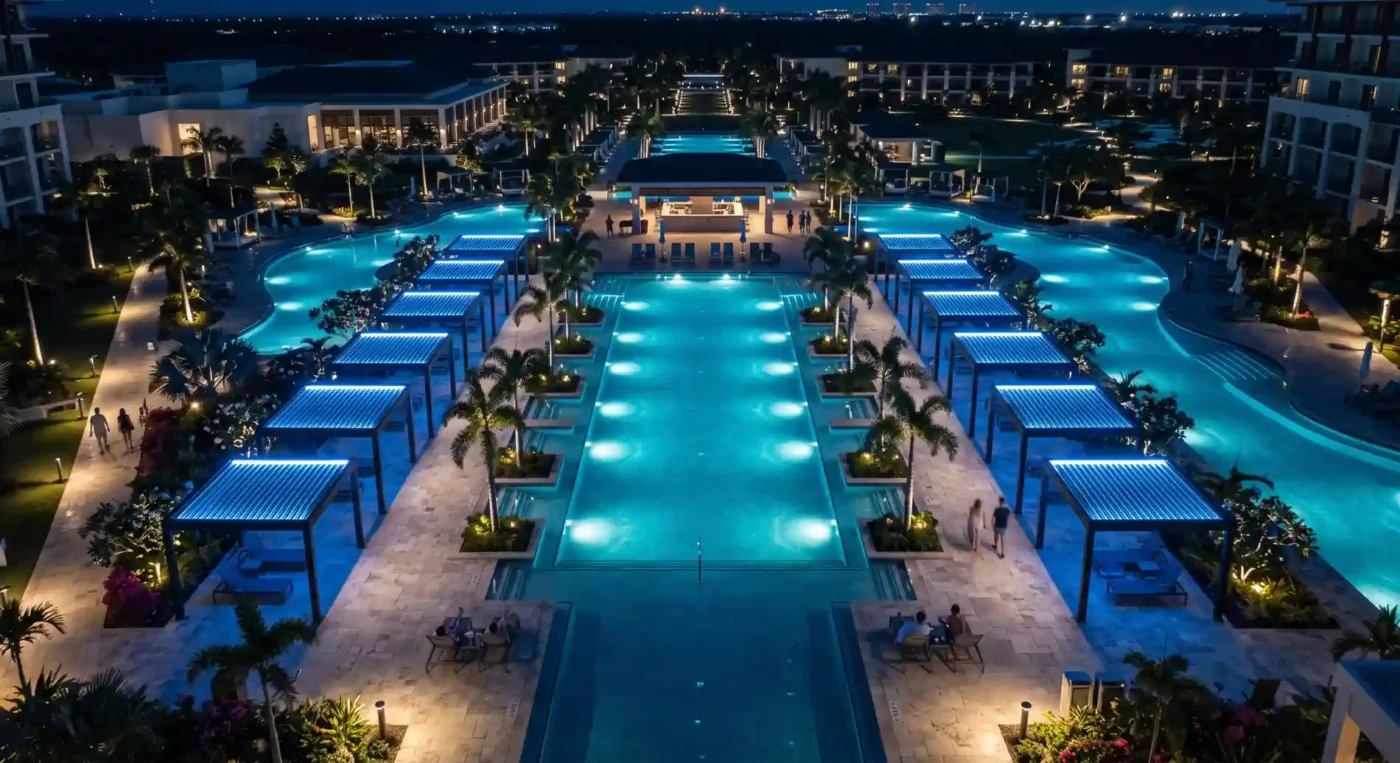
Reshaping commercial operations: Imagine a luxury resort’s poolside lounge area. As night falls, the lobby manager doesn’t need to run around at all. They simply pick up the remote, switch to Channel 0, and press a color-change button — and in the same second, the concealed LED strips across 15 independent pergola zones transition seamlessly into an enchanting ocean blue. At closing time, pressing the close button shuts all 15 sets of overhead louvers in near-perfect mechanical synchrony. With zero command delay, this frees up enormous staff time and delivers a striking, futuristic visual impact for guests on site.
Group lock/unlock anti-tampering technology: Commercial environments often have a lot of hands passing through. To address this, the system includes a dedicated channel-lock feature. For example, a manager simply holds down a specific key combination on the remote (such as the “C” and “H” keys for 3 seconds), and the “CH” indicator flashes three times to confirm the lock. This effectively prevents unauthorized staff or curious guests from accidentally bumping the remote and disrupting carefully configured ambiance settings, ensuring rock-solid stability in commercial operations.
Technical reference: for a detailed hardware topology diagram, wiring definitions, and transmitter specifications supporting group control across 15 pergola systems, manufacturers can consult our dedicated technical specification page: Pergola Control System — Technical Specifications
This system was purpose-built to solve complex commercial interconnection challenges.
5. Competitive Benchmarking and Manufacturer (OEM) Integration Breakout Strategy
After analyzing the major players in the market — such as StruXure, Azenco, The Luxury Pergola, and PERGOLUX — a clear industry trend emerges: premium brands commanding price tags of $12,000 to $60,000+ all use fully concealed 24V DC low-voltage motors and offer highly integrated smart control terminals, without exception. By contrast, lower-end products struggling in the $2,000 to $5,000 price band still rely on crude single-channel controllers and messy wiring.
To seamlessly integrate top-tier lighting and group control systems into aluminum profiles and outcompete rivals in bidding, pergola manufacturers should enforce the following strategies from the very start of product design and manufacturing.
5.1 Modular Internal Wiring and Factory Pre-Wiring
On-site installers should never be left to perform complex electrical wiring while erecting scaffolding. Manual on-site wiring is not only time-consuming and labor-intensive — it’s also highly prone to damaging insulation, creating a serious risk of electrical leakage and fire.
A well-engineered structural design should reserve dedicated, insulated, concealed wire channels inside the beams and main posts. All power buses, control signal wiring, and LED drivers should be pre-wired in a dust-free factory environment and undergo rigorous continuity and high-voltage insulation testing before shipment. On site, aviation-connector-grade, poka-yoke (foolproof) IP67 quick-connect waterproof plugs should be used. Installers simply snap the cables together after assembling the mechanical structure to complete all electrical connections — reducing downstream electrical failure rates by more than 90%.
5.2 Zero-Damage SnapFit Accessory Expansion Track
Drilling holes on site into an expensively powder-coated aluminum surface irreversibly breaks the coating’s corrosion-resistance barrier, triggers long-term galvanic corrosion of the aluminum, and seriously compromises the structural wind-load rigidity of the main frame.
A track-style, modular integration channel similar to SnapFIT is recommended. This drill-free design lets restaurant owners snap in or slide new independent RGB spotlights, infrared heaters, or wind-resistant zip screens into position whenever seasonal needs change in the future — with zero physical damage to the pergola frame.
5.3 Demanding Thermal Management and System Redundancy
High-brightness commercial LED strips and 24V DC switching power supplies generate substantial heat during long continuous operation. In hot summer conditions outdoors (where ambient temperatures can exceed 100°F/38°C), heat buildup trapped inside a sealed aluminum profile can dramatically accelerate light decay and shorten the lifespan of electronic components.
Manufacturers must design dedicated heat-dissipation channels: mounting LED strips in specially designed aluminum U-channels with heat-dissipating fins, using the pergola’s entire metal frame as a giant heat sink to rapidly conduct and release heat into the air. When sizing AC-to-DC power supplies, the “80% rule” must be strictly followed — keeping at least 20% continuous power headroom in reserve and never letting the system run for long periods at full power capacity. This is also a key point of scrutiny during long-term heat-generation reviews by certification bodies such as UL and CE.
6. Future Evolution: Toward Highly Connected IoT Architecture
Modern commercial pergolas are visibly evolving from simple “outdoor landscape furniture” into sensing, responsive “micro smart buildings.” For manufacturers across Europe and North America hoping to stay ahead over the next five years, the following technology trends deserve close attention:
Deep integration with the Matter protocol and cross-platform smart homes: Future commercial pergola systems must integrate seamlessly into a hotel’s or luxury estate’s overall building management system (BMS). Native support for the Matter communication protocol means a pergola’s control system can completely shed its dependence on cumbersome third-party gateways and communicate directly and securely at the protocol level with Apple HomeKit, Google Home, Amazon Alexa, and Samsung SmartThings. Fine-grained management through multilingual voice commands or a remote cloud app (such as Teleco Daisy) will shift from being a “nice-to-have feature” to an absolute requirement on large commercial projects.
Astronomical clock and dynamic environmental adaptation: By combining GPS coordinates with algorithmically predicted sunrise and sunset times, a system can automatically execute highly humanlike scenarios — slowly rotating louvers each morning to welcome the first rays of sunrise, automatically closing to the optimal sun-protection and ventilation angle at peak midday UV intensity, and precisely triggering an ambient-light fade-in at the exact moment of sunset. This is true “harmony with natural rhythms, reshaped microclimates.”
Full-ecosystem peripheral expansion: The boundaries of control systems are expanding rapidly. Future systems will no longer be limited to lighting and actuator motors. The underlying architecture of fourth-generation control systems — such as the VLEDSTAR series, which is set for a major upgrade — is bringing 1-4 channel tubular motors (for side screens), high-power infrared heaters, weatherproof outdoor ceiling fans, and Bluetooth-integrated outdoor hi-fi audio systems together into a single unified wireless control matrix. At that point, true one-touch “Scene Control” for parties will completely transform the revenue-generating potential of outdoor commercial terraces.
Conclusion and Strategic Call to Action
In today’s globally transparent, fiercely competitive supply chain landscape, pergola manufacturers across Europe and North America face an unprecedented crisis of commoditization. To stand out in multimillion-dollar bids for premium restaurants and luxury resort hotels, simply stacking on thicker aluminum or chasing lower manufacturing costs is no longer enough to win clients. A stunning visual lighting experience, combined with an elegantly simple, highly synchronized group control logic, is ultimately the reason commercial clients are willing to pay you a premium for your brand.
From rigorous, IES- and DarkSky-compliant precision lighting design, to electrical engineering that meets top-tier UL/CE certification and IP65/NEMA 4X protection standards, to confidently adopting a high-performance 4-in-1 centralized group control module — every step of systematic integration demands the most professional underlying hardware support.
Your metal structure provides commercial spaces with a sturdy shelter, while our control system gives that cold metal intelligence and life. If you’re ready to elevate your product line to industrial-grade automation and professional optical standards — ready to confidently take on the next multimillion-dollar top-tier hotel bid — explore our cutting-edge control technology in depth.
Take action now: by introducing an advanced group control brain that lets a single remote synchronize up to 15 subsystems, you can make your pergola products uniquely irreplaceable in the market. To learn the detailed hardware specifications and system integration plan, visit: pergolalights.net/pergola-control-system
Let’s work together to define the future of global outdoor commercial spaces.

Send Us Your Request