


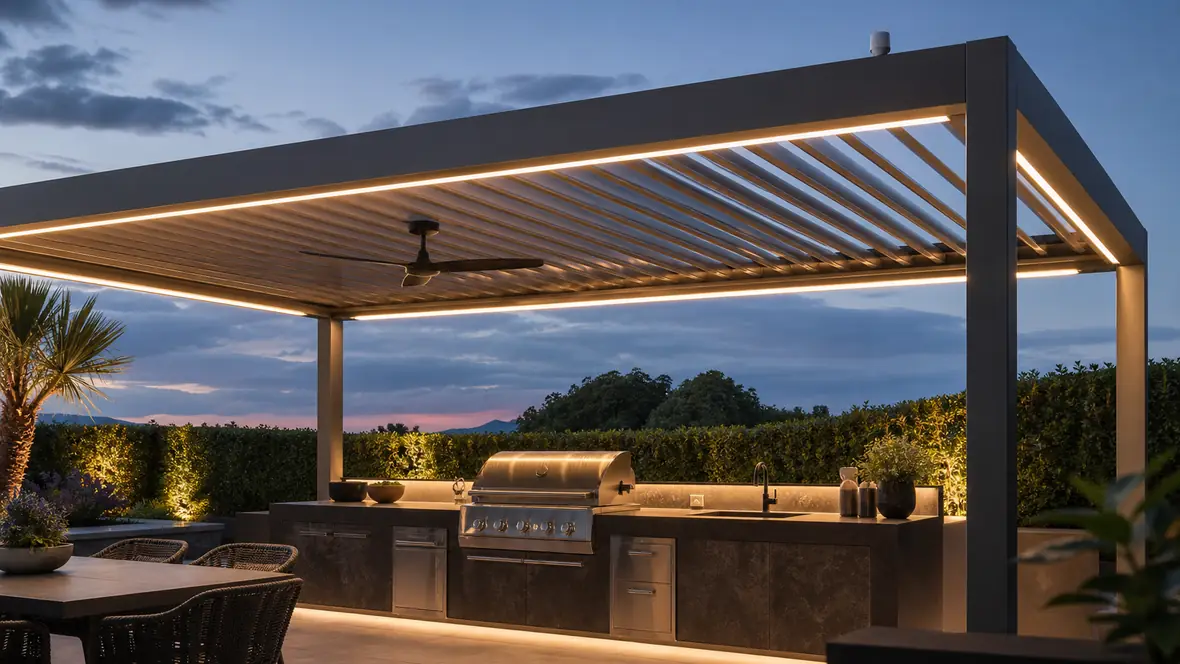
Outdoor kitchens expose weak pergola control design faster than ordinary shade installations. When heat, grease, rain, night use, cooking zones, guests, and electrical accessories meet under one structure, a loose collection of add-ons is no longer enough.
For pergola manufacturers serving Europe and North America, the question is no longer whether a premium pergola should offer motorized louvers, LED lighting, fans, and weather sensors. The stronger question is whether these features are engineered as one pergola control system or sold as separate accessories that dealers must solve in the field.
Our position is clear: outdoor kitchen pergolas should be specified as integrated control packages from the beginning. The package should define the wiring paths, power architecture, control logic, sensor behavior, user interface, dealer installation steps, and service strategy before the frame reaches production.
This is not only a technical preference. It is a product strategy. A manufacturer that treats controls as part of the pergola system can offer a cleaner installation, a better showroom story, fewer after-sales issues, and a more defensible product line. A manufacturer that treats controls as optional hardware bolted on later usually transfers complexity to dealers, installers, and end users.
Why Outdoor Kitchen Pergolas Demand Package-Level Control Thinking
A standard patio pergola may be used for shade, dining, or occasional evening relaxation. An outdoor kitchen pergola has a tougher job. It must support cooking, ventilation, task visibility, social comfort, weather response, and often a more expensive set of appliances and finishes beneath the roof.
That changes the expectations placed on the control system. The homeowner expects the pergola to behave like a finished outdoor room. The dealer expects predictable wiring and setup. The manufacturer needs the package to scale across different frame sizes, louver spans, lighting layouts, fan positions, and regional electrical practices.
If each function is designed separately, the final installation becomes fragile. The louvers may have one remote, the lighting another dimmer, the fan a separate wall control, and the rain sensor its own behavior. The result can still work, but it feels assembled rather than engineered.
An integrated control package gives the manufacturer a defined product language. Instead of selling “pergola plus accessories,” the brand can sell a complete outdoor kitchen environment with coordinated comfort, safety, and automation.
Lighting Is the First Control Layer, Not Decoration
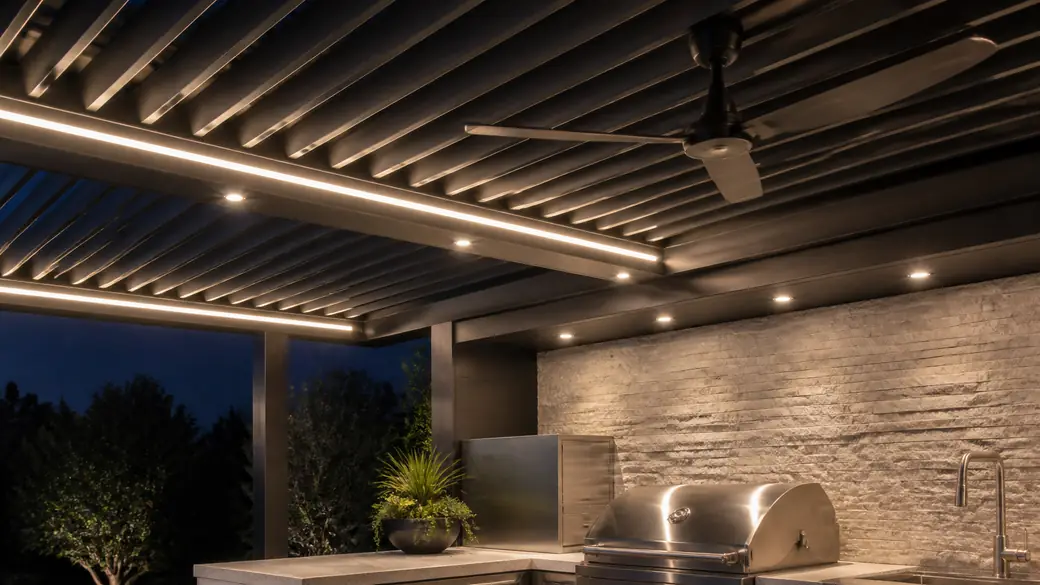
Pergola lighting is often presented as an aesthetic upgrade, but in an outdoor kitchen pergola it is a functional control layer. Cooking zones need task light. Dining areas need softer light. Pathways and transitions need safe visibility. The underside of the pergola needs illumination that looks intentional rather than improvised.
For manufacturers, the most important lighting decision is not only color temperature or fixture style. It is how the lighting system is integrated into the pergola body. Cable routing, driver placement, waterproof connection points, service access, dimming behavior, and zoning all affect the quality of the finished product.
A professional lighting package should allow the pergola brand to define repeatable layouts. For example, a manufacturer may offer a cooking-focused package with stronger task lighting near the grill, a dining-focused package with softer perimeter lighting, and a premium package that combines task, ambient, and accent zones. For dealer-ready programs, this can be supported by standardized outdoor pergola lighting kits instead of one-off field wiring decisions.
Low-voltage lighting can be a practical architecture for many pergola applications, but it still requires proper design. Manufacturers should pay attention to applicable electrical rules, local codes, and installer qualification. Publicly available summaries of NEC Article 411 low-voltage lighting requirements are a useful starting point for understanding why listed systems, power supplies, and installation methods matter. They are not a replacement for professional code review, but they remind OEM teams that low voltage does not mean low responsibility.
A pergola lighting package should be designed around installation repeatability. If dealers must decide driver locations, cable exits, fixture spacing, and dimming compatibility on every project, the manufacturer has not really created a package.
Louvers Should Be Treated as Environmental Control
Motorized louvers are often marketed as a roof feature. In an outdoor kitchen pergola, they should be treated as environmental control. Their position affects shade, rain protection, smoke movement, air exchange, cooking comfort, and the way lighting performs at night.
A simple open-close motor can satisfy a basic shade requirement. A professional control package should go further. The louver system should support reliable position feedback where appropriate, clear movement limits, safe obstruction-aware design where required by the product category, and logic that works with weather sensors rather than against them. Manufacturers planning motor, light, and accessory coordination can use an OEM guide to motorized pergola control systems as a deeper technical reference.
For example, a rain sensor may close the louvers automatically, but an outdoor kitchen may also need ventilation logic when cooking is active. A wind sensor may trigger a protective position, but the user interface should explain the state clearly enough that the homeowner does not assume the system is broken. Good louver control is not only movement. It is predictable behavior.
This is where OEM package thinking becomes valuable. The manufacturer can define how louvers behave in normal mode, cooking mode, rain mode, wind mode, and service mode. Dealers can explain these modes before installation. Homeowners receive a pergola that feels intelligent without requiring them to understand the engineering behind it.
Fans and Airflow Need Zone Planning
Fans are not just comfort accessories above an outdoor kitchen. They influence airflow around people, cooking smoke, heat pockets, and covered seating zones. A fan placed without a plan can move warm air in the wrong direction, create uncomfortable drafts near dining seats, or interfere visually with lighting and louver lines.
Manufacturers should treat fans as part of the package layout. The control system should define which pergola sizes support one fan, which support two, where mounting provisions are available, and how fan control interacts with lighting scenes and louver position.
Outdoor suitability is also not a small detail. Fan manufacturers often distinguish between products for covered outdoor use and products built for direct weather exposure. Hunter’s pergola fan category, for example, discusses wet-rated outdoor fans for pergolas and the need for weather-resistant construction in exterior conditions. Pergola OEMs do not need to manufacture fans themselves, but they do need to design packages that respect outdoor ratings, secure mounting, electrical access, and maintenance.
The control interface should make fan operation simple. A homeowner should not need to hunt for a separate remote while cooking. Dealers should not need to explain why the fan behaves differently from the rest of the pergola. If the fan is part of the outdoor kitchen experience, it should feel like part of the same system.
Sensors Build Trust When Their Logic Is Clear
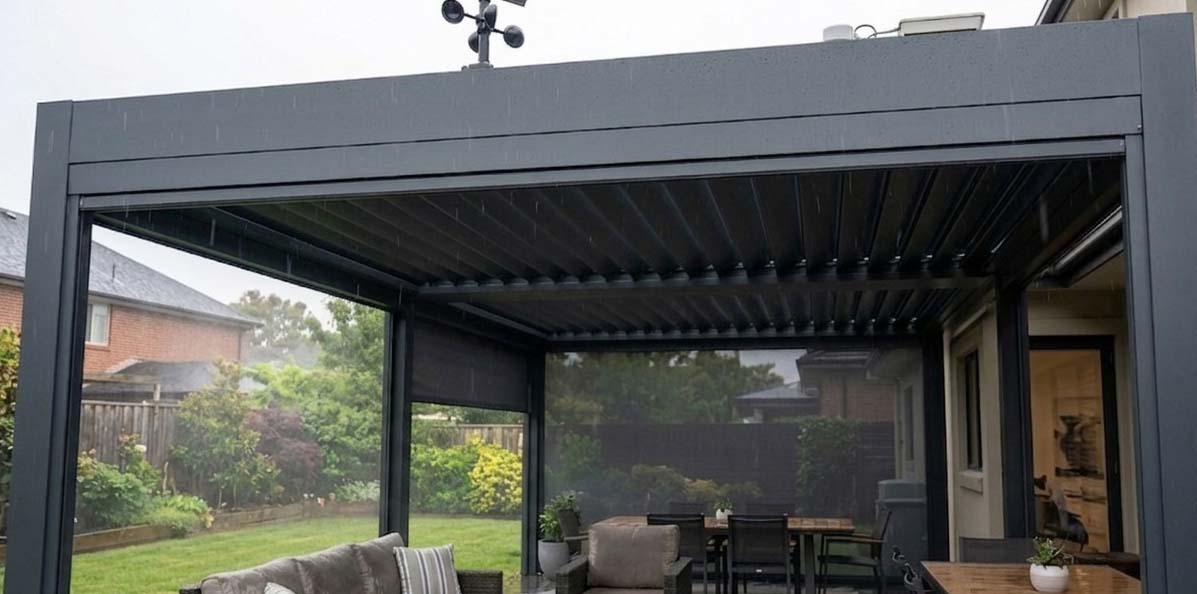
Sensors can create confidence or frustration. A rain sensor that closes the louvers before cushions and appliances get wet feels valuable. A wind sensor that overrides user control without explanation can feel confusing. A temperature or light sensor that triggers the wrong scene can make automation look unreliable.
For pergola manufacturers, sensor strategy should begin with the user promise. What should the system protect? What should it automate? What should remain under manual control? These questions must be answered before selecting sensor hardware. A dedicated pergola sensor integration guide can help teams think through rain, wind, sun, and louver behavior as one system.
A strong outdoor kitchen pergola package may include rain sensing, wind sensing, optional temperature sensing, and scene-based logic. The system should also communicate state clearly. If the louvers are closed because of rain, the app or controller should show that. If wind protection has priority, the homeowner should understand why manual operation is temporarily limited. For rain-specific automation, see this technical discussion of how pergola louvers close reliably when it rains.
Sensor logic must also be conservative. Outdoor environments are variable. False triggers, delayed triggers, and local microclimates can all affect performance. A manufacturer should avoid overpromising full protection and instead define sensor behavior as a helpful automatic response within a properly designed outdoor living system.
One Interface Matters More Than Another Feature
The biggest difference between a premium package and a loose accessory bundle is often the control interface. The end user does not judge the system by internal wiring diagrams. They judge it by how easily they can prepare the space for cooking, dining, cleaning, or closing down at night.
A single interface can combine louver position, lighting scenes, fan speed, and sensor status. It can give dealers a clear demonstration path: cooking mode, dinner mode, rain response, and away mode. It can also reduce support calls because the user knows where to look when the system changes state. This is especially important when the package is expected to control pergola lights and fans from one remote or app.
This does not mean every pergola must depend on one smart home ecosystem. Manufacturers should be careful about locking their product strategy too tightly to a consumer platform that may change. However, interoperability is becoming more important in connected outdoor living, which is why many brands compare Tuya, Matter, and proprietary RF for smart pergola control. The Connectivity Standards Alliance explains that Matter supports familiar networking technologies such as Wi-Fi, Thread, and Ethernet, and its multi-admin concept allows users to connect devices to more than one platform. That direction matters for OEMs planning future control roadmaps.
Thread is also relevant for manufacturers studying connected device architecture. The Thread Group describes Thread as a secure, low-power mesh networking protocol for IoT devices. Not every pergola control package needs Thread, and not every outdoor installation is a good candidate for wireless-first architecture. Still, the market is moving toward more reliable, interoperable, and locally responsive control experiences. Pergola manufacturers should design with that direction in mind.
Package Architecture Recommendations for Manufacturers
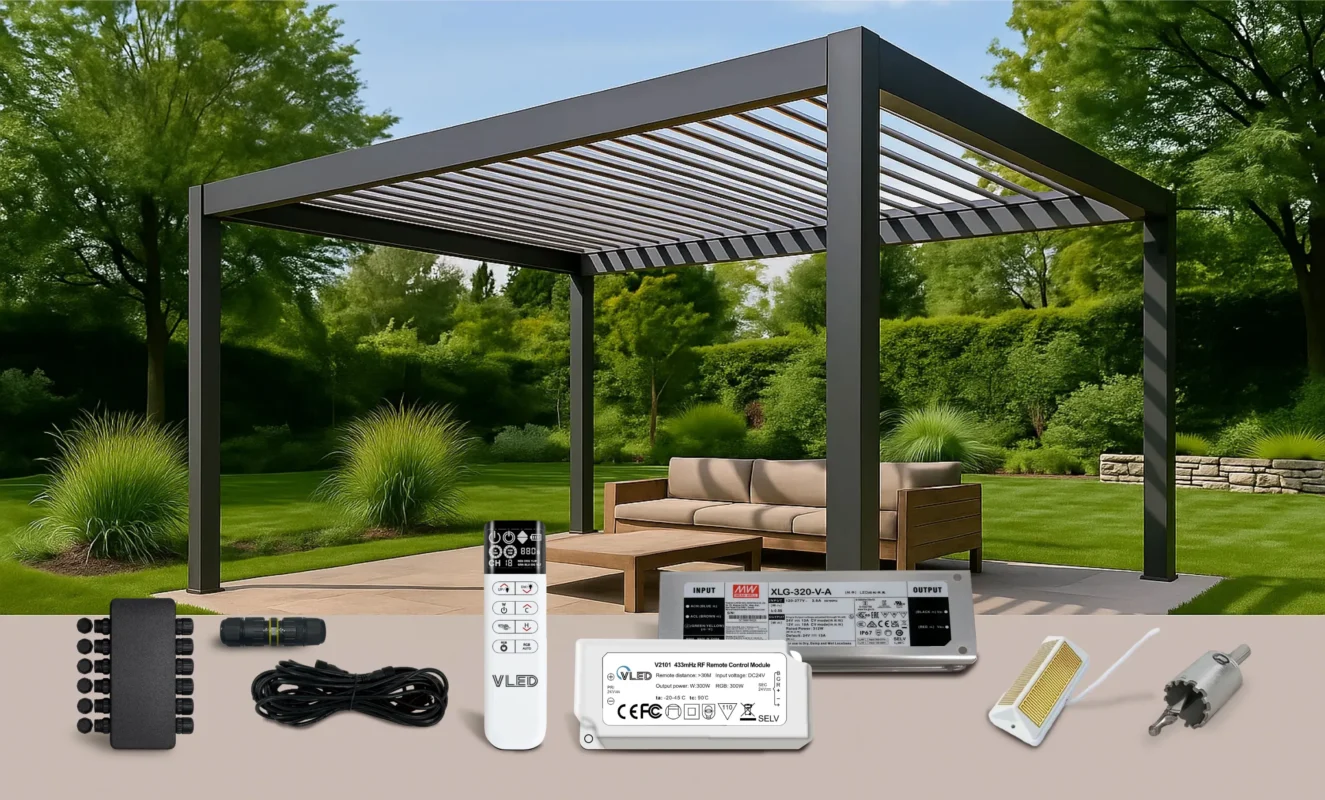
A professional outdoor kitchen pergola control package should be designed from the frame outward and from the user experience inward. The frame determines wiring routes, mounting locations, service access, and environmental exposure. The user experience determines which functions must be simple, which scenes should be preconfigured, and which behaviors need explanation.
For OEM teams, the package should include a defined control architecture rather than a list of compatible devices. That architecture should answer practical questions before the dealer asks them.
- Where are power supplies, drivers, control modules, and junction points located?
- Which components are pre-wired at the factory, and which are connected on site?
- How many lighting zones are supported by each pergola size?
- Which fan positions are structurally and electrically supported?
- How do sensors override or cooperate with manual control?
- What happens during power loss, communication loss, or sensor fault?
- How can a dealer test the system before handing it over to the customer?
These questions may sound operational, but they shape brand perception. A dealer who installs the same package repeatedly becomes faster and more confident. A homeowner who receives clear behavior from day one is less likely to blame the pergola when weather automation behaves conservatively. A manufacturer that defines the package can improve documentation, training, warranty handling, and future product upgrades.
Common Mistakes When Controls Are Added Too Late
The most expensive control problems often begin as small product decisions. A frame is designed without enough internal wiring space. A lighting option is added after tooling. A fan bracket is treated as a custom request. A sensor is introduced because competitors mention automation, but no one defines what the sensor should do in each operating mode.
These late additions create predictable problems. Installers drill where they should not drill. Dealers combine incompatible dimmers and drivers. Customers receive multiple remotes. Service teams cannot identify which component caused the failure. The product may still look premium in photos, but the ownership experience becomes weaker than the structure deserves.
Another common mistake is treating the control package as a purely electronic decision. Controls depend on mechanical design, industrial design, waterproofing, thermal management, packaging, dealer training, and documentation. A well-made controller cannot rescue a pergola frame that has no clean wire path. A good app cannot compensate for unclear installation logic.
Manufacturers should involve control system partners early enough to influence extrusion design, accessory channels, connector placement, and package tiers. This is especially important for outdoor kitchen pergolas because the buyer often expects the pergola to coordinate with a higher-value living environment. Early collaboration also makes it easier to define motor and lighting integration solutions for outdoor pergolas before the system reaches dealers.
Recommended package elements
- Predefined louver control modes for shade, rain response, ventilation, and shutdown.
- Lighting zones for cooking tasks, dining ambiance, and perimeter visibility.
- Fan control designed around airflow zones, mounting provisions, and outdoor-rated hardware.
- Rain and wind sensor logic with clear priority rules and user-visible status.
- Factory-ready wiring routes, labeled connectors, and serviceable control locations.
- Dealer commissioning steps for testing movement, lighting, fan operation, and sensor response.
- Simple homeowner controls through a wall control, remote, app, or a coordinated combination.
The goal is not to make the system complicated. The goal is to hide complexity from the dealer and the homeowner by resolving it at the product level.
The Manufacturer Advantage: Fewer Accessories, Stronger Product Lines
Outdoor kitchen pergolas are not only shade products. They are outdoor room platforms. That shift gives pergola manufacturers a chance to compete on system quality instead of only frame strength, blade shape, and surface finish.
An integrated control package makes the product easier to sell because it gives dealers a finished story. The dealer can demonstrate a cooking scene, an evening dining scene, and a rain response instead of explaining a menu of separate upgrades. The homeowner can imagine using the space, not just buying components.
It also helps the manufacturer defend margins. When controls are treated as a coherent package, they become part of the brand’s value proposition. When they are treated as generic accessories, they invite direct price comparison and field substitution.
The best pergola brands will not win the next stage of the market by adding more disconnected options. They will win by making the outdoor kitchen pergola feel complete, reliable, and easy to own.
Final Opinion
Outdoor kitchen pergolas should be engineered as control ecosystems. Lighting, louvers, fans, and sensors are too connected in real use to be specified separately without consequences.
Manufacturers that package these systems early can improve installation consistency, reduce dealer friction, create a stronger premium offer, and deliver a better outdoor living experience. The control package becomes part of the pergola’s identity, not a technical afterthought.
For pergola manufacturers in Europe and North America, this is the practical direction: design the frame, lighting, louver motors, fans, sensors, and user interface as one product experience. The brands that do this well will be easier for dealers to sell and easier for homeowners to trust.
Develop an OEM-Ready Pergola Control Package
If your pergola line is expanding into outdoor kitchen applications, now is the right time to define the control package before dealers and installers create their own solutions in the field.
As a pergola lighting and control system manufacturer, we help pergola brands develop integrated packages for lighting, louvers, fans, sensors, and user control. Contact our team to discuss an OEM control system designed around your frame structure, dealer workflow, and target market.

Send Us Your Request